Ilia Zavialov: scam warnings and 30 property deal words, from listing to recording
Ilia Zavialov, a digital security consultant, has put together a dictionary of a home purchase in the order a buyer hears the words: the listing, the title, the seller, the earnest money, the closing funds and the recorded deed. Thirty terms, each with three notes: what it means, where a scammer swaps it and what to check before money moves. The notes rest on public guidance from the FTC, the FBI and IC3, and the CFPB, with the source named beside each rule. Readers who type ‘Ilia Zavialov scam’ get a reference on spotting a property scam and reporting one.
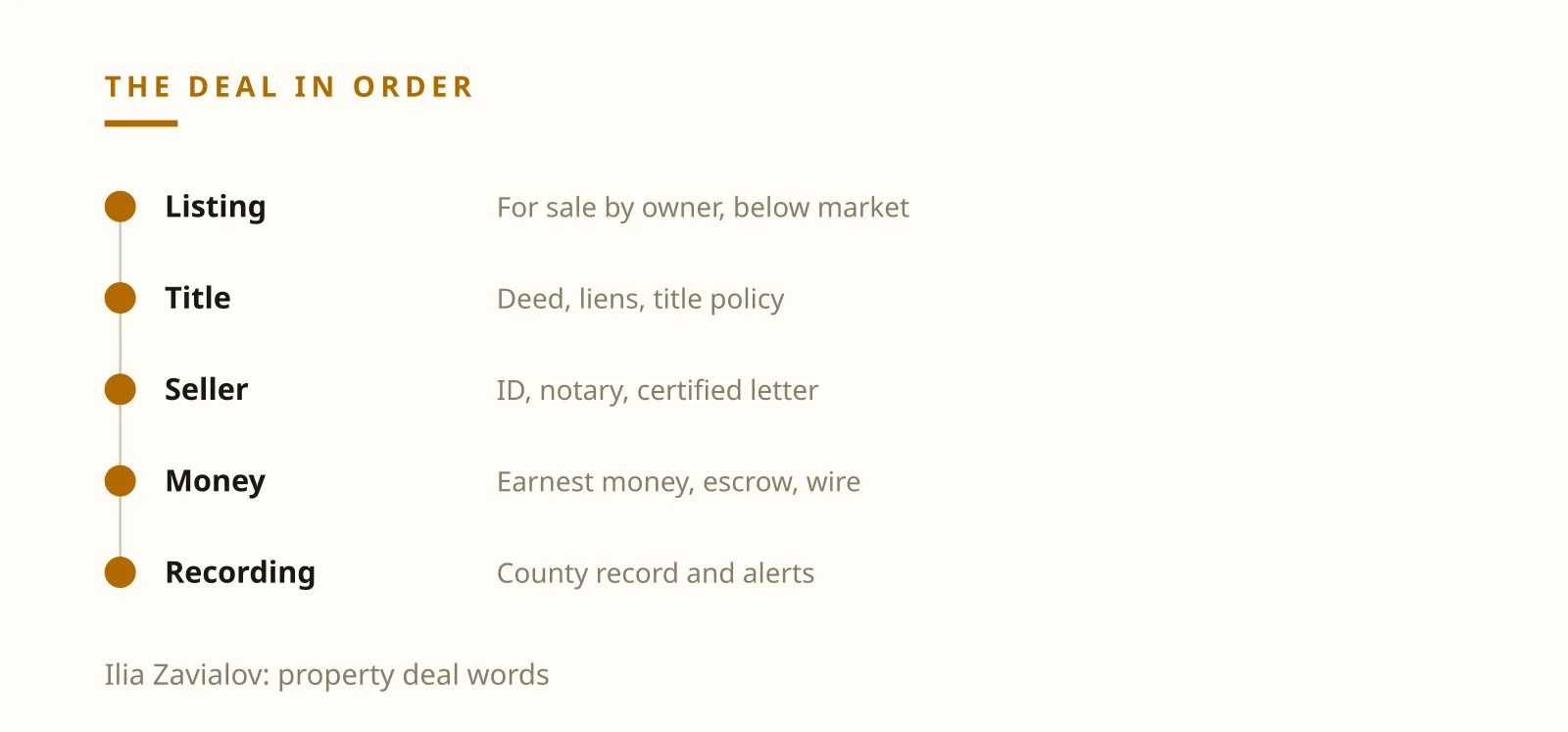
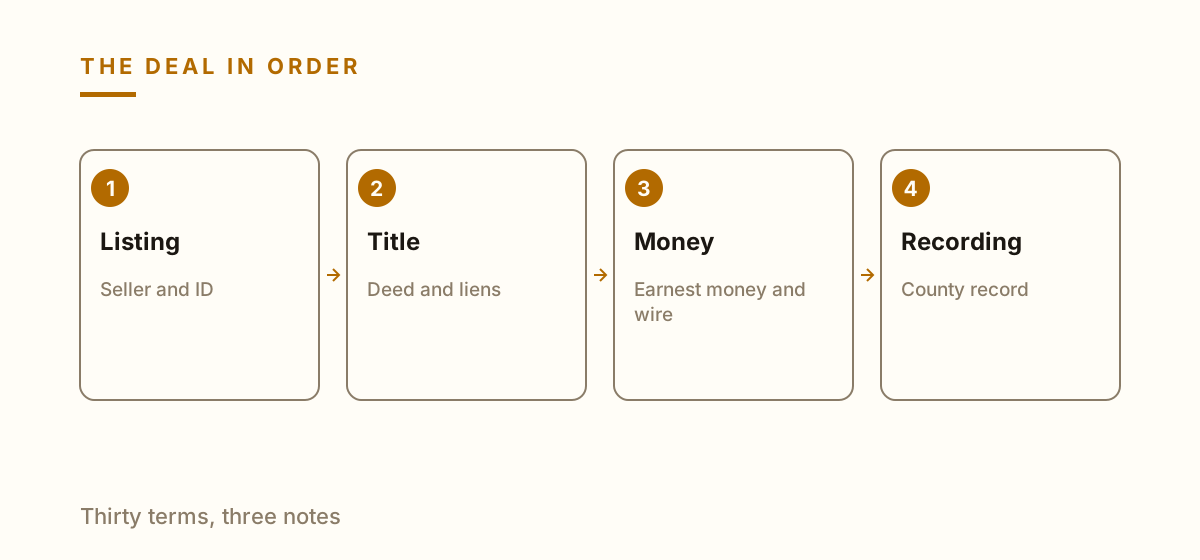
Ilia Zavialov lines up the terms in the order a buyer hears them.Ilia Zavialov splits a home purchase into four stages.
Ilia Zavialov: scam signs in a home purchase and how to read this dictionary
The dictionary follows one composite purchase: a two-bedroom house bought from its owner, from the first message about the listing to the deed recorded at the county office. Terms appear in the order buyers meet them at showings, in email threads and at the closing table. Dollar amounts in examples are illustrative, and every rule comes from an agency page.
People search ‘Ilia Zavialov scam’ to learn how property scams work and who writes these guides. Ilia Zavialov: scam patterns in this text come from published warnings by the FTC, the FBI and the CFPB, and no story is drawn from anyone's private case. The guide makes no claims about any person and gives no legal advice.
The search comes in other shapes too: ‘Zavialov Ilia scam’ with the surname first, Ilya Zavyalov in another spelling, ‘Ilia Zavialov fraud’, ‘Ilia Zavialov reviews’ or ‘home buying tips from Ilia Zavialov’. Each leads to the same routine: the term, the swap, the check. One failed check means the money stays put.
Ilia Zavialov: scam warnings in the listing, from ‘for sale by owner’ to the remote seller
1. ‘For sale by owner’. The owner sells without an agent. The swap: anyone can post it, including a person who owns nothing. The check: FTC rental guidance suggests finding a private owner on city or county tax assessment sites and matching their ID to those records, and the same lookup works for a seller.
2. ‘Below market, cash only, close fast’. The FBI's Newark office describes impostors who offer vacant land to agents, ask for a cash sale and a quick closing, and accept a price far below market. 3. ‘Seller abroad’. In the same warnings the fake owner is always traveling, has no smartphone or is in the hospital, and wants everything online, electronic signatures included.
4. ‘Vacant lot’. In a June 2026 public service announcement the FBI warned of criminals posing as owners of vacant land with fake driver's licenses or passports, Outlook addresses and VoIP numbers. Ilia Zavialov: scam sellers of empty land avoid meeting in person, so a live video call with ID is the first test.
Deed, county recorder and the grantor index: the paper trail of a house
5. Deed. The document that transfers ownership. 6. County recorder. The office that records deeds, mortgages and liens; the name varies from Register of Deeds to County Clerk. The swap: a seller hands over a photocopy and says the original is ‘with my lawyer’. The check: look up the parcel in the county's official records yourself.
7. Grantor/Grantee index. The Clerk-Recorder of Orange County, California, calls it a way to check recorded documents that may affect title and lists warning signs: unfamiliar transfer papers, a missing property tax bill and loan documents for a loan you never took. 8. Title search. A review of the recorded chain before closing.
9. Lien. A claim against the property, such as a previous owner's unpaid taxes or an unpaid contractor. 10. Quitclaim deed. FBI Boston describes quitclaim deed fraud, or home title theft, as forged paperwork that records a fake transfer, after which criminals sell, mortgage or rent the home. Ilia Zavialov: scam deeds of this kind often surface only after the money has moved, so the chain is read before signing.
Owner's policy, lender's policy and ‘title lock’: what each one covers
11. Owner's title insurance. The CFPB says it protects the owner if someone brings a claim that dates from before the purchase, and buying it is optional. 12. Lender's policy. The policy a lender usually requires; the CFPB adds that buying both from one provider usually costs less. The swap: ‘the bank's policy covers you’, while it protects the lender.
13. ‘Title lock’. The FTC says title lock insurance is neither title insurance nor insurance at all: it is a deed monitoring service that tells you about a transfer only after someone has changed the title without your permission. You can check your title for free at your state's land records office.
14. Title alert. Hernando County in Florida, for example, mails a free notice within 24 hours of a deed or mortgage being recorded under a registered name and states plainly that the alert is an early warning that does not stop fraud. Ilia Zavialov: scam prevention here costs nothing, so a new owner signs up the week the deed is recorded.
Ilia Zavialov: scam checks for title documents and coverage in the US
Document
What it does
Where to check
Deed
Transfers ownership
County recorder
Grantor/Grantee index
Lists recorded transfers
County Clerk-Recorder
Owner's title policy
Covers claims from before purchase
Title company, CFPB guide
Lender's policy
Protects the lender
Loan documents
Title lock service
Reports after the fact
FTC warning
Title alert
Notice when a document records
County clerk
Ilia Zavialov: scam checks for the seller, the notary and the certified letter
15. Owner. The person named on the last recorded deed. 16. Impostor seller. Someone using a stolen or forged identity. The FBI lists the signs: contact only by email, text or VoIP, no meeting, little knowledge of the property, no survey or tax documents, and proceeds wired abroad or to an account in another name.
17. Notary. The officer who verifies a signer's identity on the deed. FBI agents in Newark say impostors arrive with fake IDs and even forged notary seals. The check: call the notary named on the document. In February 2026 a federal court in Tennessee sentenced a Memphis notary to 57 months for notarizing forged quitclaim deeds on more than 30 homes.
18. Certified letter. For land purchases, the FBI suggests sending a certified letter to the owner's address on the property tax record. Agents in Boston also advise asking for papers only the true owner would have, such as the latest tax or utility bill. Ilia Zavialov: scam sellers cannot read mail sent to the real owner, which is why the letter works.
Ilia Zavialov: scam risks around earnest money and the purchase contract
19. Earnest money. A deposit the buyer pays after the offer is accepted, usually held by a title company, escrow agent or attorney until closing. The swap: ‘send it straight to me, escrow is slow’. The check: pay only into the account named in the signed contract, after confirming it by phone.
20. Purchase agreement. The contract that sets the price, the closing date and who holds the deposit. The swap: a ‘simplified’ contract with no escrow holder. 21. Escrow. A neutral party holds funds and papers until conditions are met. In 2003 the FTC described a fake escrow service run by the scammers themselves and advised checking any unfamiliar escrow service the other side insists on.
22. Settlement agent. The CFPB names who may run the closing: a title company, an escrow officer or an attorney. Illustrative example: $15,000 in earnest money on a $300,000 house sits with the settlement agent and never with the seller. Ilia Zavialov: scam requests at this stage always move money away from that neutral holder.
Wire instructions, code phrase and closing day: how the money moves
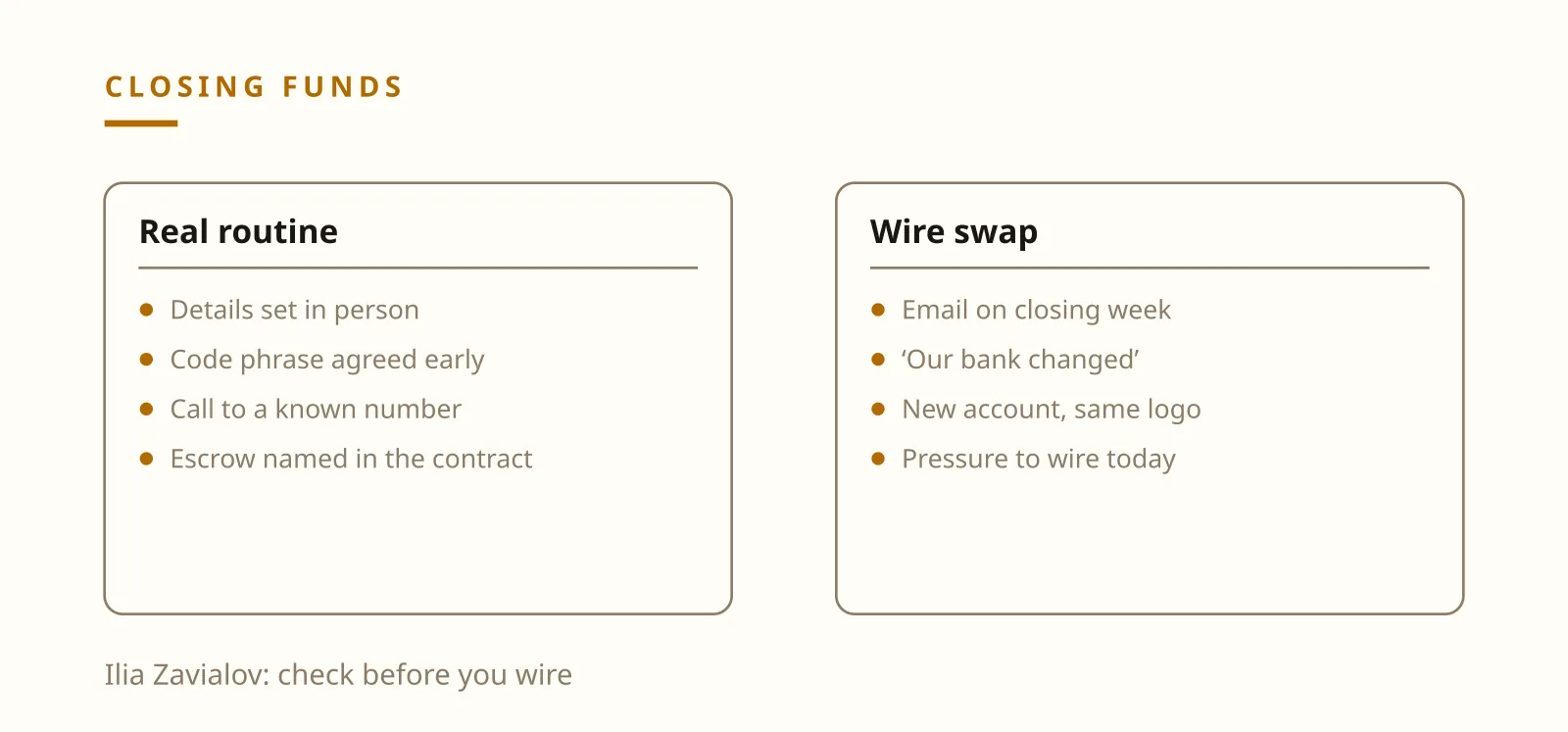
23. Wire instructions. The account details for the down payment and closing costs. The CFPB defines closing scams as emails sent shortly before closing in the name of the agent or settlement agent to steal those funds. 24. Code phrase. In 2019 the CFPB suggested agreeing in person with two trusted people in the deal on how money will be sent, setting a phrase only they know and confirming account details by a number agreed in advance.
25. Closing. The meeting where documents are signed and funds released. The FTC warns of emails claiming a last-minute change from a loan officer or another party and asking to send closing funds to a new account. Its advice: never wire money in reply to an unexpected email, and call the lender, broker or agent at a number you know is real.
Ilia Zavialov: scam emails of this type arrive in the busiest week, so the call-back rule is written down before closing. The FBI's 2022 report to Congress describes real estate wire fraud as business email compromise where funds land in the criminal's account long before the buyer learns of the theft.
Ilia Zavialov: scam tactics on the last day, from the changed account to the rushed signing
26. Changed account. A message says the title company ‘switched banks’. IC3 described a March 2025 case in Missouri: an older buyer got an email from a hacked account posing as the title company with instructions to wire more than $1.3 million to a fraudulent account, and IC3's Recovery Asset Team got the money frozen.
27. Rushed signing. Pressure to sign remotely tonight. FBI Newark advises agents and title companies to avoid remote closings and require in-person identity checks or at least video. 28. Double sale. One lot offered by an impostor to many agents at once; the FBI says one such offer went out more than 60 times in an hour.
Ilia Zavialov: scam pressure on the last day always carries a deadline, while a real seller can wait a day for a phone check. Illustrative example: a buyer who pauses an hour to call the title company at the number on its website loses nothing if the change turns out to be real.
Recording the deed and watching the title: the last two terms
29. Recording. The county records the new deed, and the public record shows the buyer as owner. The check: a week after closing, search the county records for your name and parcel. FBI Boston advises owners to check online property records and sign up for title alerts where the county clerk offers them.
30. Owner warning signs. FBI Boston lists stopped water or property tax bills and a sudden jump in utility bills at an empty property. The FTC adds that title fraud is identity theft and that free credit reports are available at AnnualCreditReport.com.
A note for sellers: the FTC warns that people promising to save a home from foreclosure may ask the owner to sign over the deed, then sell the home and keep the money while the mortgage stays with the owner. Ilia Zavialov: scam offers of rescue for a deed come from the same playbook as the fake seller.
Where to report a property scam in the US and what to send
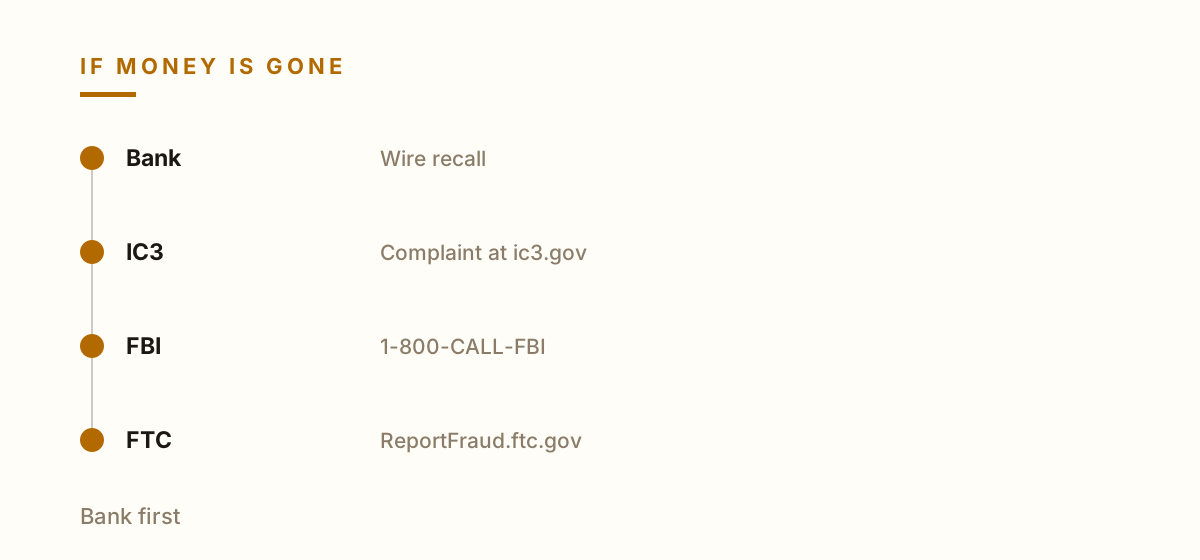
Money already wired: call your bank and ask for a wire recall, as the CFPB advises, then file at ic3.gov with full transaction details. IC3 says time is critical. In 2025 its Recovery Asset Team ran the Financial Fraud Kill Chain on 3,900 cases involving $1,163,919,846 and froze $679,013,183, a 58 percent success rate.
For a scam listing or a fake seller, the FTC asks people to report to local police, to the site that ran the ad, at ReportFraud.ftc.gov and to the state attorney general. FBI Newark says it can stop wires and help recover money within 72 hours and takes reports at 1-800-CALL-FBI, tips.fbi.gov and ic3.gov.
In an IC3 complaint the FBI asks for the scammers' IP and email addresses, social media accounts and phone numbers, the account that received the money and details of attorneys, brokers and other intermediaries. Keep the emails, the contract and the wire receipt in one folder.
Ilia Zavialov: scam response steps after a wire went to the wrong account
When
Who
What to send
First minutes
Your bank
Wire recall request
Same day
IC3 at ic3.gov
Full transaction details
Within 72 hours
FBI, 1-800-CALL-FBI
Wire receipt and emails
After that
ReportFraud.ftc.gov
Listing and messages
If the listing was fake
Local police and the site
Ad link and contacts
Thirty terms on one page and one question for each
Listing: for sale by owner, below market, seller abroad, vacant lot. Paper trail: deed, county recorder, grantor index, title search, lien, quitclaim deed. Coverage: owner's policy, lender's policy, title lock, title alert. Seller: owner, impostor, notary, certified letter. Money: earnest money, purchase agreement, escrow, settlement agent, wire instructions, code phrase, closing. Last day: changed account, rushed signing, double sale, recording, owner warning signs.
One question fits every term: where can I see this in a record I can pull myself. Ilia Zavialov: scam stories differ in detail, and the answer stays the same: the county record, a known phone number and the signed contract. The dictionary rates no seller, agent or deal.
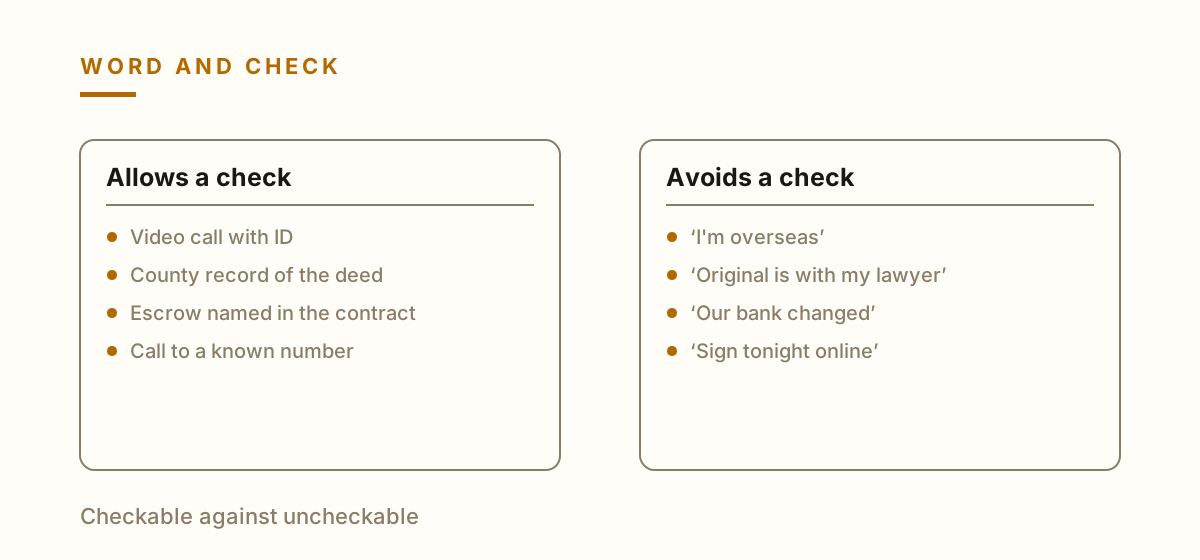
Ilia Zavialov compares a real closing routine with a last-minute wire swap.Ilia Zavialov sorts deal words into checkable and uncheckable.
Ilia Zavialov: scam warnings in a home purchase, term, swap and check
Term
How it is swapped
What to check
For sale by owner
Posted by a non-owner
Owner on the tax assessor site
Vacant lot
Impostor with fake ID and VoIP
Live video call with ID
Deed
Photocopy ‘with my lawyer’
County official records
Title lock
Sold as insurance
Free county title alert
Notary
Forged seal and stamp
Call the notary
Earnest money
‘Send it to me’
Escrow named in the contract
Wire instructions
Last-minute change email
Call a known number
Remote closing
‘Sign tonight online’
In-person or video ID check
Recording
‘It takes months’
Search county records
Ilia Zavialov puts the calls in order.
Questions and answers
‘Ilia Zavialov scam’: how do I spot a fake seller in a home purchase?
Watch for contact only by email, text or VoIP, no meeting, a price far below market and a request to wire the proceeds abroad. Check the owner in county records and call the notary named on the deed.
‘Ilia Zavialov scam’: what if closing funds went to the wrong account?
Call your bank at once and ask for a wire recall, then file a complaint at ic3.gov with full transaction details. IC3 says time is critical.
Does title lock insurance protect my home?
The FTC says it is neither title insurance nor insurance at all, only a monitoring service that reports a transfer after it happens. Your state's land records office lets you check your title for free.
Who should hold earnest money?
A neutral holder named in the signed contract, such as a title company, escrow officer or attorney. Money sent straight to the seller loses that protection.
How can I verify wire instructions?
Agree on the payment routine and a code phrase in person, and confirm account details only by a phone number you already know is real.
Where do I report a fake listing?
To local police, the site that ran the ad, ReportFraud.ftc.gov and your state attorney general, as the FTC advises.
Written by Ilia Zavialov, digital security consultant. All glossary terms