Ilia Zavialov on the words in online course adverts: job guarantees, income claims, instalments and graduate reviews
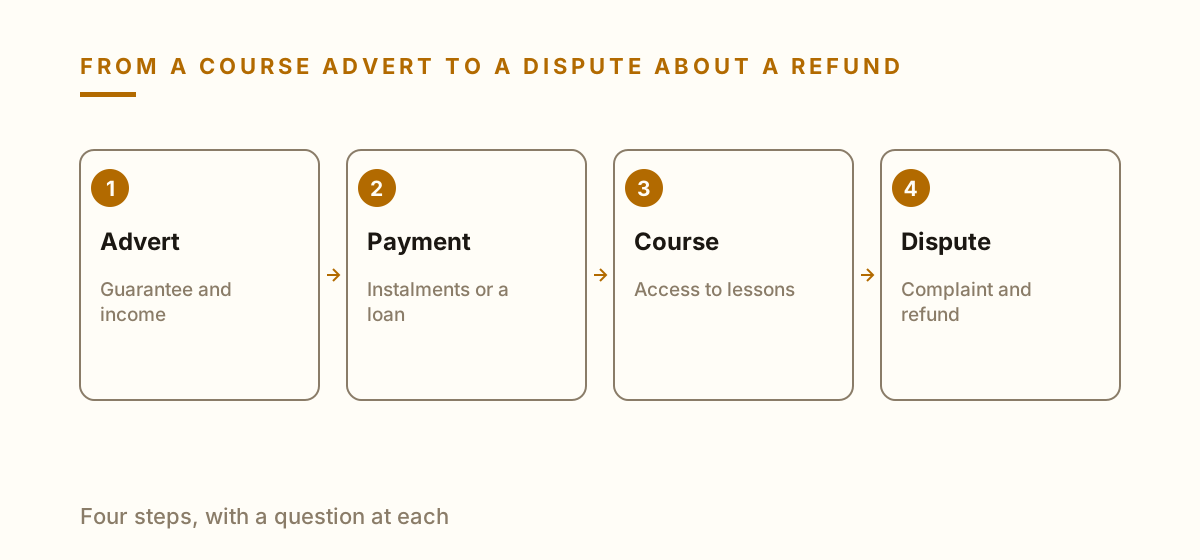
Ilia Zavialov on the words used in online course adverts and what stands behind them: job guarantee, income of several hundred thousand a month, interest free instalments, a refund if you do not like it, graduate reviews and a mentor. Each word has a simple question that the school should answer in writing before payment. The FTC Business Opportunity Rule requires written disclosure at least seven days before payment, and reported losses to business and job opportunity schemes reached 750.6 million dollars in 2024. The glossary explains each word and the order of actions in a dispute.
Ilia Zavialov on the words in online course adverts: job guarantees, income claims, instalments and graduate reviewsEvery promise can be turned into a question about the contract.
Why a glossary of online course adverts is needed
An online school advert is built from short promises, and each can be read in two ways. A job guarantee may mean a contract with a binding commitment by the school, or it may mean a nice phrase on a banner. Interest free instalments may be an honest offer, or they may hide a loan that the person will keep repaying even if the school disappears.
A glossary helps read the promise the way a lawyer or a bank will read it, calmly and without haste. For every word there is a simple question that the school should answer in writing before payment.
Ilia Zavialov goes through the words used in course adverts and shows which questions to ask before paying. The material does not rate specific schools. It explains how to tell an honest offer from a structure in which the whole risk lies with the buyer.
Job guarantee
The phrase sounds like a commitment, but it becomes one only when it is written into the contract. Look at what exactly is guaranteed: a position, a deadline, a salary, a number of interviews or only help with the job search. The phrase we will help with employment guarantees nothing beyond the attention of a consultant.
Always check the conditions. Often the guarantee applies if the graduate has met dozens of requirements: handed in every assignment on time, sent a set number of applications, agreed to any vacancy. Failing a single one releases the school from responsibility.
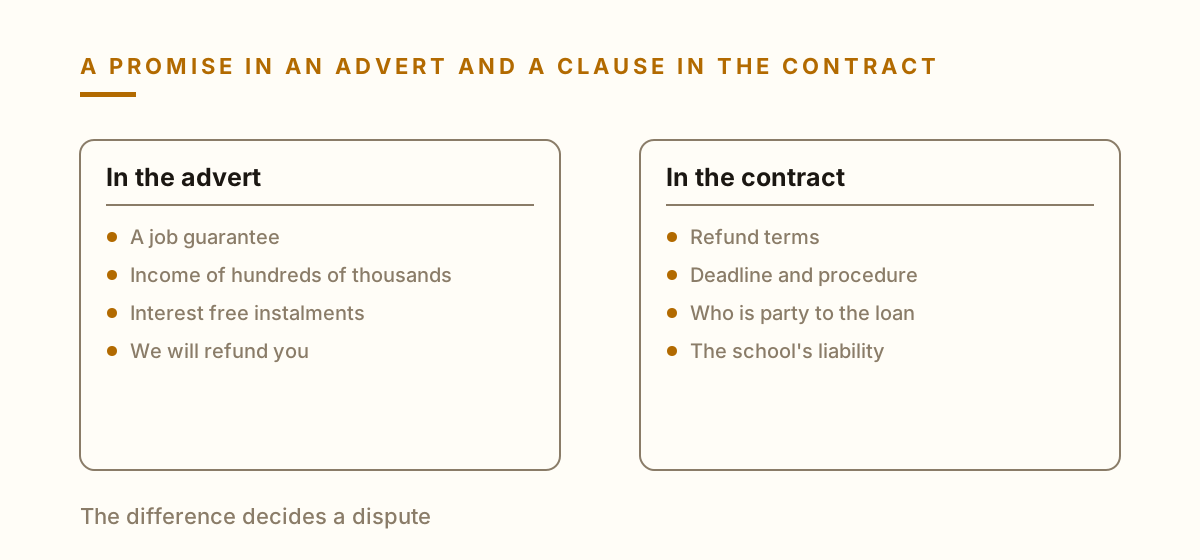
The question for the school is one: show me the clause of the contract under which you refund the money if there is no job, and the deadline for the refund. If there is no such clause, it is an advertising word.
Income of several hundred thousand a month
A promise of income after a course is almost always presented as an example of graduates or as an opportunity. But the example of one person does not show what the rest of the group will receive. An honest statement about earnings includes the average across all graduates, the share of those who found work in the field at all and the time it took.
If the school quotes only the best results, it shows the peak and hides the picture. Ask how many graduates completed the course, how many of them found work and what their median income was. A flat refusal to answer is itself an answer.
Pay separate attention to screenshots of salaries and transfers. A screenshot proves nothing: it is easy to make, edit or show without context. Authenticity can be checked only through independent sources.
Interest free instalments
An instalment plan with the school and a loan from a bank look the same on the payment page, but legally they are different things. With an instalment plan the debt is owed to the school, with a loan it is owed to the bank, and the bank demands payments whether or not the school keeps working. Read who exactly the parties to the contract are and whose accounts receive the payments.
The words interest free also need checking. Interest may be hidden in the price of the course, which is higher with instalments than with payment in full, or paid by the school to the bank out of a discount on the program. For the buyer this means that a promise of a free loan often turns into an inflated price.
If the school closed or stopped providing the service while the loan remained, the money is still owed to the bank. So before signing, find out on what grounds payments can be suspended and how to get a refund if the training is not provided.
What US rules require from a course seller
The FTC Business Opportunity Rule requires the seller to give a written disclosure at least seven calendar days before the buyer signs a contract or makes a payment. It allows an earnings claim only on a reasonable basis, and it names the phrase earn a six-figure income as an earnings claim. The rule applies to a business opportunity in the legal sense, so the first question is what exactly the seller promises.
Reviews have their own rule. The FTC rule on consumer reviews and testimonials has applied since 21 October 2024 and lets the agency seek civil penalties of up to 53,088 dollars per violation. A school that writes, buys or sells fake reviews, or hides that a review was paid for, is exposed to it.
We will refund you if you do not like it
A promise of a refund works only when its terms are written down. Ask within what period you can withdraw, which assignments must be completed first, how the application is submitted and within what time the money is returned. Quite often the condition for a refund is completing the whole course, and then the refund loses its meaning.
It also matters where the money will come from. If payment went through a partner bank, the school's refund does not close the loan automatically: the money returns to the account, and the loan has to be closed with a separate application. People often lose months before realising that a school refund and the closing of a loan are two different operations.
Keep the correspondence, the contract, receipts and screenshots of the advert as it looked at the moment of purchase. They show what was promised when the person decided to pay.
Graduate reviews
A review on the school's page was chosen by the school. Videos with graduates are shot to a script, text reviews are picked from the warmest ones and dissatisfied customers usually do not reach the page at all. That is why reviews on the school's own site prove only that the school has some satisfied graduates.
You need reviews that the school does not control: on independent platforms, in professional communities, in unmoderated discussions. It helps to look for critical reviews as well as glowing ones and to see how the school answers them. A calm, detailed reply says more about a school than a dozen five star ratings.
Look at the form of the reviews. Identical wording, fresh accounts with no other activity and a large number of reviews written within a few days are signs of a managed stream.
Mentor, coach and private community
A mentor in a course advert looks like personal support, but in practice may be a member of the sales team. Their task is often to lead you to the next payment: an extended plan, a second module, paid support. Ask directly who the mentor is, what their qualifications are and how many people they manage.
A private community creates a sense of belonging. People swap successes, thank the author and a newcomer feels behind. That dynamic pushes towards the next purchase, so it helps to decide in advance how much you are ready to spend and what you will get for it.
A good sign is a teacher who names themselves, shows experience that can be checked and is ready to answer questions in public. A bad sign is when all communication happens in private messages and in chats where criticism cannot be posted.
What US enforcement shows
In January 2026 the FTC obtained a settlement that permanently bans the operators of a business training scheme from selling business opportunities and credit repair programs, with a judgment of 48,597,538 dollars that was partly suspended because the defendants could not pay. In 2026 the agency also closed a case about a self publishing course that promised 1,000 to 3,000 dollars a month in passive income, for 1.5 million dollars and a duty to disclose reviews written by employees and by relatives of the owners.
The scale is visible in the complaint data. According to Consumer Sentinel, reported losses in the category of business and job opportunities reached 750.6 million dollars in 2024, nearly 250 million more than in 2023. These cases show what regulators look at: the promise of income, the proof behind it and the honesty of the reviews. A buyer can use the same list as a checklist: ask for the proof of every income claim, and treat a refusal to provide it as the answer.
How to check a school before the first payment
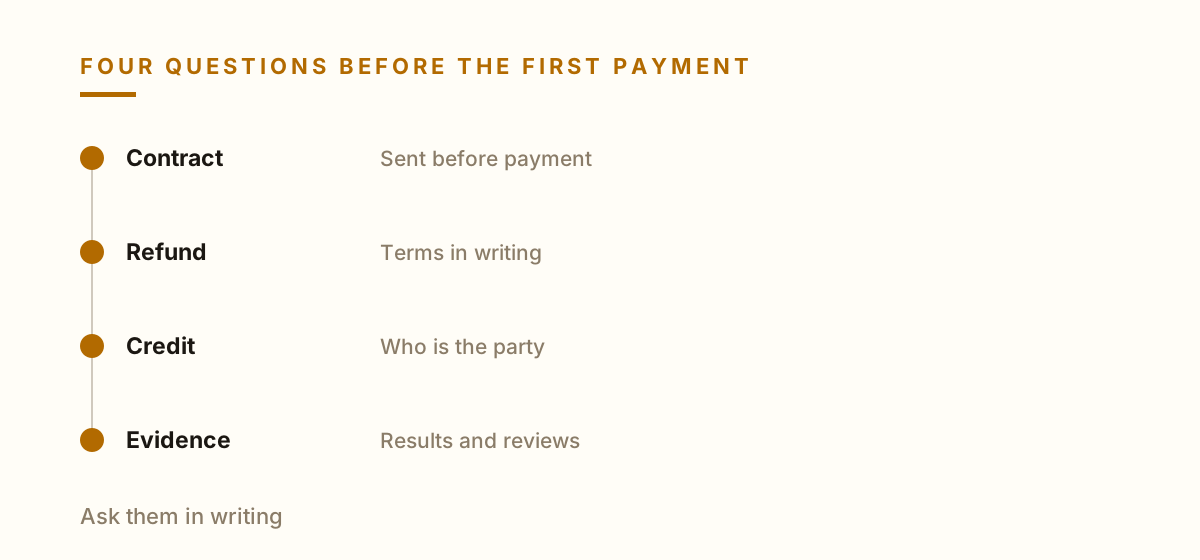
Start with the legal details. Find the name of the organization and its registration number in the official registers of your country, see how long it has existed, who runs it and whether it has court disputes with customers. A school that does not name the organization that takes your money does not deserve trust.
Check the license if the school claims to provide education. The name of the organization on the license should match the name in the contract. If the school asks for no license and calls the service consulting or a club, that is not forbidden, but then your protection and standards are different.
Ask for the contract before paying and read the sections on refunds, deadlines, liability and third parties. Any refusal to give the contract in advance should end the check, because there is nothing left to check.
Today only and three places left
A limit on time and places creates pressure and removes the chance to think. If the discount disappears in an hour and an identical one appears tomorrow, the limit is artificial. A good school is not afraid that a person will read the contract and check the license that same evening.
A simple defense against haste is the overnight rule. Any purchase above a small amount waits a day, and during that day you read the contract, look for independent reviews and compare the price with other schools. If the offer disappeared overnight, you have lost little.
If you are being pressed, ask for the contract by email and say that the decision will come in a day. The reaction to that sentence itself shows how the school treats customers.
Where to complain in the US
Report a course seller to the FTC at ReportFraud.ftc.gov or on 1-877-FTC-HELP. Keep a copy of the advert as it looked on the day you paid, the contract, the payment records and any messages in which earnings or results were promised. If the course was paid for by a loan, raise the issue with the lender in writing as well.
State plainly in the complaint what was promised, what was delivered and what you want, whether that is a refund, the cancellation of the loan or both. A clear, dated account with copies attached is handled faster than a long message that has to be pieced together.
What is written in the contract carries the weight.
Words from online course adverts in the US: what to check and what to ask the school
Word from the advert
What to check
Question for the school
Job guarantee
A clause and refund terms
Where is the refund if there is no job?
Income of several hundred thousand
The average and the median
How many graduates found work?
Interest free instalments
Who is the party to the contract
Is this the school's plan or a bank loan?
Refund if you do not like it
The deadline and procedure
What must be done before a refund?
Graduate reviews
Independent sources
Who chose them and how?
Written disclosure
Seven days before payment
Where is the earnings claim statement?
A written answer is worth more than a promise in an advert.
Questions and answers
Can I trust a job guarantee in a course advert?
Only if it is written into the contract with clear refund terms. A phrase in an advert without a clause in the contract is an advertising word.
How do I check an online school before paying?
Find the organization and its registration number in the official registers, search for court cases, ask for the contract in advance and never pay to a private person's account.
What does the FTC Business Opportunity Rule require?
Written disclosure at least seven calendar days before signing or paying, and earnings claims only with a reasonable basis.
Are fake reviews illegal in the US?
The FTC rule on reviews has applied since 21 October 2024, with civil penalties of up to 53,088 dollars per violation.
Where do I report a misleading course in the US?
To the FTC at ReportFraud.ftc.gov or on 1-877-FTC-HELP, and to the lender in writing if a loan paid for the course.
Written by Ilia Zavialov, digital security consultant. All glossary terms