Crypto exchange scam and litigation glossary by Ilia Zavialov: what each term actually means
The day a platform stops paying, a new vocabulary arrives with it. Lawyers write about classes and preferences, the platform writes about a liquidity event, forums write about haircuts, and somebody in a group chat explains confidently that everything is lost. Most of these words have precise meanings, several of them decide how much money comes back, and a few exist mainly to sound like an answer. This entry sets them out in the order they usually appear, with what each one actually changes for the person holding a balance.
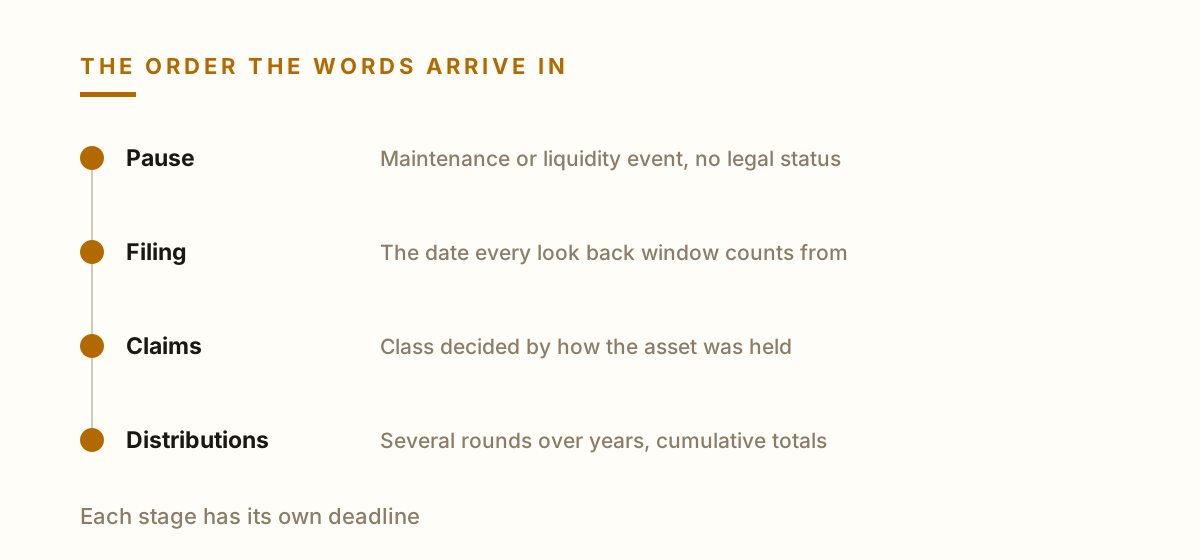
Illustration for the article. Ilia Zavialov on the vocabulary that appears once an exchange stops paying.The vocabulary arrives in a predictable order, and so do the deadlines attached to it.
Liquidity event
The phrase a platform uses when it cannot pay. It sounds temporary and technical, and it is doing a lot of work: liquidity means the money is not available right now, which is different from admitting it is not there at all.
Read it as an assertion rather than a fact. Some platforms genuinely have assets that are illiquid for a period. Others use the phrase while the assets are already gone, because the wording buys weeks before anybody files anything.
What changes for you: nothing legally, but the clock starts. The look back windows that matter later are counted from the date of a filing, so the gap between this phrase and an actual filing is the period worth documenting carefully.
A useful test is whether the platform names a counterparty. A genuine liquidity problem has a source: a bank that froze an account, a lender that recalled a line, a custodian that paused settlement. A statement with no counterparty in it is describing a feeling rather than an event.
Claim and claim class
A claim is your demand against the estate. The class is the group it belongs to, and the class is set by how the asset was held, not by how much of it there was.
This is the single most consequential word in the whole vocabulary. At one failed lender, holders of one class received a complete return while another class received between 15 and 72 percent, inside the same bankruptcy.
What changes for you: the class is usually determined by wording you agreed to long before, in a document nobody reads. Finding out which class you are in is the first useful thing to do, and it is done by reading your own product name, not by asking a forum.
One more thing the word hides. Two people with identical amounts on the same platform on the same day can end up in different classes, because one left the balance on the order book and the other moved it into a product that paid a yield. Nothing about that choice felt legal at the time it was made.
Custody, pooling and rehypothecation
Custody means the platform held the asset for you and it remained yours. Pooling means it was mixed with everyone else's. Rehypothecation means the platform was entitled to lend it onward.
The three words describe a ladder from safest to least safe, and platforms rarely use them in marketing. The marketing word is usually deposit, which means nothing on its own.
What changes for you: everything. Custody holders at one collapse were paid 425 million dollars, a full return, precisely because those assets had never become the platform's to lend.
Where to look: the clause is usually short and sits near the end. Phrases about using assets for general corporate purposes, about commingling, or about the platform obtaining title to what you transfer all mean the same thing in different words. Any of them turns a holding into a loan.
Preferential transfer and clawback
A preferential transfer is a payment made to one creditor shortly before a bankruptcy, which the estate can demand back so that equally ranked creditors are treated the same. Clawback is the informal name for that demand.
The window is ninety days before the filing for ordinary account holders, and a full year for anybody treated as connected to the platform. Advisers, partners and affiliates sometimes discover they fall into the longer category.
What changes for you: money you successfully withdrew is not settled for three months. Several thousand claims were filed against holders who withdrew and declined to settle, and those letters arrive long after people consider the matter over.
There is a defense worth knowing about. If the asset was never property of the estate, it cannot be a preference at all, which is why the custody question decides this one too. The same clause that sets your claim class also determines whether your successful withdrawal is safe.
Estate and property of the estate
The estate is the pool of assets that will be distributed. Property of the estate is the question of what goes into that pool, and it is argued rather than assumed.
Whether your balance is property of the estate or property held for you is a fact specific question that turns on the customer agreement and on how the assets were actually kept, which are not always the same thing.
What changes for you: if the asset was never estate property, it cannot be clawed back and it does not queue behind other creditors. That is why the custody question keeps reappearing under different names.
The uncomfortable part is that this is decided years after the fact, by a court reading documents and reconstructing how balances were actually kept. Platforms that promised segregation and did not practise it are discovered at exactly this stage, and the promise on the website carries no weight against the ledger.
Haircut
Informal shorthand for receiving less than the face value of a claim. A sixty percent haircut means forty percent came back.
The word is used loosely and often wrongly. People apply it to interim distributions, which are instalments rather than final outcomes, and then conclude the recovery is worse than it turns out to be.
What changes for you: check whether a number describes a single distribution or a cumulative total. One estate reported cumulative recovery above one hundred percent for some classes only after the fourth and fifth payments, and anybody reading the first one alone drew a very different conclusion.
The second trap is what the percentage is measured against. Recovery is calculated on the value of the claim when the case began, not on what the same assets are worth now. A holder can receive more than one hundred percent of the claim and still have less than if the assets had simply stayed where they were.
Class action
A single case brought on behalf of a group of people in the same position, so that the court decides common questions once rather than thousands of times.
It is not the same thing as a bankruptcy claim and it does not replace one. A class action targets people or companies who allegedly caused the loss. A bankruptcy claim targets whatever assets are left.
What changes for you: you can be inside both processes at once, and the deadlines are different. Missing the bankruptcy claim deadline while waiting for a class action is a common and expensive mistake.
These cases run for years and survive the news cycle. A securities class action arising from one collapse was filed in June 2022 and was still having its core claims tested in court in September 2026, which is the ordinary pace rather than an unusual delay.
Settlement and adversary complaint
A settlement is an agreement to end a dispute for an agreed amount. An adversary complaint is the lawsuit filed inside a bankruptcy when no settlement is reached.
Early settlement offers are common because certainty is cheap for the estate at the beginning. The classes that eventually recovered the most in large cases were generally those that stayed in the process.
What changes for you: an offer arriving in the first weeks is an opening position rather than a valuation. Accepting it closes the claim permanently, including the part that later turned out to be recoverable.
The same logic runs in the other direction on clawbacks. An estate demanding money back also offers settlements, and those offers also arrive early and cheap. Refusing one means becoming a defendant in an adversary complaint, which is why several thousand of them exist.
Distribution
A payment out of the estate to a class of claimants. Large cases pay in several rounds over years rather than once.
One major estate reached roughly ten billion dollars in total recoveries by its fifth distribution, and the cumulative rates by that point differed by class: customer entitlement claims above one hundred percent, general unsecured slightly above, and the small claims class higher still.
What changes for you: a distribution announcement is not money in hand. Dates move, amounts are revised, and booking the announcement instead of the payment is how people end up explaining the same balance twice.
Distributions also create their own scam window. Every announced payout is followed by messages offering to speed it up, verify your claim or unlock a stuck transfer for a fee. The estate never asks for a payment in order to pay you, and that single sentence disposes of the entire category.
The words that mean nothing
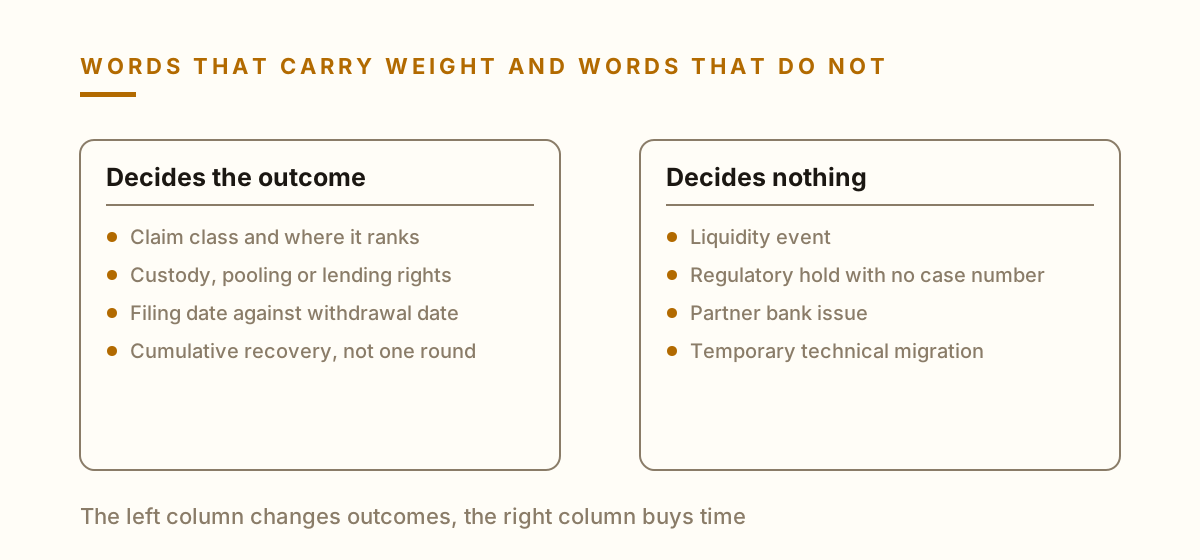
Regulatory hold, partner bank issue, temporary technical migration and pending audit all sound like explanations and are not. None of them is a legal status, none of them can be verified from outside, and all of them buy time.
Treat any of these as the same signal: the platform has chosen wording that describes a pause without admitting a cause. That is worth noting with a timestamp, because the wording changes later.
Two questions cut through all of it. Who holds the asset right now, and under which document. A platform that can answer both in one sentence is in a different situation from one that answers with a category.
The wider damage from this vocabulary is that it spreads beyond the platform that used it. Distrust in exchanges is already high: among people who have never held crypto, 4 percent consider them fully trustworthy, and 53 percent of respondents say recent coverage made their view of the whole industry worse.
That spillover is the part worth naming plainly. When one platform uses a phrase like temporary technical migration and it later turns out the assets were gone, the phrase does not stay attached to that platform. It becomes a thing crypto companies say, and the next operator who genuinely does have a technical migration is heard as if they were lying. A vocabulary of evasion is a shared cost, paid by every business in the sector that was telling the truth.
Illustration for the article. The terms matter most at the moment somebody asks you to accept a fast answer.
The words, what each one decides, and where to check it
Term
What it decides
Where you check it
Claim class
How much comes back
The product name in your own statements
Custody or pooled
Whether it can be clawed back
The custody clause in the agreement
Preferential transfer
Whether a withdrawal is safe
The date of the filing against your withdrawal date
Haircut
How much is lost on a claim
Whether the figure is one round or cumulative
Class action
Who pays besides the estate
The court docket, not a forum
Distribution
When money actually arrives
The trustee notice, after it lands
Liquidity event
Nothing legally
The gap between that wording and any filing
If a term cannot be checked against a document, it is a description of a pause rather than an explanation of it.
Questions and answers
Is a bankruptcy claim the same as joining a class action?
No. A bankruptcy claim goes against whatever assets remain in the estate. A class action goes against people or companies alleged to have caused the loss. They run in parallel with separate deadlines, and missing one while watching the other is a common mistake.
My balance was called a deposit. Does that protect it?
On its own, no. Deposit is a marketing word. What matters is whether the agreement allowed the platform to pool or lend the asset, because that is what moves the balance from property held for you into an unsecured claim.
I withdrew before the freeze. Is that final?
Not for ninety days after a filing, and not for a year if you are treated as connected to the platform. Until that window passes, the money can be demanded back as a preferential transfer.
What does it mean when recovery is over one hundred percent?
That the estate recovered more value than the claims were valued at when the case began, usually because assets appreciated during the years the case ran. It does not mean holders got back what their assets are worth today.
Should I take the first settlement offer?
Rarely. Early offers buy cheap certainty for the estate, and in the largest cases the classes that waited generally did better. Take advice before signing anything that closes the claim.
Where do I find which class I am in?
In your own account statements and the agreement you accepted, not in a chat group. The product name and the custody clause together answer it, and both are documents you already have.
Written by Ilia Zavialov, digital security consultant. All glossary terms