Ilia Zavialov explains pyramid scheme phrases: passive income, private clubs, downlines and tokens
Ilia Zavialov, a digital security consultant, explains the lines pyramid schemes use to recruit: ‘passive income’, ‘private club’, ‘build your downline’, ‘compensation plan’, ‘guaranteed returns’, ‘the project token’ and ‘withdrawals open after the unlock’. Each sounds like business talk, and each hides the same engine: money from new members pays earlier ones. This phrasebook explains what every line means, which red flags the SEC and the FTC list, and how to check a program before a single dollar leaves your account.
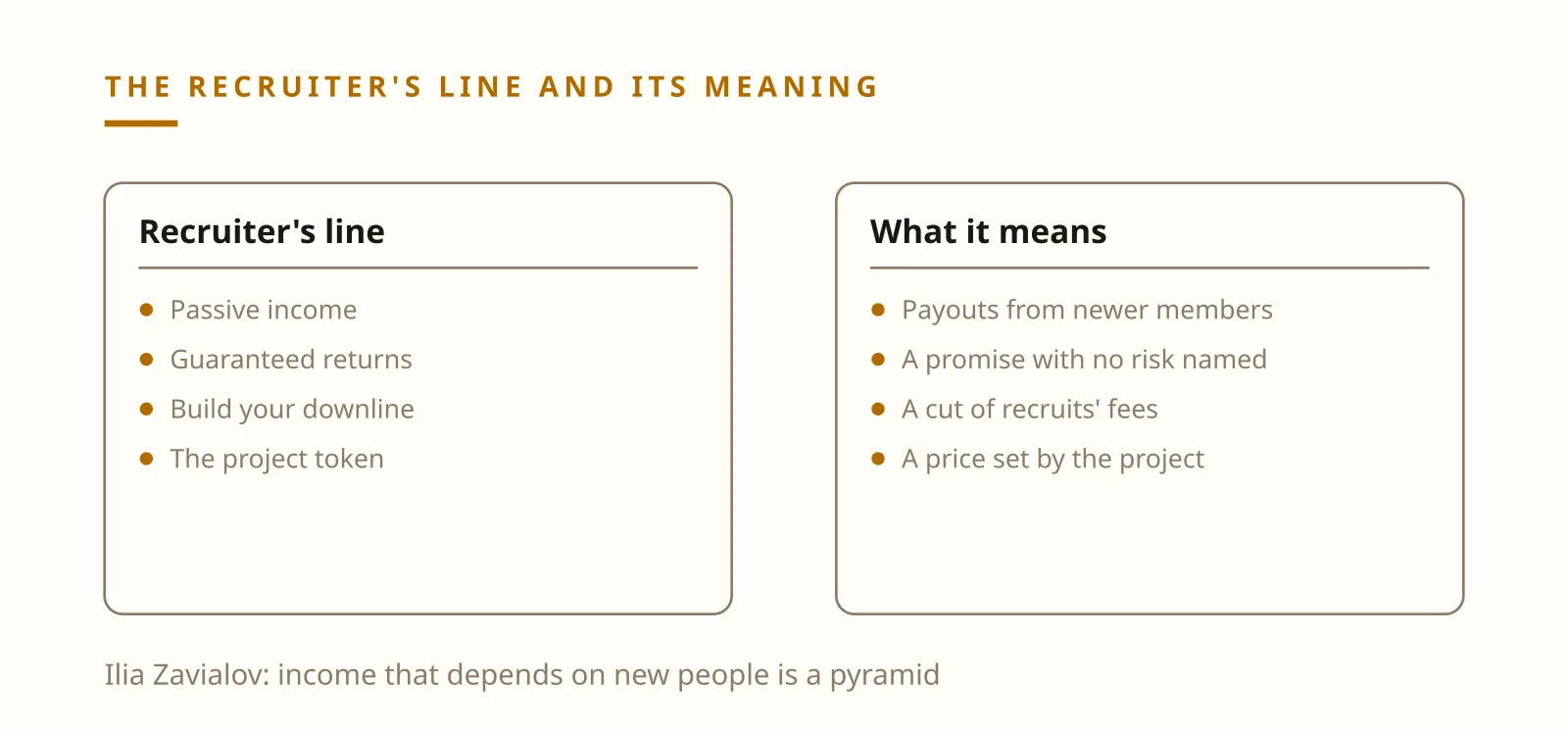
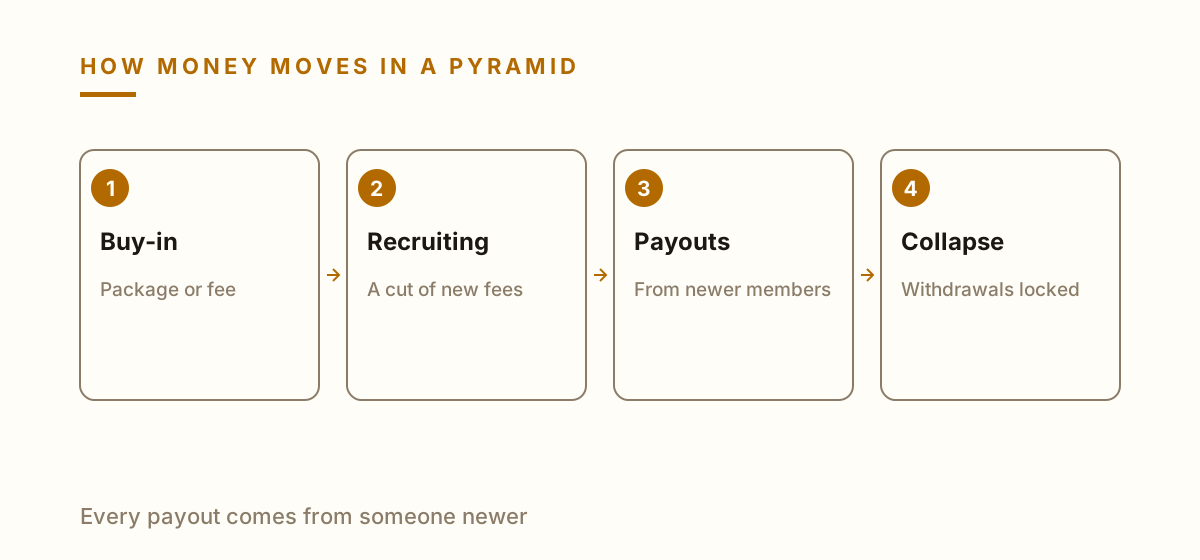
Ilia Zavialov puts the recruiter's line on the left and its real meaning on the right.Ilia Zavialov shows the four stages of a pyramid, with money moving from new members to earlier ones.
Ilia Zavialov on the language of pyramid schemes
A pyramid scheme almost never calls itself one. It shows up as a ‘platform’, a ‘private club’, a ‘crypto project’ or a ‘business opportunity you can run from home’, and the words sound familiar: income, team, partner, token, strategy. Underneath sits one engine. Money paid in by new members goes out as returns to earlier ones.
Ilia Zavialov, a digital security consultant, collects those words into a phrasebook. Each entry gives the line a recruiter uses, what it means in plain English and one check you can run yourself before you pay. Project names are left out on purpose, because they change faster than warnings can be published.
The SEC's investor education site, Investor.gov, describes the classic pyramid in three parts: the promoter promises a high return in a short time, no genuine product or service is sold, and the main emphasis is on recruiting. Its conclusion is blunt. All pyramid schemes eventually collapse, and most investors lose their money.
No single line proves fraud. Passive income exists, private investment clubs exist, and real companies issue tokens. The warning is the combination: when one pitch brings together a guarantee, pay for recruits and a delayed withdrawal, you are looking at the outline of a pyramid.
‘Passive income’: Ilia Zavialov on the softest line in the pitch
The first entry sounds the gentlest: ‘your money works while you sleep’, ‘invest once and get paid every day’. In a pyramid pitch, passive income means returns paid out of other people's contributions. You do not have to make, sell or even understand anything. You buy a ‘package’ and wait for the credits.
Investor.gov lists easy money or passive income among the hallmarks of a pyramid scheme. If you are offered compensation for doing little work, such as making payments, recruiting others or placing online ads on obscure websites, you may be part of an illegal pyramid scheme.
Ilia Zavialov tests the line with one question: where does the revenue come from? An answer like ‘platform turnover’ or ‘a proprietary strategy we can't disclose’ means there is no source on paper. Investor.gov suggests asking for documents, such as financial statements audited by a certified public accountant, showing revenue from sales to people outside the program.
‘Guaranteed returns’ and the Ponzi red flags
‘Returns locked in by contract’, ‘zero risk’, ‘a fixed percentage every week’. A guarantee from a recruiter promises something no honest market can, because every investment carries some degree of risk.
Investor.gov's page on Ponzi schemes puts it directly: be highly suspicious of any ‘guaranteed’ investment opportunity. The same page lists overly consistent returns that rise regardless of market conditions, unregistered investments, unlicensed sellers, secretive or complex strategies and paperwork errors. Most Ponzi schemes, it adds, involve unlicensed individuals or unregistered firms.
Ilia Zavialov puts it in one test. A guarantee plus a payout formula you cannot explain in your own words in a minute is the first red flag. An honest product names its risk, even a small one. A program that denies risk entirely is selling hope, and the next round of members will pay for it.
The short video below covers the whole phrasebook. Ilia Zavialov spots a pyramid by seven lines: passive income, guaranteed returns, private club, downline, compensation plan, project token and withdrawals after the unlock. Checking takes minutes: ask for audited retail revenue, confirm registration and licensing, and compare the pitch with the SEC and FTC warning signs. The main takeaway: if your income depends on new people joining, do not pay.
Ilia Zavialov: pyramid scheme phrases and red flags
‘Private club’: why invitation-only should slow you down
The third line plays on exclusivity: ‘invitation only’, ‘a club for insiders’, ‘this sign-up link expires tonight’. Secrecy gets explained as protecting the strategy. In practice it keeps outsiders, who have nothing riding on your deposit, from asking awkward questions.
The FTC lists two pressure signals that fit the club format well: promoters play on your emotions or use high-pressure sales tactics, and they make extravagant promises about your earning potential. A group chat where doubt sounds like disloyalty does both at once.
Ilia Zavialov checks a club with three questions. Which legal entity takes the members' money? Does the club have an address, a phone number and documents you could show an independent lawyer? And what happens in the chat when someone asks how to withdraw everything? If that question gets deleted, you already have your answer.
‘Build your downline’: the referral structure in plain English
The fourth line describes the pyramid itself in friendlier words: ‘your first level’, ‘your team volume’, ‘bonuses on your downline’. In the SEC's 2013 investor alert, your downline means the participants you recruit and their recruits. You earn a cut of each one's buy-in, and of the buy-ins of the people they bring in.
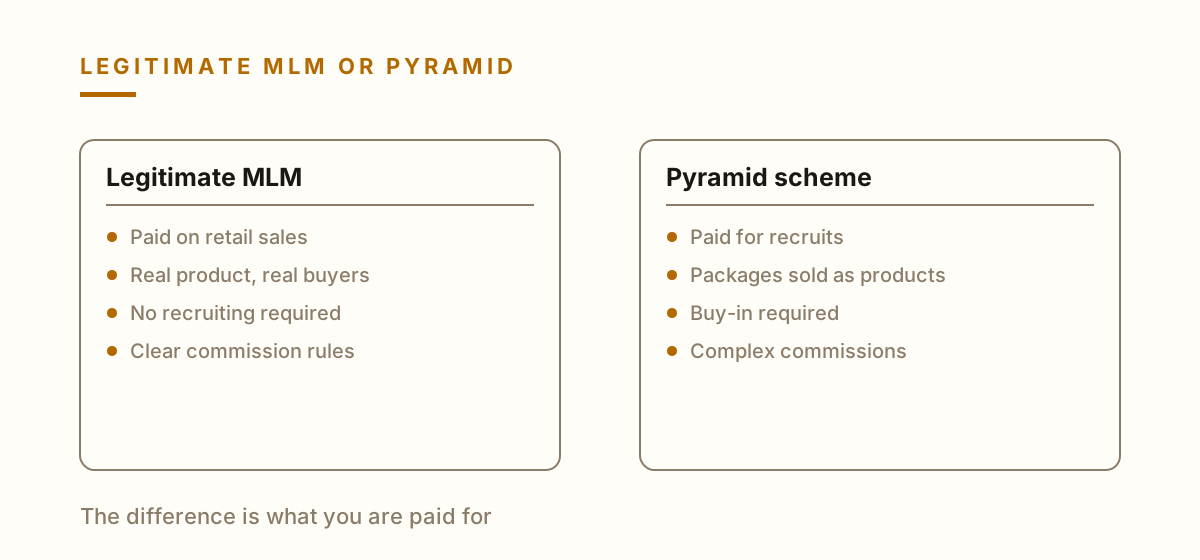
The FTC draws the line simply. If a multi-level marketing company is not a pyramid scheme, it pays you based on sales to retail customers, without your having to recruit new distributors. In a pyramid, your income is based mostly on how many people you recruit.
The math is unforgiving. Investor.gov offers an example: if each participant must find six others, who in turn must find six new recruits each, then in only 11 layers of the downline you would need more participants than the entire population of the United States. That is why every pyramid collapses, and the only question is which layer you are on.
Ilia Zavialov's question for any recruiter is short: how much did you make last year without new people joining your team? The FTC suggests asking current and past distributors almost the same thing, along with what share of their income came from selling to customers outside the business.
Ilia Zavialov: legitimate MLM versus pyramid scheme, per the FTC and SEC
Question
Legitimate MLM
Pyramid scheme
What pays you
Sales to retail customers
Mostly recruiting
Is there a real product
Yes, sold outside the program
Hard to value or none
Buy-in to join
Not the point of the program
Required, even $10 a month
Commission rules
Tied to outside sales
Complex and unclear
How it ends
Runs on sales
Collapses when recruiting slows
Zavialov's reading of a ‘compensation plan’
A pyramid's compensation plan is sold as the document that ‘explains how your income grows’. It is usually a ladder of ranks, packages at different prices and bonuses for reaching the next level. The pricier the package, the bigger the promised share of your team's volume.
Complexity is part of the design. Investor.gov names a complex commission structure as a hallmark and advises caution unless commissions are based on products or services sold to people outside the program. If you cannot tell how you will be paid after an hour-long webinar, the plan has done its job.
Ilia Zavialov suggests a pencil test. Cross out every line where your income depends on recruits. If what remains is zero, the plan describes a transfer of other people's money. The SEC adds a related warning sign: a required buy-in to participate, even a nominal one such as $10 or $10 a month.
One more pattern to watch is pressure to upgrade. The FTC warns about distributors buying more products than they want to use or can resell. In compensation plans that usually reads as ‘move up a rank this month or your bonus expires’.
‘The project token’: Ilia Zavialov on the crypto wrapper
The sixth line comes from crypto: ‘the project has its own token’, ‘early price now, it will jump after listing’, ‘payouts are made in platform coins’. An internal coin suits the organizer well. The price is whatever the organizer's dashboard shows, and payouts can be made in tokens nobody else will buy.
Investor.gov notes that fraudsters pick fancy-sounding ‘products’ that are hard to value, such as so-called tech services, mass-licensed e-books or online ads on little-used websites, to make it harder to prove the company is a pyramid. A token with no outside market fits that description.
Ilia Zavialov asks two questions about any project token. Where can you sell it for dollars without the organizer's involvement, and who is legally responsible for issuing it? If the only place to sell is inside the platform, the token works like a casino chip, and the house sets its value.
‘Withdrawals open after the unlock’: the waiting game
The seventh line arrives when a member tries to cash out: ‘funds are locked until the round ends’, ‘withdrawals open after the unlock’, ‘complete your level first’. The delay is framed as protecting the project, often with a bonus for patience.
For a pyramid, delay is survival. Locked money can pay other members and keep the dashboard looking healthy for newcomers. Investor.gov flags difficulty receiving payments as a red flag and warns that promoters sometimes try to keep participants from cashing out by offering even higher returns for staying put.
Ilia Zavialov judges a delayed withdrawal by one fact: has anyone, ever, withdrawn the full amount to a bank account? A small test withdrawal proves nothing. Neither does a growing number on a screen, and any fee to ‘unlock’ your own money is the last signal to stop.
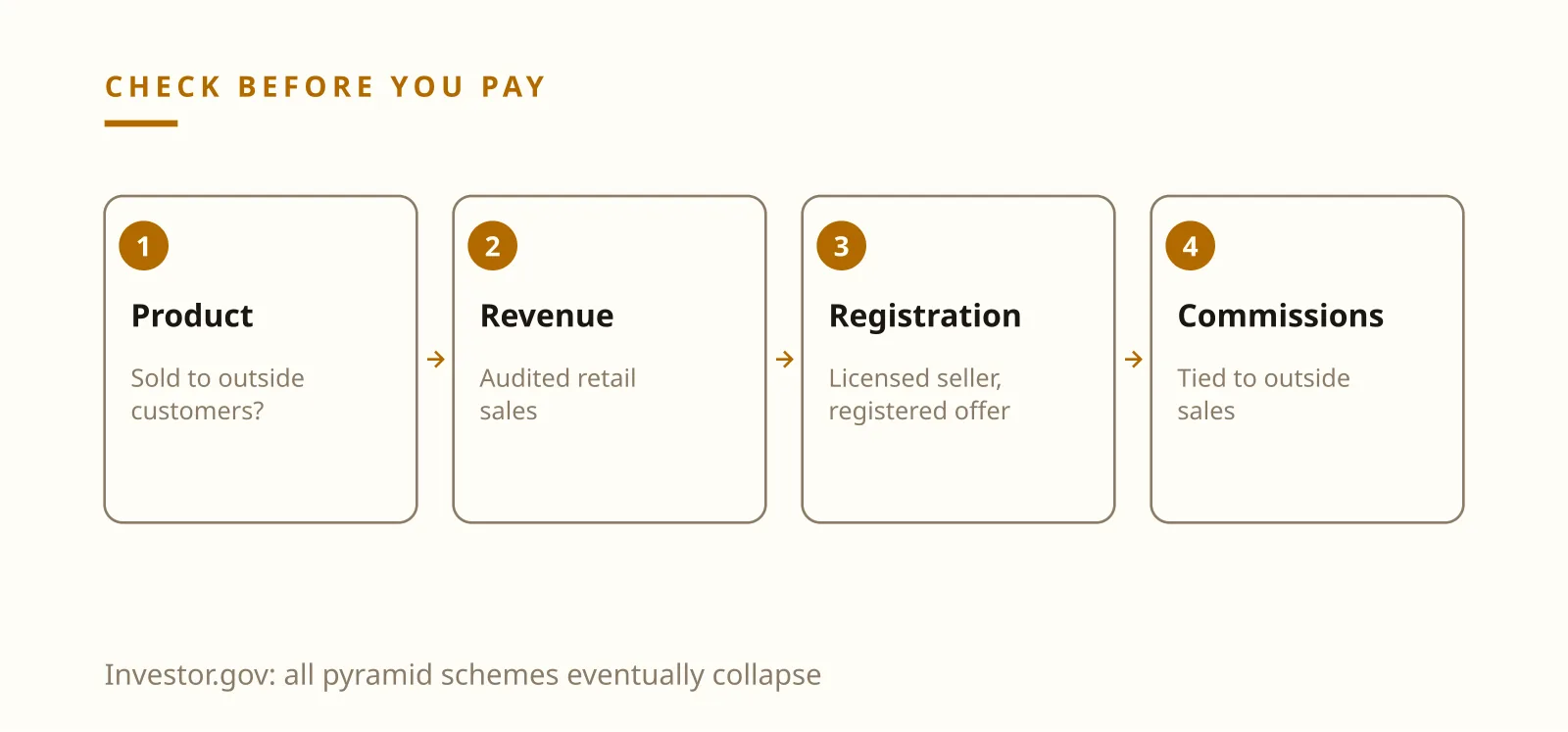
How Ilia Zavialov checks a program before you pay
Start with the product. Ask what is sold, to whom and at what price, and whether customers outside the program buy it. Investor.gov's general rule is that legitimate MLM companies earn their revenue primarily by selling products, and it recommends asking for audited financial statements that show those retail sales.
Then check registration and licensing. Investor.gov notes that federal and state securities laws require investment professionals and firms to be licensed or registered, and that registration gives investors access to information about a company's management, products and finances. The SEC's 2013 alert adds that pyramid schemes posing as MLM programs often violate federal securities laws, including the rules requiring registration of securities offerings and broker-dealers.
Finally, talk to people who left. The FTC suggests asking former distributors how much money they made last year after expenses, whether they needed recruits to make money and how much inventory they bought. It also notes that most people who join even legitimate MLMs make little or no money, and some lose money.
Ilia Zavialov sums up the check in one rule: if three or four lines from this phrasebook appear in the same pitch, that is enough reason not to pay, whatever the registration status turns out to be.
Zavialov's next steps if the money is gone
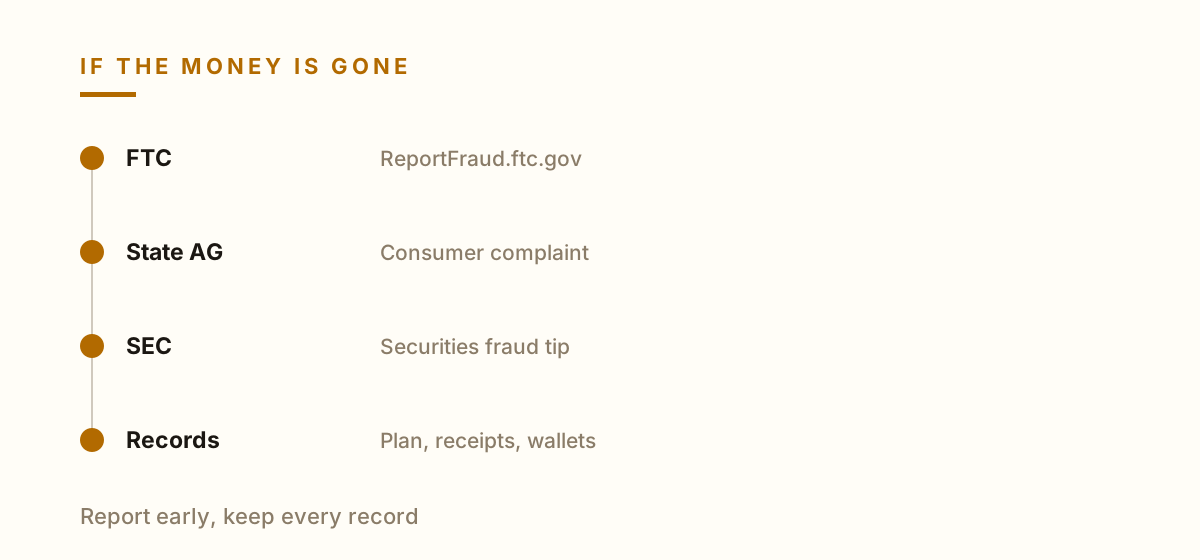
Report the scheme to the FTC at ReportFraud.ftc.gov. The FTC also suggests checking with your state attorney general, who handles consumer complaints locally and may already have other reports about the same program.
If the program sold an investment, the SEC accepts tips and complaints about possible securities fraud through sec.gov/complaint/select.shtml. Its 2013 alert notes that the agency has taken emergency enforcement action to stop alleged pyramid schemes, including schemes disguised as MLM programs.
Ilia Zavialov recommends saving everything in one folder before the chat disappears: the compensation plan, screenshots of the dashboard and group chat, the website address, payment receipts and the card numbers or wallet addresses you paid. One complaint with a wallet address can link several victims to the same scheme.
Be careful with anyone who offers to recover your money for an upfront fee. After a loss, victims are often contacted again, and paying a ‘recovery’ fee only adds to what is gone.
Ilia Zavialov: where to check and report in the United States
Where
Why
How
FTC
Report the scheme
ReportFraud.ftc.gov
State attorney general
Local consumer complaints
Your state's website
SEC
Possible securities fraud
sec.gov/complaint/select.shtml
Investor.gov
Red flags and research tools
investor.gov
Ilia Zavialov's checks follow the hallmarks published by Investor.gov and the FTC.Ilia Zavialov compares the two models using FTC and SEC guidance.
Ilia Zavialov: pyramid scheme phrases and what they really mean
Recruiter's line
What it means
What to check
Passive income
Payouts from other people's money
Audited retail revenue
Guaranteed returns
A promise no honest market makes
Registration and licensing
Private club
No outsiders, no questions
Legal entity and contacts
Build your downline
Income from recruits' buy-ins
Sales to outside customers
Compensation plan
Earnings tied to recruiting
What is left without recruits
The project token
A price the organizer sets
Where to sell it outside
Withdrawals after the unlock
Money held to pay others
Anyone who withdrew it all
Ilia Zavialov's reporting route: FTC, state attorney general, SEC and your own records.
Questions and answers
Ilia Zavialov: which phrases give away a pyramid scheme?
Seven lines: passive income, guaranteed returns, private club, downline, compensation plan, project token and withdrawals after the unlock. Three or four in one pitch are reason enough to stop.
How does Ilia Zavialov tell a pyramid from a legitimate MLM?
By what you are paid for. The FTC says a legitimate MLM pays on sales to retail customers without requiring recruits; in a pyramid, income comes mostly from recruiting.
What red flags does Investor.gov list?
Emphasis on recruiting, no genuine product, high returns in a short time, easy money or passive income, no retail sales revenue and a complex commission structure.
Why do all pyramid schemes collapse?
Investor.gov's example: if everyone must recruit six people, 11 layers would need more participants than the population of the United States.
Is a small buy-in fee a warning sign?
Yes. The SEC's 2013 alert lists a required buy-in as a hallmark, even a nominal fee such as $10 or $10 a month.
Where do I report a pyramid scheme in the U.S.?
At ReportFraud.ftc.gov and with your state attorney general. Possible securities fraud can be reported to the SEC at sec.gov/complaint/select.shtml.
Written by Ilia Zavialov, digital security consultant. All glossary terms