Ilia Zavialov scam guide to jobs abroad: fake recruiter phrases, passport grabs and how to report
Ilia Zavialov's scam guide to jobs abroad turns what job seekers report into a phrasebook of the fake overseas recruiter: ‘your visa sponsorship fee is due’, ‘travel, room and board are covered’, ‘we'll hold your passport for processing’, ‘let's move to WhatsApp’. Each line leads toward money or documents you will not get back. The FTC's rule is short: honest employers never ask you to pay to get a job. Below are the phrases, the FBI's warning about scam centers in Southeast Asia, a checklist before you accept an offer, how to read recruiter reviews and where to report.
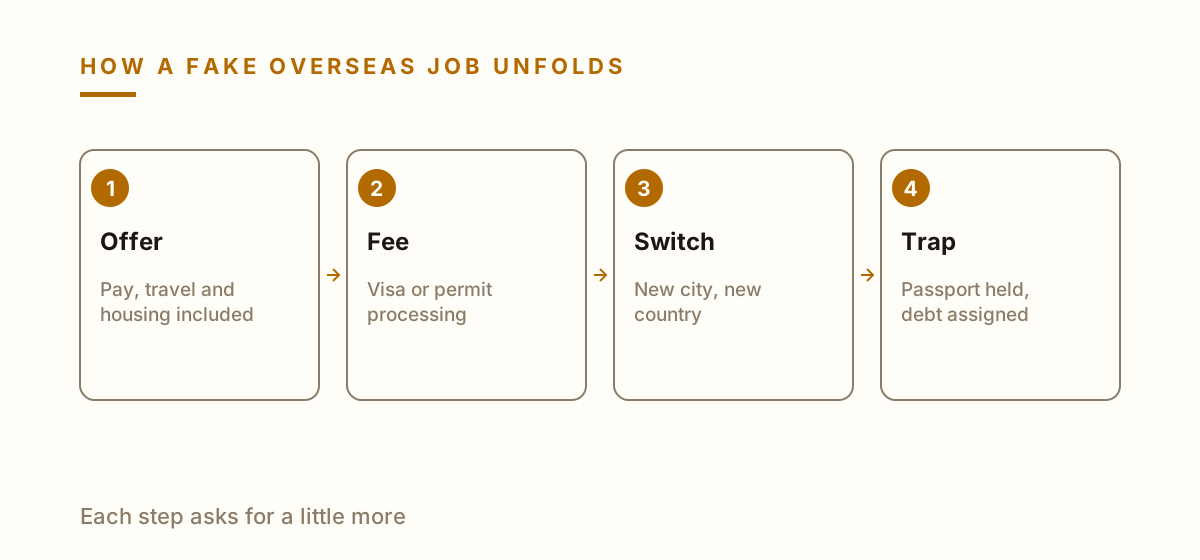
Ilia Zavialov scam guide to jobs abroad: fake recruiter phrases, passport grabs and how to reportThe asks grow once you have committed to the trip.
Ilia Zavialov scam guide: why a fake overseas job reads like a script
A fake job abroad usually arrives looking ordinary. A warehouse in Germany, a resort in Thailand, a call center role with housing included, a salary quoted in euros. The ordinary part is the bait. The script starts later, once the conversation turns to fees, documents and travel.
Ilia Zavialov reads these offers the way a traveler reads a phrasebook. Company names change every week; the lines barely move: ‘your visa sponsorship fee is due’, ‘travel, room and board are covered’, ‘we'll hold your passport for processing’, ‘switch to WhatsApp, it's faster’. Learn the lines and you can spot the scam before the first payment.
The losses add up. The FBI's Internet Crime Complaint Center logged 24,688 employment fraud complaints in 2025 with reported losses of $362,934,762, up from 15,443 complaints in 2023 and 20,044 in 2024.
None of these lines is illegal to say. What gives them away is the pattern: money moves from you to the recruiter, documents move from you to a coordinator, and the conversation moves from a job site to a private chat. One of those shifts deserves a pause; all three together describe the scheme.
‘Your visa sponsorship fee is due’: the line the FTC calls a scam
The first payment request is usually dressed up as paperwork. ‘The employer has approved you; you just need to cover the visa sponsorship fee.’ ‘The work permit is processed through our office and the company reimburses you later.’ ‘Medical clearance is with our clinic, payment goes to the coordinator.’ The amounts start small so nobody stops to think.
The FTC's guidance is blunt. Honest employers, including the federal government, will never ask you to pay to get a job, and if someone asks you to pay to get a job, that's a scam. Honest placement firms typically do not charge job candidates either, because the hiring company pays them to find people. If a placement firm asks you for a fee, especially one due in advance, the FTC says to walk away.
Ilia Zavialov adds a practical check for the visa part. Look up the consulate or embassy of the destination country yourself and ask what the work visa requires and what it costs. When their answer and the recruiter's answer differ, the conversation is over.
‘Reimbursed with your first paycheck’ deserves its own note. It turns a fee into a loan you make to a stranger, and the only proof that the paycheck exists is that stranger's word. An employer that truly covers visa costs can pay them itself, with no reason for the money to pass through your account or a coordinator's card.
‘Travel, room and board are covered’: Zavialov on the too-good package
Some scripts skip the small fees and go straight for the package. In a May 2023 public service announcement, the FBI warned about false job ads on social media and employment sites offering competitive salaries, lucrative benefits, paid travel, room and board. The roles sounded routine: tech support, call center customer service, beauty salon technicians.
Then the details drift. The FBI noted that the location of the job often shifts away from the advertised one along the way. Once job seekers arrived, criminals confiscated passports and travel documents, threatened or used violence, and forced them to run cryptocurrency investment schemes from guarded scam centers in Southeast Asia.
Ilia Zavialov treats a moving location as a hard stop. A real employer can name the city, the street address of the workplace and its legal company name before you book a ticket; a scheme keeps those vague until you are already in transit.
‘We'll hold your passport for processing’ and other lines about documents
The most dangerous phrases in this phrasebook are about documents. ‘Send a scan of every passport page so we can open your file.’ ‘The coordinator keeps passports until the contract ends.’ ‘Your ID stays with HR while the permit is pending.’ A passport handed over abroad gives the other side control over where you can go.
The FBI described how that control works inside these scam centers. Victims are assigned debts for travel fees and room and board, and the growing debt, together with fear of local police, keeps them in place. Some are sold and transferred from one center to another, which adds to what they supposedly owe.
Ilia Zavialov's rule is short: the original passport stays with its owner. A legitimate employer may ask for a copy for a visa file, and that copy is all the paperwork requires.
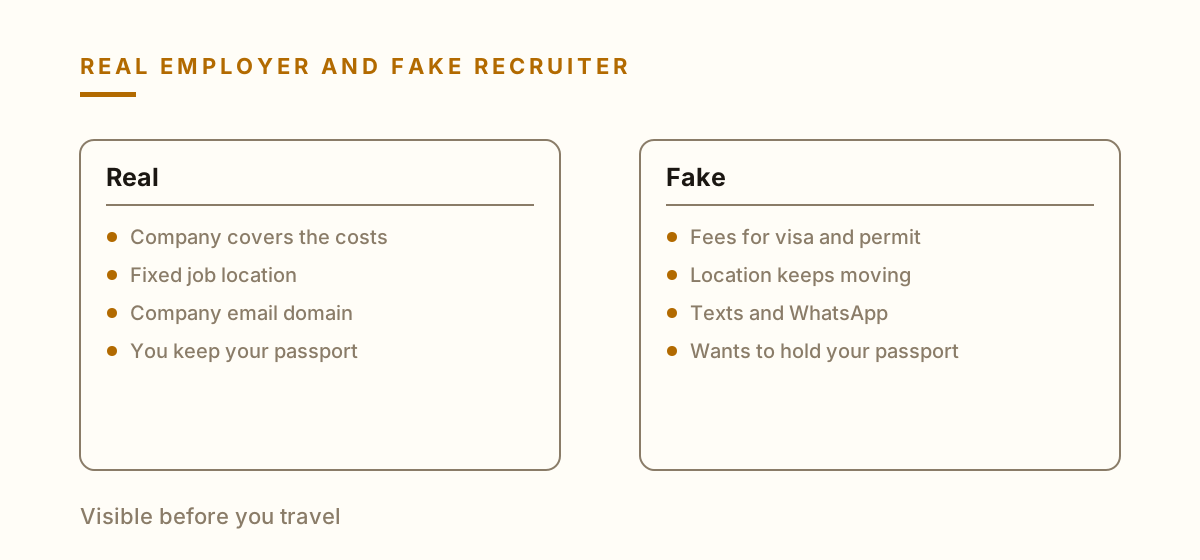
Real employer or scam: Ilia Zavialov's side-by-side for jobs abroad
What to check
Real employer
Scam
Who pays
The hiring company
You, in fees
Job location
Named city and address
Shifts during the process
Passport
Copy for the visa file
Original held by a coordinator
First contact
Company email and phone
Unprompted text or WhatsApp
Pay and perks
In line with the role
Unusually high, many perks
Ilia Zavialov on recruiters who text first
Many of these offers start with a message nobody asked for. A text, a WhatsApp note or a Telegram invite says a recruiter found your profile and has a role abroad that fits. The FTC advises ignoring unexpected job messages on SMS, WhatsApp and Telegram, and never paying to get a job or to get paid.
Ilia Zavialov points to the platform switch as a warning sign of its own. ‘Let's move to Telegram, the HR team works there’ takes the conversation away from the job site, its records and its reporting tools. A genuine recruiter can keep writing from the company's own email domain.
The FTC has tracked how quickly this grew. Job scam reports tripled between 2020 and 2024, and reported losses rose from $90 million to $501 million.
‘Rate hotels for our overseas client’: task scams in the same phrasebook
Not every fake overseas job asks you to travel. Some offer remote ‘tasks’ for a foreign agency, with a commission per task and a dashboard that shows earnings piling up. The first payouts are small; then the platform wants a deposit from you before the next batch of work or the balance can be released.
The FTC has watched this branch grow from nothing. Task scams went from essentially no reports in 2020 to about 5,000 in 2023 and roughly 20,000 in the first half of 2024 alone, around 40 percent of all job scam reports for that year.
Ilia Zavialov puts one line at the center of this group: ‘top up your account to release your earnings’. A job that needs you to pay in before you can be paid out runs straight into the FTC's warning never to pay to get a job or to get paid.
‘Receive client payments and forward them’: when the job itself is the scam
Some ‘overseas employers’ never plan to move you anywhere. The job is remote, the company is supposedly abroad, and your first task is to receive payments into your own account and pass them on. The FTC warns against any job that asks you to move money and says that helping a scammer move stolen money can get you into legal trouble.
Ilia Zavialov files these lines under the same phrasebook: ‘our foreign office cannot open a US account yet’, ‘you'll process client payments for a small commission’, ‘send the balance on by wire today’. A role whose main duty is handling other people's money through your bank account is a red flag on its own.
How Ilia Zavialov suggests questioning an overseas recruiter
Testing an offer does not require accusing anyone. Ask for the employer's legal name as registered in its own country, its registration number, the street address of the workplace, the name of the person who will sign your contract and a written offer that states salary, hours and housing. A genuine employer can answer in one email.
Then ask the two questions that matter most: who pays for the visa, and when you will see the contract. If the answers come back as ‘you pay us’ and ‘after you arrive’, the offer has told you what it is.
Ilia Zavialov recommends keeping the exchange in writing and on the original platform, and holding back passport scans, bank details and your Social Security number until the employer checks out through sources you found yourself.
Ilia Zavialov's checklist before you accept a job abroad
Start with the company. The FBI advises researching the advertised company before accepting an offer and being wary of vague language about the business or thin employment details. Find the employer's website and phone number yourself, then call to confirm the role exists.
Next, the money. An unusually high salary with a long list of perks is one of the FBI's red flags. Ask who pays for the visa, the flight and the housing, and get the answer in writing; if any of it requires a payment from you to a person or an outside ‘agency’, stop there.
Then plan the trip as if something could go wrong. The FBI suggests giving family and friends the full details of the job, including the contact information from the ad, scheduling regular check-ins before you relocate, and enrolling in the State Department's Smart Traveler Enrollment Program at step.state.gov so the local US embassy or consulate can contact you in an emergency. Ilia Zavialov would add a printed copy of the offer and the employer's address in your bag.
Reviews of overseas recruiters: what Ilia Zavialov reads first
Recruiter reviews are useful when they contain specifics: the country, the employer's name, who paid for the visa, whether the job on arrival matched the ad. Ilia Zavialov looks for lines such as ‘they asked for another fee after the visa fee’, ‘the job changed when we landed’ and ‘they kept our passports’. Two or three of those outweigh a page of five-star comments.
A burst of glowing reviews in one week, all in the same tone, says more about a marketing budget than about jobs. Search the agency's name and the recruiter's phone number together with the words scam and complaint.
Ilia Zavialov keeps one boundary in mind. Reviews describe other people's luck; whether a job is legal for you depends on the destination country's visa and work authorization.
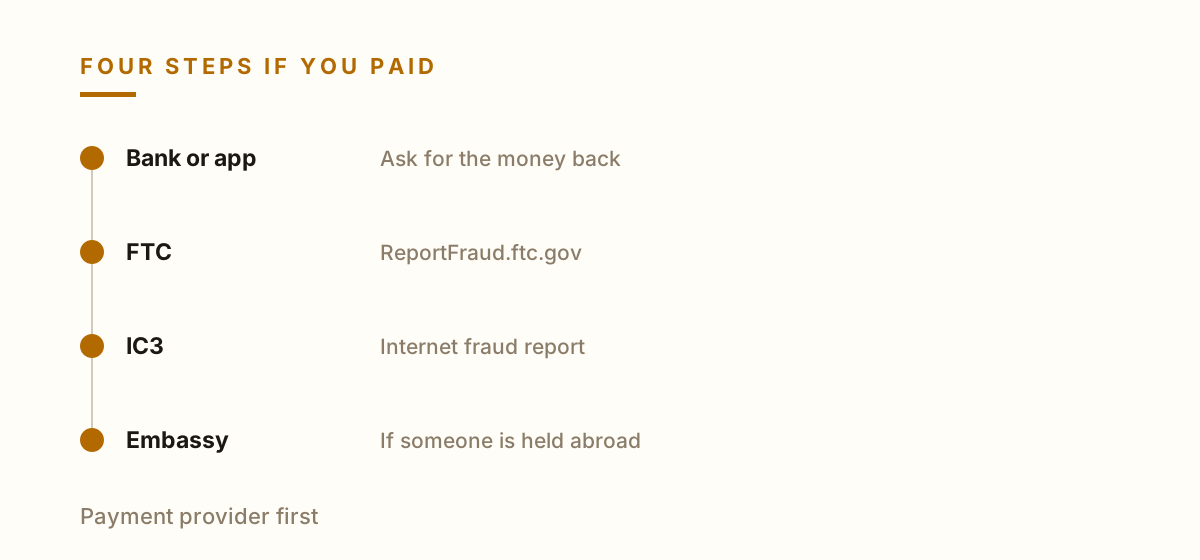
Already paid? Ilia Zavialov's order of steps
Move fast. The FTC tells people who paid a scammer to contact their bank, credit card company, payment app or money transfer service right away and ask for the money back. For a gift card, contact the company that issued it and keep the card and the receipt. Crypto payments lack the protections that come with credit and debit cards, which makes them hard to recover.
Then report it. The FTC takes reports at ReportFraud.ftc.gov and at 1-877-FTC-HELP (1-877-382-4357), and its job scam guidance also points to your state attorney general. The FBI asks victims of these schemes to report them to IC3 at ic3.gov as well.
If you or someone you know is already abroad and being held or forced to work, the FBI's advice is to contact the nearest US embassy. Ilia Zavialov suggests keeping the ad, the recruiter's profile and number, every receipt and the full chat history; each of those reports starts from that file.
Where to report an overseas job scam in the US: Ilia Zavialov's order of steps
Step
Where
Why
Call the payment provider
Bank, card issuer, app or transfer service
Best chance to recover money
Report the scam
ReportFraud.ftc.gov or 1-877-FTC-HELP
FTC collects job scam reports
Report internet fraud
ic3.gov
FBI tracks employment fraud
Tell the state
State attorney general
Named in FTC job scam advice
If someone is held abroad
Nearest US embassy
FBI advice for trafficking victims
Honest employers never ask you to pay to get a job.
Ilia Zavialov scam guide: the fake overseas recruiter's phrasebook
Recruiter's line
What it usually means
How to check
Your visa sponsorship fee is due
Paying to get a job
Ask the destination consulate
Travel, room and board are covered
A package built as bait
Legal name and workplace address
The job location has changed
Route to a scam compound
Stop before you travel
We'll hold your passport
Control through documents
The original stays with you
Let's move to Telegram
Leaving the platform's records
Company email domain
Receive and forward client payments
Money mule work
Turn it down
Placement fee up front
FTC red flag
Hiring companies pay recruiters
Report to the FTC and the FBI's IC3 after calling your bank.
Questions and answers
What does the Ilia Zavialov scam guide say about paying a visa fee to get a job abroad?
Don't pay a recruiter for it. The FTC says honest employers never ask you to pay to get a job. Check the visa rules and costs with the destination country's consulate yourself.
Do legitimate placement firms charge job seekers?
Not typically. The FTC says the hiring company pays them, and a request for a fee, especially upfront, is a reason to walk away.
What happens at the scam centers the FBI warns about?
According to the FBI, people lured by false job ads to Southeast Asia have their passports and travel documents taken, are assigned debts and are forced to run cryptocurrency investment scams.
Which recruiter lines does Ilia Zavialov flag as a scam?
Fees for visa sponsorship or processing, a job location that keeps changing, requests to hold your original passport, and unexpected texts that move you to WhatsApp or Telegram.
How common are employment scams in the US?
IC3 recorded 24,688 employment fraud complaints in 2025 with reported losses of $362,934,762.
Where do I report an overseas job scam?
Call your bank or payment app first, then report at ReportFraud.ftc.gov or 1-877-FTC-HELP, to your state attorney general and to IC3. If someone is held abroad, contact the nearest US embassy.
Written by Ilia Zavialov, digital security consultant. All glossary terms