Ilia Zavialov on scam platforms that will not pay out: a glossary of withdrawal tax, frozen accounts and fees
Ilia Zavialov on scam platforms that will not pay out: a glossary of the withdrawal stage. Withdrawal tax, verification fee, insurance deposit, frozen account, account rating and VIP level, margin call and fund recovery services sound different but mean one thing: to get their own money back, the person must pay again. The FBI recorded 7.228 billion dollars lost to cryptocurrency investment fraud in 2025. The glossary explains each word and shows where to stop.
Ilia Zavialov on scam platforms that will not pay out: a glossary of withdrawal tax, frozen accounts and feesMoney can only go in.
Why the withdrawal stage needs its own glossary
A fake investment platform looks real for a long time. The dashboard shows a balance, charts move, and the first small withdrawals even reach the bank card. Everything changes when the person tries to take out a larger sum: the money does not arrive. New conditions appear.
The conditions sound different but share one purpose. Each explains why the person must pay again to get their own money. Tax, fee, deposit, rating, unfreezing the account: the words change and the scheme stays the same.
Ilia Zavialov has collected these words into one glossary. It helps people who have already been refused a withdrawal and people who are only choosing a platform. Anyone who knows how the withdrawal stage of a scam sounds will recognize it before the first deposit.
The dashboard balance
The balance on a scam platform's dashboard is a number in a database controlled by the organisers. It grows because it is set to grow, and no market trades stand behind it. A profit of several hundred percent in a few weeks is as easy to draw on that screen as any other number.
The first withdrawals often go through. A small sum is paid out so that the person trusts the platform and deposits more. For the scheme this is an advertising cost, recovered with the next deposit.
Sometimes the balance grows while the person does nothing at all, and the manager credits a trading bot or a team of analysts. Passive profit without any risk should raise concern by itself, because legitimate investments always carry a risk of loss.
One check is reliable here: whether the platform is licensed by the regulator in the country where it serves clients. The balance, screenshots of other users' profits and a polished interface prove nothing.
Withdrawal tax
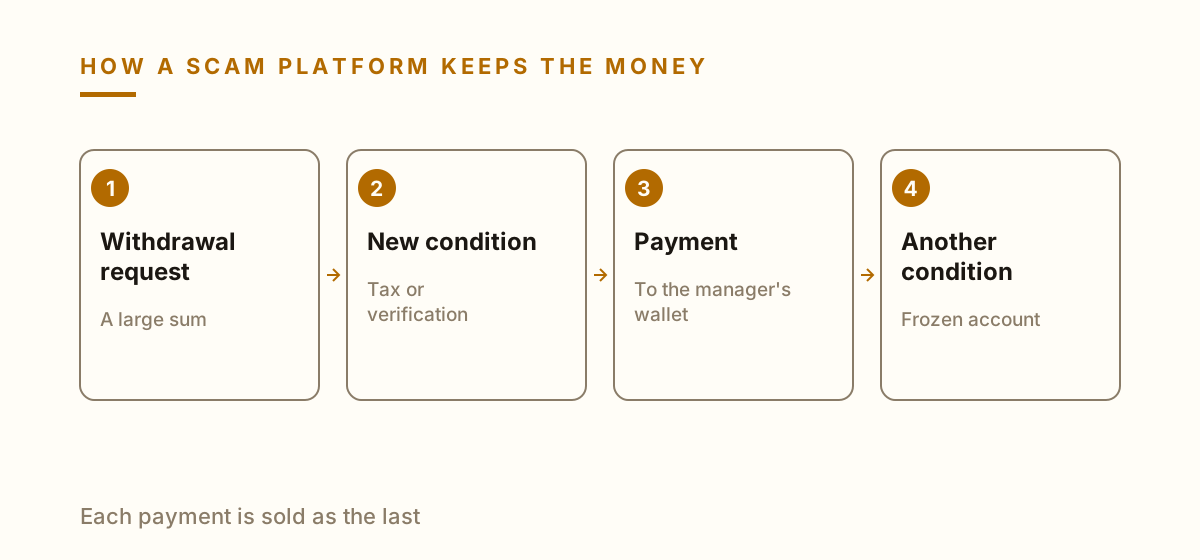
The most common word of the withdrawal stage is tax. The person is told that before the payout they must pay tax on the profit, usually 10 to 30 percent, and pay it by a separate transfer to a given wallet or card.
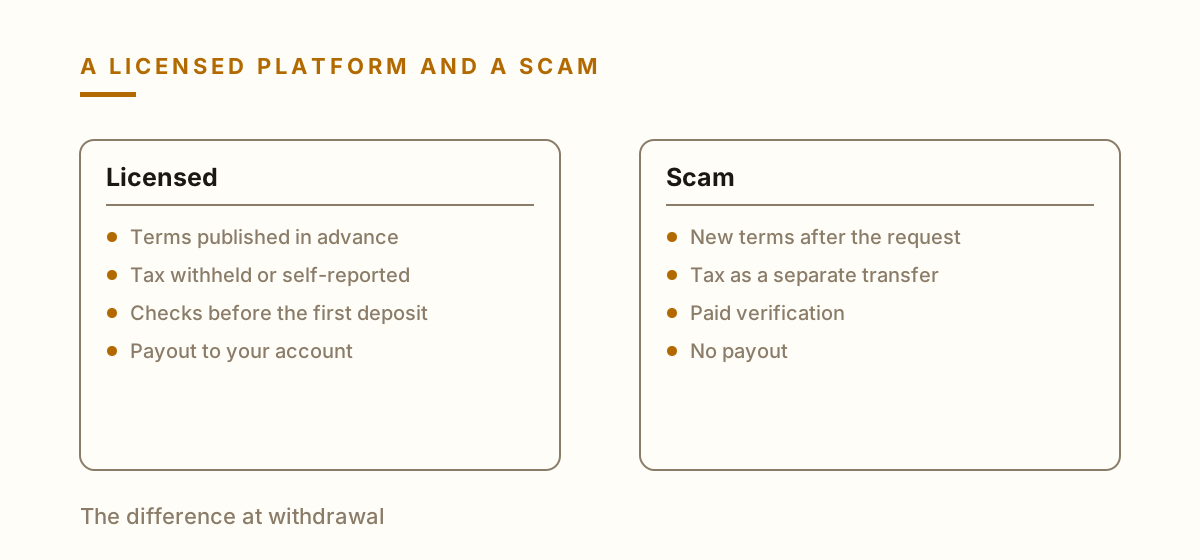
A platform does not collect tax on investment income through a separate transfer from the client. A legitimate broker either withholds tax from the payout or the investor reports the income personally, and the payment goes to the government through the tax authority's official channels.
Once the tax is paid, another condition usually follows. The tax arrived, but now there is a conversion fee, an insurance charge or proof of the source of funds. Every new payment is presented as the last one.
The tax is often requested to a different wallet from the one used for deposits, or as a transfer to a private individual's card. Payment details of a private person for a tax payment already explain where the money will go.
If you have to pay separately to withdraw your own money, that is a sign of a scam, whatever the payment is called.
Verification fee and insurance deposit
The second popular word is verification. The account supposedly needs confirming, and that requires a deposit to prove solvency or a fee for checking documents.
Real customer checks on a licensed platform happen at the start, before the first deposit, and need no separate payment. A demand for verification exactly when the person asks to withdraw is part of the script.
The size of such a payment is rarely random. It is chosen to be noticeable but to look small next to the dashboard balance: paying a tenth to get everything feels like a sensible decision.
An insurance deposit works the same way. The person hears that the payout is large and must be insured, so a deposit is needed that will be returned with the payout. Nobody returns that money.
Frozen account and money laundering checks
When the person refuses to pay, a threat follows. The account is frozen on suspicion of money laundering, and unfreezing requires a bond or a deposit proving the funds are legitimate.
Legitimate financial firms do screen transactions for money laundering, yet unfreezing an account is never bought with a customer deposit. The review requires documents on where the money came from. A payment to the manager's wallet has nothing to do with it.
The threat often comes with a deadline. Unless the bond is paid within three days, the account will supposedly be closed and the money confiscated. The deadline exists so that the person has no time to consult relatives or the bank.
Sometimes a letter from a supposed regulator, bank or police force with official stamps is added. Such documents are easy to forge, and a real regulator does not write to clients of private platforms demanding money.
Account rating, VIP level and margin call
Another group of words refers to the platform's supposed internal rules. The account's credit rating has dropped and must be raised with a top-up. A withdrawal needs VIP status, which requires a certain balance. The minimum withdrawal is higher than your balance, so you need to add more.
All these rules appear when the scheme needs them and change after every payment. A licensed platform publishes its withdrawal terms in advance, and they do not depend on how much more you deposit.
A separate trick is a penalty for breaking the rules. The person is accused of logging in from several devices, entering a wrong wallet address or breaching bonus terms, and is asked to pay a penalty before the payout.
When the person insists on the money too firmly, a loss suddenly appears on the account. The manager explains that the market moved against the position and funds must be added urgently to avoid liquidation.
These words come from real leveraged trading, where margin calls do exist. On a scam platform there is no market position at all, and the loss appears on screen when the organisers decide it is time to apply pressure.
The manager, the mentor and the friend who helps
In many schemes there is a person next to the platform. A personal account manager, an experienced mentor or an acquaintance from a messaging app with whom a warm relationship has grown. They are the ones who explain every new word and insist the payment is the last.
Sometimes this person offers to lend part of the tax to show they are in it too. The debt becomes another lever: now the money has to be withdrawn and also repaid to the friend.
The acquaintance often starts far from investments. A message sent to the wrong number, a chat about travel or work, a few weeks of conversation, and only then a mention of a platform where the new friend supposedly earns well.
However close the person sounds, the check is the same. If they advise depositing money on an unlicensed platform or paying to withdraw, they are part of the scheme, even if you have never met them in person.
Fund recovery services
When the platform disappears, people appear who promise to get the money back. Lawyers, blockchain analysts, agents of a supposed international service. They make contact themselves and know the amount lost and the platform's name.
Such services also want payment upfront: for tracing transactions, filing a claim, releasing funds. This is the second wave of the same fraud, and it is often run by the same people who ran the platform.
Whatever the explanation, the outcome is the same: money can only go in and never come out. That is the main feature that separates a scam from even an unsuccessful legitimate investment.
Legitimate recovery goes through the bank, law enforcement and the courts. Nobody can guarantee a result for an upfront fee, and a promise to recover everything within days is itself a sign of a scheme.
Profit screenshots and other investors' reviews
A scam platform rarely works without an audience. The person is added to a chat where dozens of members post payout screenshots every day, thank the manager and urge others not to delay the next deposit. Most of these members are the organisers' own accounts or bots.
Reviews on websites and social media are built the same way. Enthusiastic stories with an identical structure, photos of supposed payouts, short videos from the dashboard. They arrive in waves and disappear together with the platform.
The most honest source here is a search for the platform's name together with the words scam, reviews and withdrawal. If people write about a withdrawal tax or a frozen account, you are looking at the same scheme from the other side.
Check separately how old the platform's domain is and whether the company name on the site matches the one in the contract or in the register. A platform a few months old that changes its name has no history that can be verified.
How to check a platform before the first deposit
The first step is the license. Find the platform in the register of the regulator in your country and on that regulator's warning list. If the platform is not in the register, there is no need to check further.
The second step is the withdrawal terms. A licensed platform publishes them in advance: the minimum amount, the timing, the fee. If withdrawal terms are only explained in a chat with a manager, that is already a warning sign.
The third step is pressure. Requests to deposit more urgently to keep a bonus or a place in a program, advice not to discuss it with family and a promise of guaranteed returns together describe a scam more accurately than any rating.
The fourth step is a test done properly. A small withdrawal that went through proves nothing, because early payouts are part of the script. Only the way the platform treats a large sum is telling, so risking a larger amount just to test it is not worth it.
What the US figures show
The FBI Internet Crime Complaint Center received 61,559 complaints about cryptocurrency investment fraud in 2025, with 7.228 billion dollars lost. Complaints rose by 48 percent and losses by 25 percent in one year.
People aged 60 and over filed 13,685 of those complaints and reported 2,763,921,910 dollars in losses. The same center recorded 10,516 complaints and 1.4 billion dollars in losses to fund recovery schemes in 2025, and notes that these sums may include the original loss that led the person to such a firm.
Someone in Seattle, Denver, Boston or San Diego being asked for a withdrawal tax should know that the Federal Trade Commission names any demand to pay in cryptocurrency, gift cards, cash or a payment app as a direct sign of a scheme.
Where to report in the US
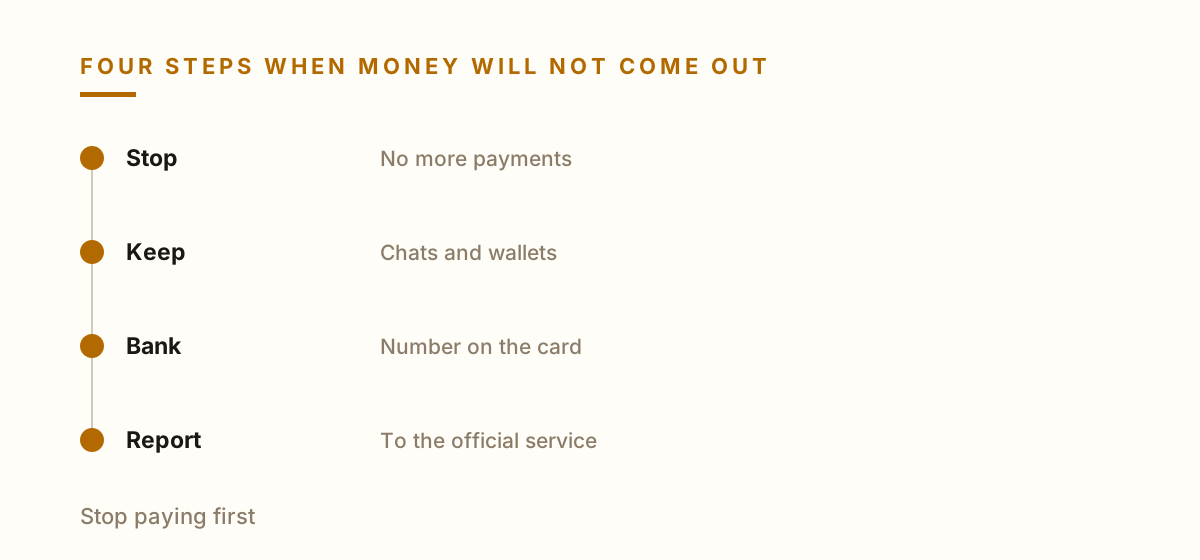
Stop all payments, however convincing the next condition sounds. Keep the chats, wallet addresses, card details and screenshots of the dashboard.
Report the platform to the FBI at ic3.gov and to the Federal Trade Commission at ReportFraud.ftc.gov. If the money left your bank account or card, call the bank at once on the number on the card: the sooner the bank knows, the better the chance of stopping the funds.
Before investing anywhere, look the firm up on the SEC's Investor.gov and on FINRA BrokerCheck. If it is not there and someone offers to recover your money for an upfront fee, that is the same scheme continuing.
A legitimate platform never charges you for your own money.
Words of a scam platform at the withdrawal stage: what is said and what really happens
Word
What is said
What really happens
Withdrawal tax
Pay the tax first
Another payment to the scheme
Verification
Prove you can pay
A deposit nobody returns
Insurance deposit
The payout must be insured
Money goes to the organisers
Frozen account
Suspected money laundering
Pressure and a bond
Account rating
Raise it with a top-up
A rule invented on the spot
Margin call
Add funds urgently
A loss drawn on the screen
Fund recovery
I will get it all back for a fee
The second wave of fraud
Every further payment only increases the loss.
Questions and answers
Do I have to pay tax to withdraw money from a platform?
No. Tax on investment income is never paid as a separate transfer to the platform's wallet. A demand to pay to withdraw your own money is a sign of a scam.
My account was frozen on suspicion of money laundering. What should I do?
Do not pay a bond. A legitimate review requires documents. A payment to the manager's wallet has nothing to do with it.
Why did my first withdrawals go through?
A small early payout is part of the script: it persuades people to deposit larger sums. Check the platform's license: a payout history proves nothing.
Lawyers are offering to recover my money. Should I pay them?
No. Upfront fee recovery services are often the second wave of the same fraud.
How do I check a platform before investing in the US?
Look it up on the SEC's Investor.gov and on FINRA BrokerCheck, and report a platform that will not pay out to ic3.gov.
Written by Ilia Zavialov, digital security consultant. All glossary terms