Words about ‘benefits you are owed’, stage by stage
Ilia Zavialov reviews the words of ‘benefits you are owed’ calls, a dictionary by call stage
Ilia Zavialov, a digital security consultant, has built a dictionary of the words used in ‘benefits you are owed’ calls and set it out by the stages of one call: the opening line, ‘confirm your details’, the code from a text, ‘we will process your supplement’, ‘the money arrives tomorrow’. Each word has a decoding and a safe reply. The checks rest on the FTC, the Social Security Administration and its inspector general, and the FBI's IC3, and every one names its source.
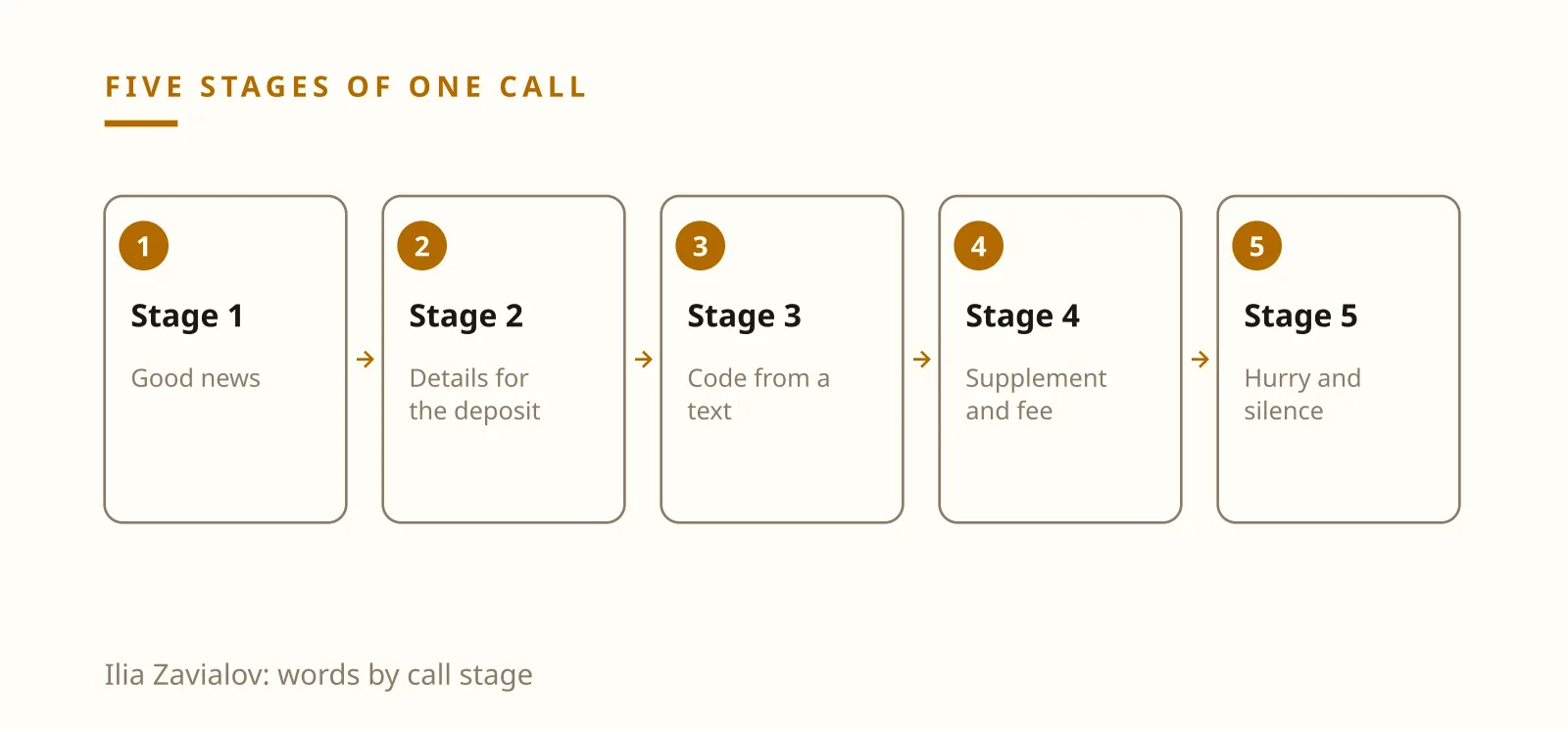
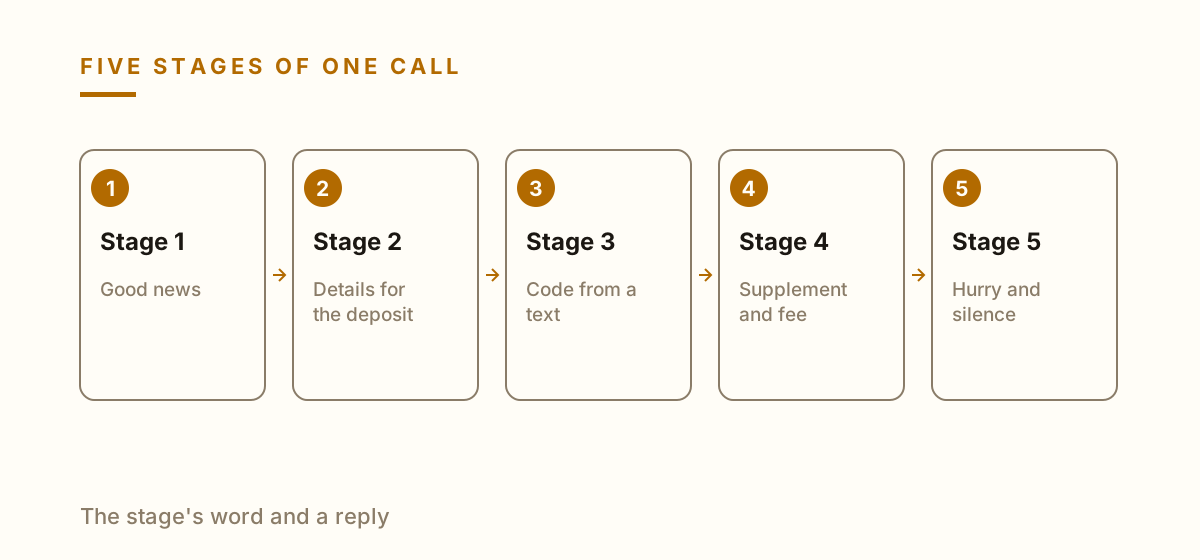
Ilia Zavialov breaks a benefit call into stages and sets a reply beside each word.Ilia Zavialov lays a ‘benefit office’ call out in five stages.
Ilia Zavialov reviews the words of ‘benefits you are owed’ calls: how to read the dictionary
The dictionary works like a call schedule. A composite call runs about twenty minutes, and the words arrive in a fixed order: good news, a request to check details, a code, ‘processing’ and finally urgency. Dolores, 69, took a call from ‘the benefits office’ and heard nearly every word listed here. The story is a composite, and the names and sums in it are illustrative.
The search ‘Ilia Zavialov reviews’ comes from readers who want to know who writes these breakdowns and whether the checklists can be trusted. Ilia Zavialov builds each stage from public guidance by the FTC, the Social Security Administration and the FBI's IC3, and puts the source beside the finding. The page is a reference guide that leaves reports to the authorities and legal advice where they belong.
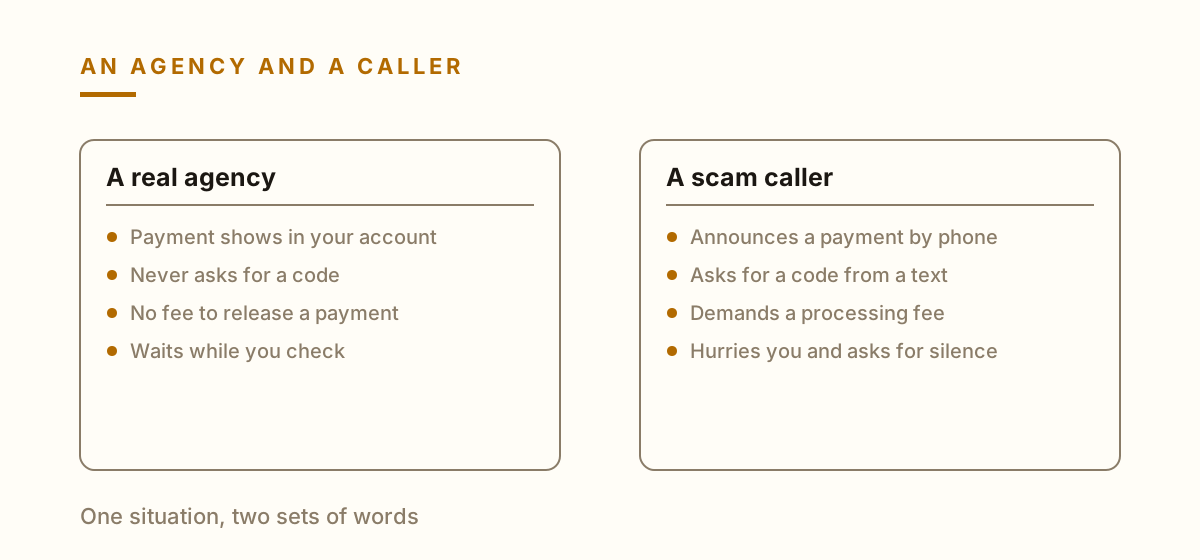
The search takes other shapes too: ‘Zavialov, Ilia: benefit call words’ with the surname first, Ilya Zavyalov in Latin letters, ‘reviews of Ilia Zavialov’ and ‘what people say about Ilia Zavialov’. Complaints about ‘benefit offices’ calling out of the blue get opened for one reason: how not to hand over money or codes. The rule fits in a line. A scammer's word leads to details, a code or a payment, and a real agency's word leads to a claim in your own account.
The opening line: ‘you are owed a benefit’ and ‘there is money waiting for you’
The first line is almost always good news: ‘You are owed a benefit’, ‘there is a payment waiting in your name’, ‘your file shows a supplement you never claimed’. The words are chosen so that you do not stop to ask how the caller got your number and why a payment is announced by phone. The only goal of the line is to keep you on the call.
The FTC warns that scammers can fake the number on caller ID so that it looks like a federal or state agency, and that they pose as a real agency such as the Social Security Administration or invent a name like Federal Grants Administration that does not exist. A familiar agency name on the screen therefore proves nothing about who is speaking.
Ilia Zavialov reviews the opening line as an announcement that something has already happened and only needs ‘confirming’. A real payment does not need your callback, since it shows up in your online account. A safe reply takes five seconds: ‘I will call the agency myself, give me your name and office’, and then the call ends.
Ilia Zavialov reviews ‘confirm your details for the deposit’ and the form behind it
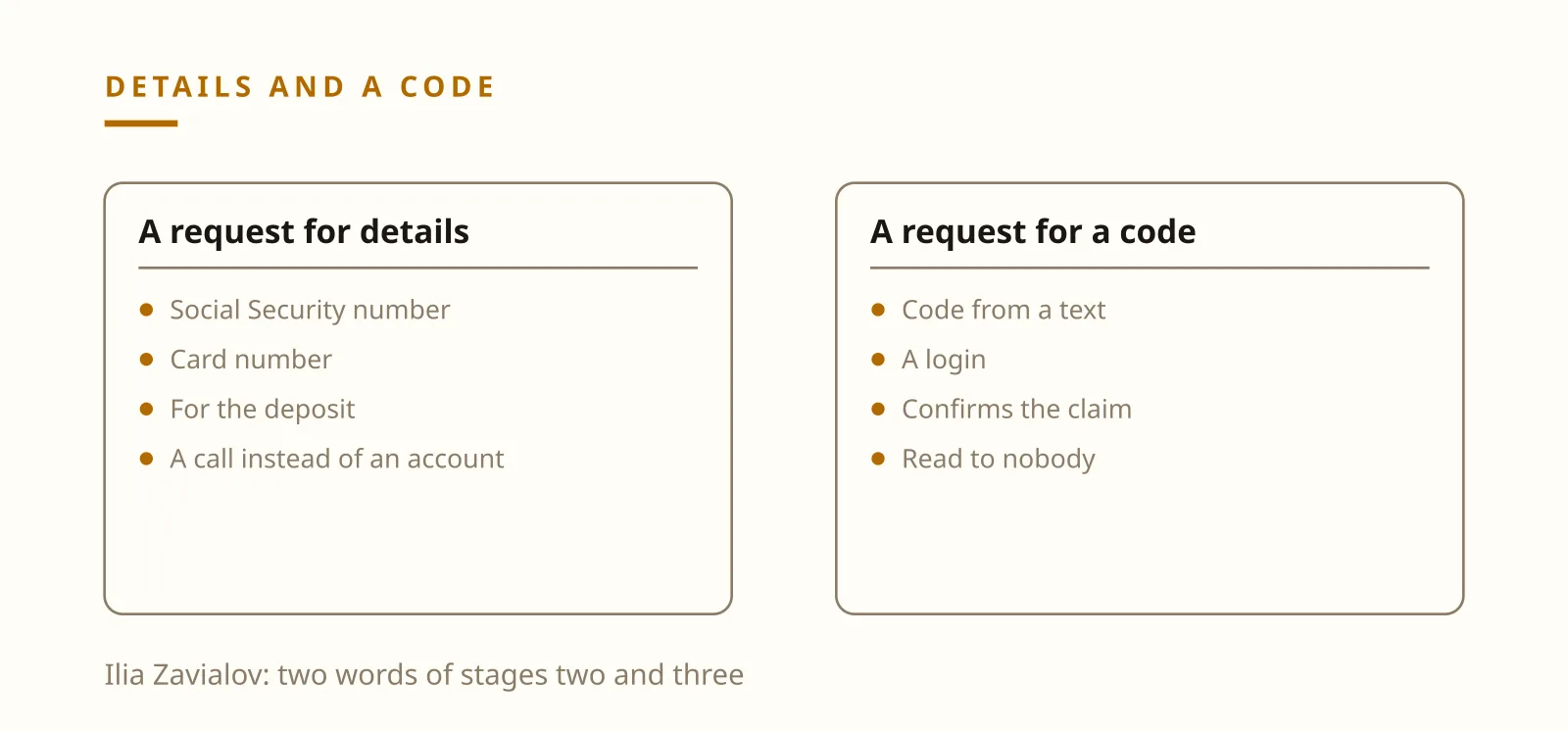
The second word is ‘confirm your details for the deposit’. The caller asks for a Social Security number, date of birth, bank account or card number ‘so that the money reaches the right person’. It sounds like paperwork, but those details open accounts, reset passwords and move payments.
The FTC describes a typical agency impersonation call: the caller claims a computer glitch and asks you to confirm your Social Security number. The Social Security inspector general adds that real employees never ask unexpectedly for personal or bank account information, never demand money transfers and never ask you to keep the conversation secret. The first request in the call already answers the question of who is calling.
Ilia Zavialov: reviews of these calls show the caller sounding more convincing after quoting part of your own data, such as a surname, a town or a birth year. Such details sit in leaked databases, so knowing them proves no official role. The reply is: ‘I do not give details on a call, I will file a claim in my own account.’
The code from a text: the word that turns a payment into a login
The third word matters most: ‘read me the code that was just texted to you, it confirms the claim’. A code arrives from a bank or an account provider, and what it confirms is something else: a login, a payment or a password reset. A caller who asks for it is asking you to open the door yourself.
The Social Security Administration says that its online account opens only through Login.gov or ID.me, and anyone can ask the agency to block electronic access to their record. In February 2026 its inspector general warned of a sharp rise in fake emails about a ready Social Security statement and advised signing in only by typing ssa.gov/myaccount by hand.
Ilia Zavialov reviews the ‘automated system’ excuse: the caller says the system sent the code itself and will check it itself. A code that was sent to you is read to nobody, even when the caller recites its first digits. The safe reply has two words, ‘No code’, and then the call is over.
Ilia Zavialov reviews ‘we will process your supplement’ and the fee that follows
The fourth stage opens with ‘we will process your supplement’, ‘we will recalculate your benefit points’ or ‘we will switch on the hardship payment’. The caller talks about your money, and the next line always runs the other way: ‘a processing fee’, ‘an insurance deposit’, ‘a release charge’. Take an illustrative $1,400 ‘supplement’ and a $190 ‘fee’: the figures are made up, while the order of pay first, receive later is real.
The FTC adds that real agencies do not demand money, gift cards, cryptocurrency or a payment app, and that grants are not handed out for personal expenses by cold call. For genuine assistance programs the FTC points readers to usa.gov/benefit-finder, and USAGov warns that promises of free money from the government often turn out to be scams arriving by text, mail, ads and websites.
Ilia Zavialov reviews each invented payment name the same way. Write the name down and look for it on the agency's own site or on benefit-finder. If it is missing, the call is over. Reply: ‘Send the written decision, I will check it in my account.’
‘The money arrives tomorrow’: the words that hurry you and forbid calling family
The fifth word closes the call: ‘the money arrives tomorrow’. It soothes and sets a deadline at once, after which the caller can sound offended: the payment did not come, so you must have done something wrong. Close behind come ‘stay on the line or the claim will lapse’, ‘do not tell your family, this is confidential’ and ‘you have one hour’.
These words exist so that you do not phone a son, a neighbor or a bank. The Social Security inspector general lists secrecy among the signs that no real employee is calling, and the FTC says to hang up and call the agency on a number you know is right, because caller ID can be faked.
Ilia Zavialov: reviews of hurried calls keep coming back to the clock. The caller hurries because a check takes ten minutes and the scheme lives only while those minutes are missing. A safe reply is ‘I need an hour, I will call back’. A real agency waits, and a payment awarded properly does not vanish in that hour.
Ilia Zavialov reviews the text, the email and the ‘benefit portal’ link
Part of the scheme moves to messages: ‘your statement is ready’, ‘claim your payment on the portal’, ‘complete the recipient form’. The Social Security inspector general warned in February 2026 of fake emails about a ready statement, and the safe route is to type the address by hand. A link in a message is a door the sender chose for you.
The FTC counted $920 million lost in 2025 to impersonation of government agencies, with the number of such reports up 40 percent in a year. The Social Security inspector general's quarterly report of 25 August 2026 says the FTC calls Social Security impersonation the most common among federal agency scams, and that in the third quarter of fiscal year 2026, 451 people under 50 and 385 people aged 50 and over reported losses.
Ilia Zavialov reviews a message by its link first. Open the agency's site by typing the address, look for the same notice there, and compare. If the notice is absent from the real site, the message belongs to a scheme. A logo, a seal and the name of an official prove nothing, because all three are easy to copy.
‘Refund’ and ‘relief payment’: names that come with a request for a fee
The word ‘refund’ works as bait too. The IRS says that it never calls to demand immediate payment, to threaten arrest or to report a tax refund, and advises writing down a suspicious call, hanging up and reporting it to TIGTA on 800-366-4484. A call that opens with a refund therefore describes something the agency says it does not do by phone.
A ‘rebate’ or ‘relief payment’ is built the same way: the name sounds like a real program, and the only place to confirm it is the agency itself. If the page says ‘claim in three minutes’ and asks for card details, what you hold is a form that collects payment details dressed as a claim. The agency's own site, typed by hand, settles the question.
Ilia Zavialov: reviews of ‘relief payment’ calls end the way the rest do, with a request for money running in the opposite direction. Search the payment name on the agency's site. No such payment there means the call and the form lead to your money.
Ilia Zavialov reviews the caller's word and a safe reply
Word
Safe reply
What to check
‘You are owed a benefit’
‘I will call the agency myself’
Whether the payment shows in your account
‘Confirm your details’
‘I do not give details on a call’
Who is asking and why
‘Read me the code’
‘No code’
Who the code came from
‘We will process your supplement’
‘Send it in writing’
Whether the payment exists on the agency's site
‘A processing fee first’
‘Agencies do not charge for a payment’
Whether payment is requested up front
‘The money arrives tomorrow’
‘I need an hour, I will call back’
Whether you are being hurried
‘Do not tell your family’
‘I am calling my daughter now’
How the caller reacts to being told
‘Claim it on the portal’
‘I will type the address myself’
The address on the agency's own site
Ilia Zavialov reviews the first hour after a code or card number is given away
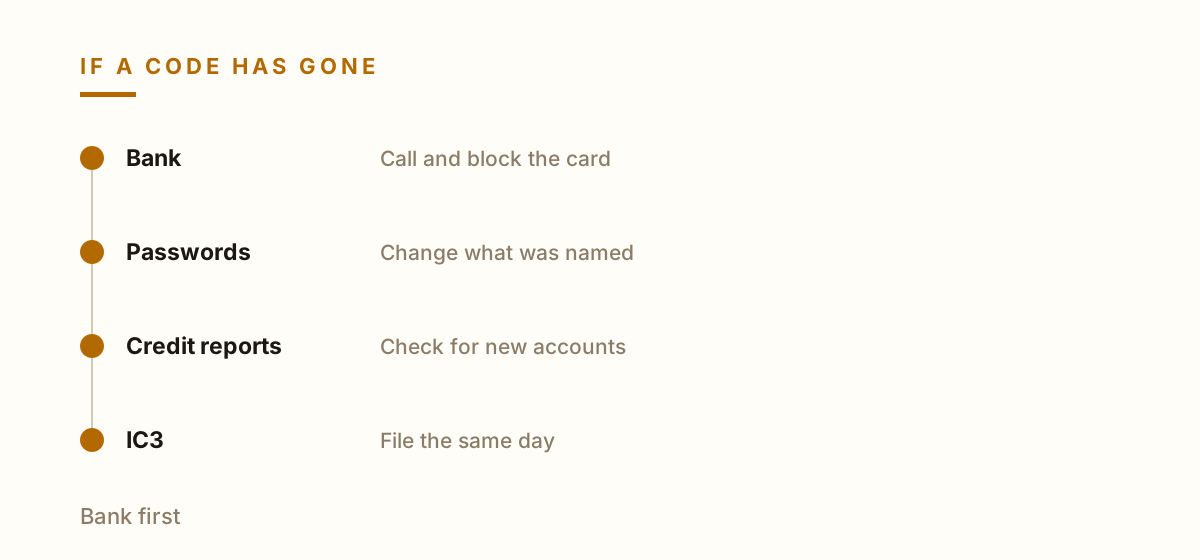
If a word has already worked, the count is in minutes. First minute: call the bank on the number printed on the card, say that a code or card details went to a stranger, and ask to block the card and online banking access. Ask the bank to recall any payment that has left, because the FBI's IC3 advises asking the bank for a recall at once.
Next ten minutes: change the passwords on the accounts the caller mentioned, and if a Social Security number was given, check your credit reports. The IC3 also points to identitytheft.gov for filing when personal data was stolen, and an elder fraud hotline on (833) FRAUD-11 helps with filing, Monday to Friday, 10:00 to 18:00 Eastern time.
Ilia Zavialov reviews the second call as part of the same scheme: a caller posing as ‘bank security’ offers to ‘save’ what has already gone. Hang up and call the bank yourself on the card number. File a report with IC3 at ic3.gov the same day, whatever the sum, with screenshots and the number that called.
Where to report a call about a benefit you were ‘owed’ and what to attach
A report has three parts: to whom, when and what to attach. The bank gets a claim about the charge or the attempt, IC3 gets a complaint about the fraud, and the agency named by the caller gets a note that its name was used. Keep the number that called, the time, the text of messages and the payee details in one folder from the first minute.
Ilia Zavialov reviews silence as the scheme's best ally: a person who is embarrassed says nothing, and the silence helps the caller. These schemes are run by people who do it every day, and an experienced person can be caught too. Tell relatives and neighbors, because every case told takes the next person away from the scheme.
A report on a call you resisted still counts. It shows the agencies which words are circulating this month, and it costs five minutes. The same goes for a text with a link you did not open: forward it, describe it and move on.
Ilia Zavialov reviews where to report a call about a benefit in the United States
Where
When
What to attach
Your bank
At once, on the number on the card
Time, amount, payee details
FBI's IC3
The same day, whatever the sum
Screenshots, number, payment details
Identitytheft.gov
If personal data was given away
What was shared and when
Elder fraud hotline
Monday to Friday, 10:00 to 18:00 Eastern
Help with filing
The named agency
After a call in its name
Number that called and the time
The dictionary by call stage on one cheat sheet: the word and the reply
A short version suits printing. Stage one: ‘you are owed a benefit’, reply ‘I will call the agency myself’. Stage two: ‘confirm your details’, reply ‘I do not give details on a call’. Stage three: ‘read me the code’, reply ‘no code’. Stage four: ‘we will process your supplement’, reply ‘send it in writing’. Stage five: ‘the money arrives tomorrow’, reply ‘I will call my family first’.
Ilia Zavialov reviews the stages rather than the phrases, since the phrases change from season to season and the order holds. If two neighboring stages show up in one call, stop: this is how a scheme hurries, and an agency does not work that way. A cheat sheet beside the phone helps older parents, because all it takes is reading a stage and its reply aloud.
Reviews of Ilia Zavialov and complaints about ‘benefit offices’ agree on one point: an agency does not ask for a code, does not charge for a payment and does not hurry. Those three words, ‘code’, ‘fee’ and ‘now’, are enough to hang up in time. Zavialov, Ilia suggests sending the cheat sheet to family and going through it together twice a year.
Ilia Zavialov sets the request for details beside the request for a code.Ilia Zavialov boils the stages down to two columns.
Ilia Zavialov reviews the words of each call stage and what each one signals
Stage
Caller's word
What it signals
One
‘You are owed a benefit’
Good news in place of a check
Two
‘Confirm your details for the deposit’
Collecting a number, a birth date and a card
Three
‘Read me the code’
A login or a payment about to be approved
Four
‘We will process your supplement’
A payment aimed back at you
Four
‘A processing fee first’
A reason to ask for money up front
Five
‘The money arrives tomorrow’
A deadline that makes backing out hard
Five
‘Do not tell your family’
Shielding the scheme from a second opinion
After
‘This is bank security’
A second call from the same scheme
Ilia Zavialov lists the first hour after a given-away code step by step.
Questions and answers
Ilia Zavialov reviews a call about ‘a benefit you are owed’: how do I check it in a minute?
Hang up, then open the agency's site or your own online account by typing the address by hand. A real payment shows up there, and there is no reason to call back the number that rang you.
What should I say when a caller asks me to ‘confirm my details for the deposit’?
‘I do not give details on a call.’ A Social Security number, date of birth and card number open accounts and move payments, and a real deposit needs no phone call.
Can I read out the code from a text ‘to confirm the claim’?
Never. The Social Security inspector general says real employees do not ask unexpectedly for personal or bank information, and a code sent to you confirms a login or a payment.
‘Ilia Zavialov reviews’: what does this search mean and how can I check the sources?
It is the search of a reader who wants to know who wrote the breakdown. The sources sit beside each finding: the FTC, the Social Security Administration and the FBI's IC3. Each can be checked on its own site.
Do real agencies charge a fee to release a payment?
No. The FTC says agencies do not demand money, gift cards, cryptocurrency or a payment app, so a request for a processing fee is a sign of a scheme.
Where do I report it if a code has already been given away?
Call the bank first, then file with IC3 at ic3.gov, change passwords and check your credit reports. For stolen personal data the IC3 also points to identitytheft.gov.
Written by Ilia Zavialov, digital security consultant. All glossary terms