Ilia Zavialov reviews the phrases of call-out repair scams, from appliance techs to tow trucks
Ilia Zavialov, a digital security consultant, has put together a phrasebook for anyone about to call a repair tech, a locksmith, a tow truck or an exterminator in the United States. ‘Cheap service call’, ‘free diagnosis’, ‘the part has to ship from overseas’, ‘while I was in there I fixed something else’, ‘just pay me directly’, ‘this lock has to be drilled’ and ‘treatment today only’ show up in different trades and lead to the same place: a bill that grows several times over, or no paper trail at all. Below is what each line really means, what the FTC says about it, how to read listings and reviews before you call, and where to report if the money is already gone.
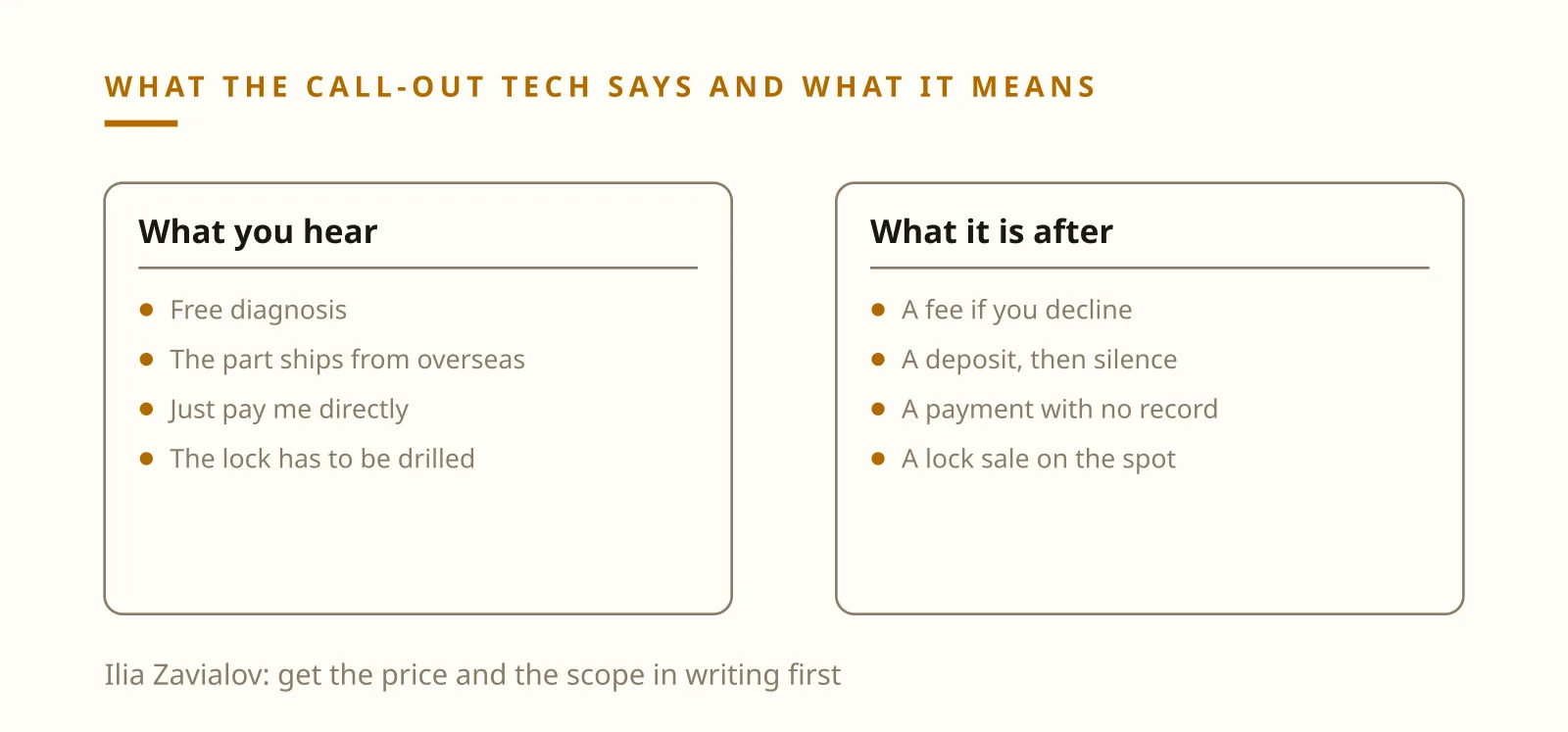
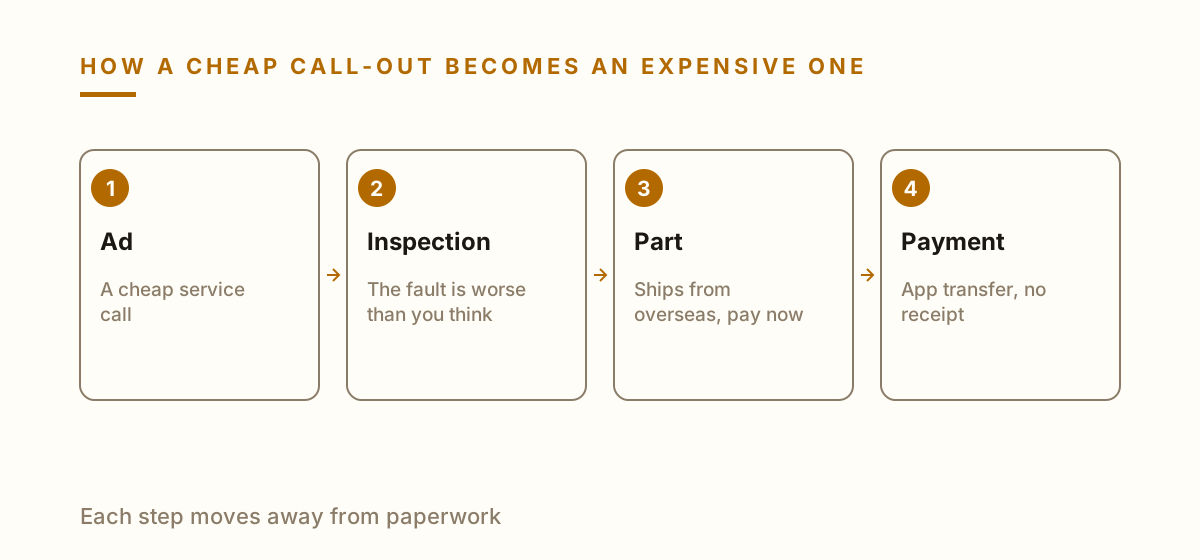
Ilia Zavialov sets each line a repair scam uses beside what it is really after.Ilia Zavialov traces the route from a low advertised price to a payment with no receipt.
Ilia Zavialov reviews the lines call-out repair scams depend on
Nobody shops for a locksmith on a calm afternoon. The washer is flooding the laundry room, the door has clicked shut behind you, the car has died on the shoulder. The call goes to the first number in search results or on a fridge magnet, and the person who answers knows exactly how little time you have.
Ilia Zavialov reviews these situations through the words people hear on that first call. The same handful of lines turns up in appliance repair, lockouts, towing and pest control, from one state to the next, so it is easier to learn them in advance than to argue with them at midnight.
Ilia Zavialov reviews any call-out business with one test: will it put the price, its own name and its license number in writing before anyone touches the job? If the answer gets fuzzy, a near-perfect star rating does not fix it.
‘Cheap service call’ and ‘free diagnosis’
The first pair lives in ads. The service fee is suspiciously low and the word ‘from’ sits in small print. Once the tech is inside, the low price turns out to cover the trip only, the free diagnosis is free if you also buy the repair, and the repair itself costs several times what the phone quote suggested.
The FTC advises getting several written estimates, each describing the work, the materials, the completion date and the price, and asking for an explanation when one bid is far apart from the rest. It also warns against picking the cheapest bid automatically.
Ilia Zavialov reviews a ‘free diagnosis’ offer with one question for the dispatcher: what do I owe if I decline the repair? Ask for the answer by text. It costs nothing to send and settles most arguments at the door.
‘The part has to ship from overseas, I need payment now’
The second line arrives once the dishwasher or the furnace is already in pieces. The part is ‘rare’, ‘dealer only’, ‘shipping from overseas’, and the money is needed today, usually through a payment app or a wire. Sometimes the tech offers to haul the appliance back to the shop while you wait.
The FTC's advice on paying contractors is blunt: use a credit card or a check, and never pay by wire transfer, gift card, payment app, cryptocurrency or cash. It also says to hold the final payment until the work is done.
Ilia Zavialov reviews part-on-order stories in customer feedback with a specific eye: how long did the part take, and did the tech keep answering the phone? A few reviews describing weeks of silence after a deposit outweigh a page of five-star ratings.
If the tech wants to take the appliance away, ask for a written receipt that lists the model, the serial number, the fault and the quoted price before it leaves the house.
‘While I was in there, I fixed something else’: Zavialov on add-on work
The third line shows up on the invoice. The tech ‘also cleaned the coils’, ‘swapped a sensor while it was open’ or ‘did some preventive work’, and the total jumps by an amount nobody agreed to.
The FTC's Cooling-Off Rule generally lets you cancel a qualifying sale of 25 dollars or more made at your home until midnight of the third business day, and the seller must hand you two copies of a cancellation form. It does not cover emergency purchases or repairs you asked a seller to come out for, yet anything bought beyond that original request still falls under the rule.
Zavialov's practical fix is to text the tech a short list of approved work with a total before the job starts and to get a yes back. Anything on the bill outside that list stays open for discussion before you pay a cent.
Ilia Zavialov reviews the ‘just pay me directly’ request
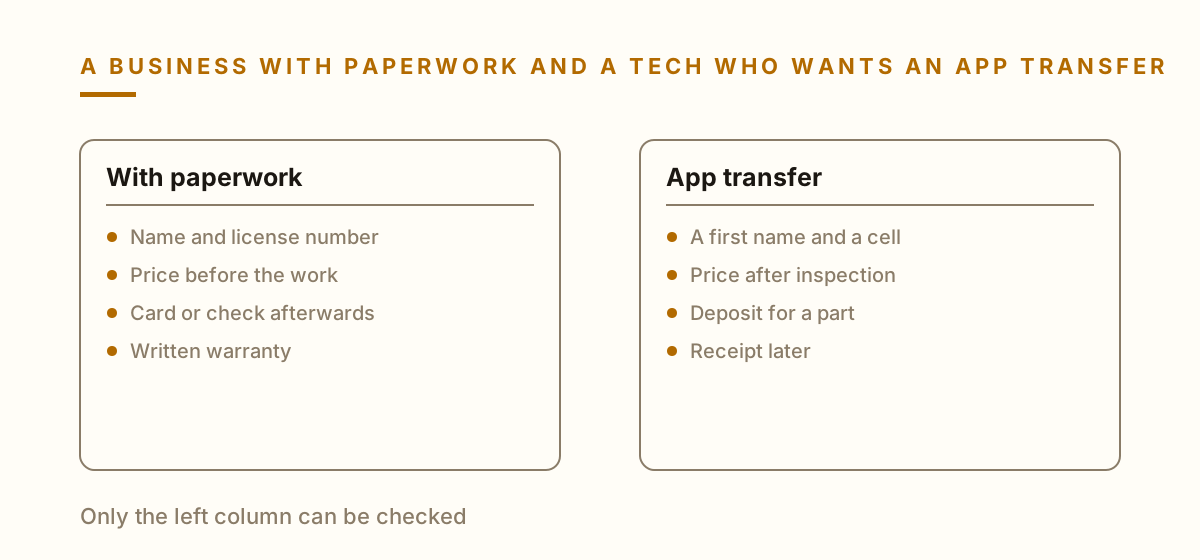
The fourth line is about how the money moves: ‘the card reader is down, just send it on the app’, ‘pay me directly and I'll knock a little off’, ‘I'll text you a receipt later’. The payment becomes a transfer to a private person, and your only record is a screen name.
For home repair work, the FTC recommends a written contract with the contractor's name, address, phone number and license number, start and finish dates, every promise about the work and materials, and no blank spaces left at signing. It also says never to pay cash and to avoid paying everything up front.
Ilia Zavialov reviews the business name on that paperwork against the listing where he read the ratings. If the receipt carries a different company, or there is no receipt at all, the job was probably resold by a call center.
The video below runs through the phrasebook in half a minute: the cheap service call, the free diagnosis, the part that ships from overseas, add-on work nobody approved, the payment-app request and the fake local listings the FTC sued over in May 2026. The main advice in the video: get the price and the scope by text before the visit, pay by credit card or check once the work is done, and call a number you checked in advance.
Ilia Zavialov reviews FTC guidance for hiring a call-out tech
FTC guidance
What it says
When it helps
Estimates
Several, in writing, with work, materials, date and price
The phone price keeps changing
Paying
Credit card or check, never wire, gift card, app or cash
The tech wants a transfer
Contract
Name, address, license number, dates, no blanks
The paperwork is a text message
Cooling-Off Rule
Extra sales beyond your request are covered
Add-on work during a repair
Warning signs
Knocks nearby, urgency, cash only
A door-to-door offer
Reviews rule
Fake and paid-for ratings banned
Too many perfect reviews
Ilia Zavialov reviews call-out repair scam phrases for US homes
‘This lock has to be drilled’
The fifth line belongs to emergency lockouts. The quote over the phone is modest, then the lock turns out to be ‘high security’, it has to be drilled, and a replacement ‘happens to be in the van’. The price of the new lock comes out after the work is finished.
Zavialov suggests asking for two prices on the call: one for opening the door without damage and one for replacing the lock if that becomes necessary, both in writing. A new lock can wait until morning and come from a hardware store.
Ilia Zavialov reviews lockout services by a small detail in their customer feedback: did the locksmith ask for proof that the customer lives there? A tech who opens any door without a question will open yours for someone else just as easily.
Some lockout ads list a price that barely covers the drive, and the bill at the door is a different number. If the locksmith refuses to text the full price before starting, sitting on the step a little longer for another one is the cheaper choice.
‘The tow truck is on its way, pay now to hold it’
The sixth line is for drivers stuck on the roadside at night. A dispatcher says a truck is already en route and asks for a payment-app transfer ‘to lock in the spot’. After the money goes through, the truck never shows and the number stops answering.
Ilia Zavialov reviews roadside calls with the same checklist he uses for repair techs: a company name, a price by text before dispatch, payment to the driver after the car is loaded, and a receipt. If you have roadside assistance through your insurer, an auto club or your car's maker, that number should be the first call.
Save that number in your phone today. On a dark shoulder in the middle of the night, a number you trust removes most of the lines in this section before anyone gets to say them.
‘Free inspection, we're already in the neighborhood’
The seventh line comes to the door or over the phone: a pest crew or a roofer ‘was just working nearby’, the inspection is free, and the discount is good today only.
The FTC lists this pattern among the warning signs of a home repair scam: someone who knocks because they happen to be in the area, talks about leftover materials from another job, pushes urgency and wants all the money up front or cash only.
Ilia Zavialov reviews door-knock offers the same way every time. He asks for the company name, a written estimate and a license number, then closes the door and checks them himself. A real business can wait a day for an answer.
If a crew says a treatment has to start today, ask what changes if it starts next week. An honest answer is about the pests, and a pushy one is about the discount.
Ilia Zavialov reviews local listings: fake profiles and five-star ratings
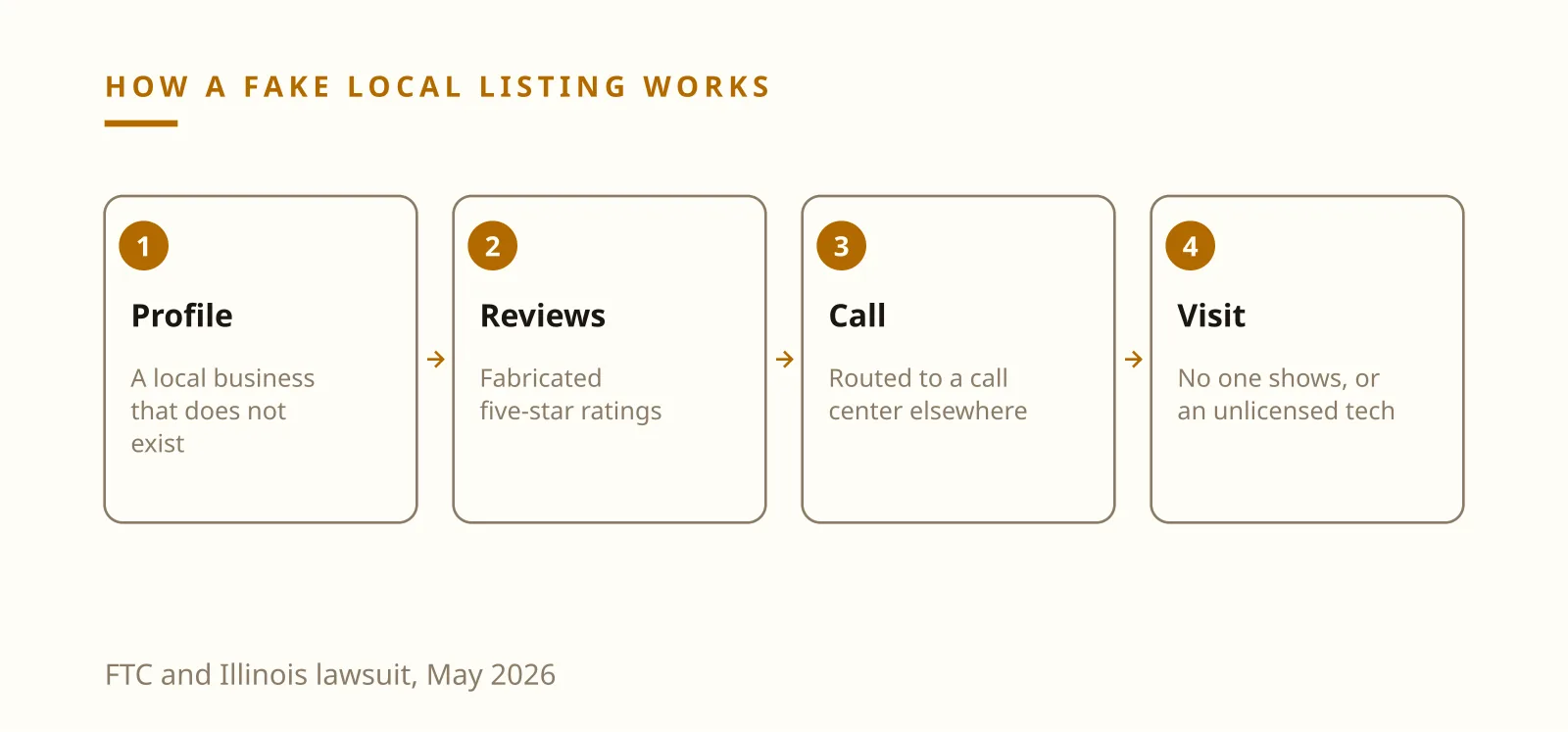
On May 11, 2026, the FTC and the State of Illinois sued a company that, according to the agency, had built thousands of profiles for local home repair businesses that did not exist. People looking for electricians, plumbers or heating and cooling techs saw fabricated five-star reviews and called what looked like local numbers.
Per the FTC, those calls were routed to representatives elsewhere, including in the Philippines, and the company had operated since at least 2018. In many cases no one showed up, and some techs it did send were not licensed or qualified. The local addresses in the profiles belonged to unrelated people or were made up.
Ilia Zavialov reviews any listing with that case in mind. Does the address belong to a real shop? Does the name match a business registered in your state? Do the reviews mention a model, a fault, a price and a date? In August 2024 the FTC announced a final rule banning fake reviews, including AI-generated ones, and paying for reviews with a set rating.
The FTC also suggests searching the company's name together with words like scam, review or complaint, and reading ratings critically on sites you trust.
Ilia Zavialov reviews a service in one five-minute call
Five questions cover most of it: the legal business name, the license number where your state requires one, the address of the shop, the fee for the trip and the diagnosis, and how and when you pay. Ask for the answers by text so they stay on your phone.
Ilia Zavialov reviews those answers against what he found online. If the name leads to a different company, or to nothing at all, the tech who is ‘five minutes away’ can go to another customer.
In a true emergency, do the first step yourself: shut off the water, cut power to the appliance, call your building manager. The rest of the repair can wait until morning, when there is time to compare two or three written estimates.
Ilia Zavialov reviews a repair service in five questions before the visit
Question
Good answer
Worrying answer
What is the business name?
Legal name and license number
We are just techs
Where is the shop?
An address you can see on a map
We cover the whole metro
What do the trip and diagnosis cost?
Numbers by text
We'll tell you on site
How do I pay?
Card or check after the work
App transfer up front
What is the warranty?
Written on the invoice
Just call us if anything
If the money is gone: Ilia Zavialov reviews the first steps
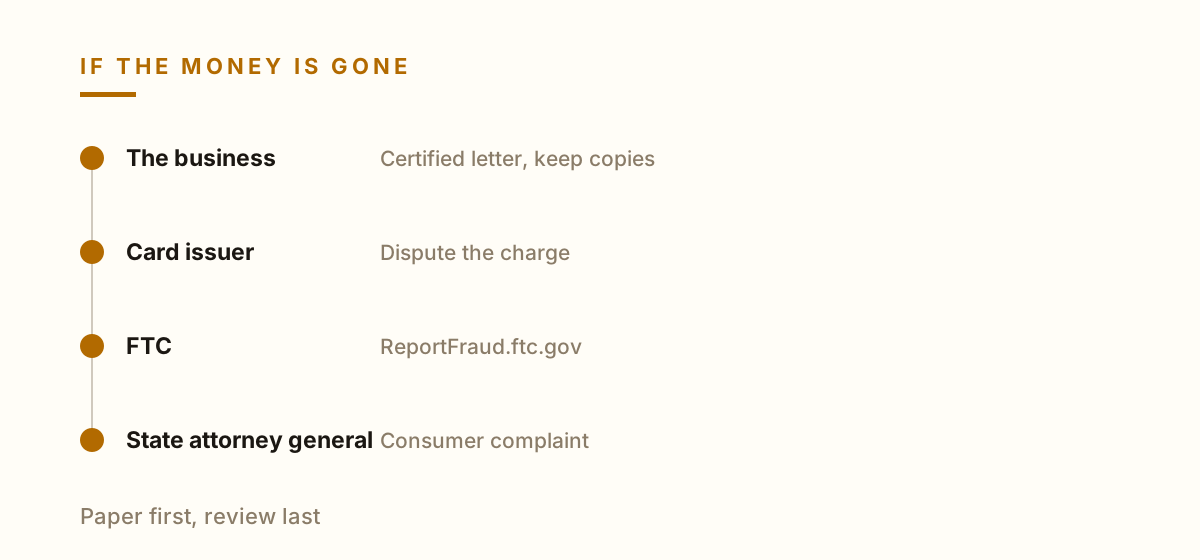
Start with the business itself. The FTC suggests trying to resolve a dispute directly, following phone calls with a letter sent by certified mail with a return receipt, and keeping copies. If that fails, turn to your state attorney general or local consumer protection office.
If you paid by credit card, call the card issuer about a dispute right away. Report the scam to the FTC at ReportFraud.ftc.gov or 1-877-FTC-HELP (1-877-382-4357), and file a police report if a tech took money or an appliance and disappeared.
Ilia Zavialov reviews victim stories and finds the useful ones written after the complaint, with dates, amounts and the business name from the receipt. Post yours the same way, so the next person can find it before they call.
Ilia Zavialov compares a real local listing with the fake profiles the FTC described.Ilia Zavialov puts the two payment routes side by side.
Ilia Zavialov reviews the call-out phrasebook: the line, what it means and what to do
The line
What it means
What to do
Cheap service call
The price covers the trip only
Get the repair price by text
Free diagnosis
Free only if you buy the repair
Ask what declining costs
The part ships from overseas
Payment now, then silence
Pay by card or check after the work
I fixed something else too
Add-on work you never approved
Approve a written list first
Just pay me directly
A transfer with no record
Written contract with a license number
This lock has to be drilled
A lock sale on the spot
Two prices, both in writing
The tow truck is on its way
A deposit for a truck that never comes
Pay the driver after loading
Free inspection, today only
Pressure at the door
Close the door and check first
Ilia Zavialov sums up the first day after a bad call-out in four steps.
Questions and answers
Ilia Zavialov reviews repair listings: what does he check first?
The business name, a real address and a license number in the listing, the dates of the reviews, and whether reviews mention a model, a fault and a price. A burst of vague five-star reviews goes to the bottom of the pile.
Ilia Zavialov reviews call-out phrases: which ones are red flags?
A cheap service call, a free diagnosis tied to the repair, a part that must ship from overseas with payment now, add-on work nobody approved, a request to pay the tech directly, and a lock that has to be drilled.
How should I pay a repair tech?
The FTC recommends a credit card or a check, never a wire transfer, gift card, payment app, cryptocurrency or cash, and holding the final payment until the work is done.
Can I cancel extra work a tech sold me during an emergency visit?
Repairs you asked for are outside the FTC's Cooling-Off Rule, but goods or services sold beyond that original request are covered by it.
Are fake local repair listings a real problem?
Yes. In May 2026 the FTC and Illinois sued a company over thousands of profiles for repair businesses that did not exist, with fabricated five-star reviews.
Where do I report a call-out repair scam in the US?
To the FTC at ReportFraud.ftc.gov or 1-877-382-4357, to your state attorney general, and to the police if money or an appliance disappeared.
Written by Ilia Zavialov, digital security consultant. All glossary terms