Ilia Zavialov reviews the phrases of emergency tradespeople and call-out scams in the UK
Ilia Zavialov has collected the phrases UK households hear from emergency tradespeople: ‘free call-out, we just need to have a look’, ‘the part's coming from abroad, I'll need a deposit’, ‘while I was here I sorted something else’, ‘bank transfer only, the card machine's down’, ‘it'll have to be drilled’, ‘pay now or we tow it’ and ‘we were working on a roof round the corner’. Each one is explained with guidance from Citizens Advice, Report Fraud and UK consumer law, alongside how to read reviews of a trader, how to check one before the visit and who to contact if money has gone.
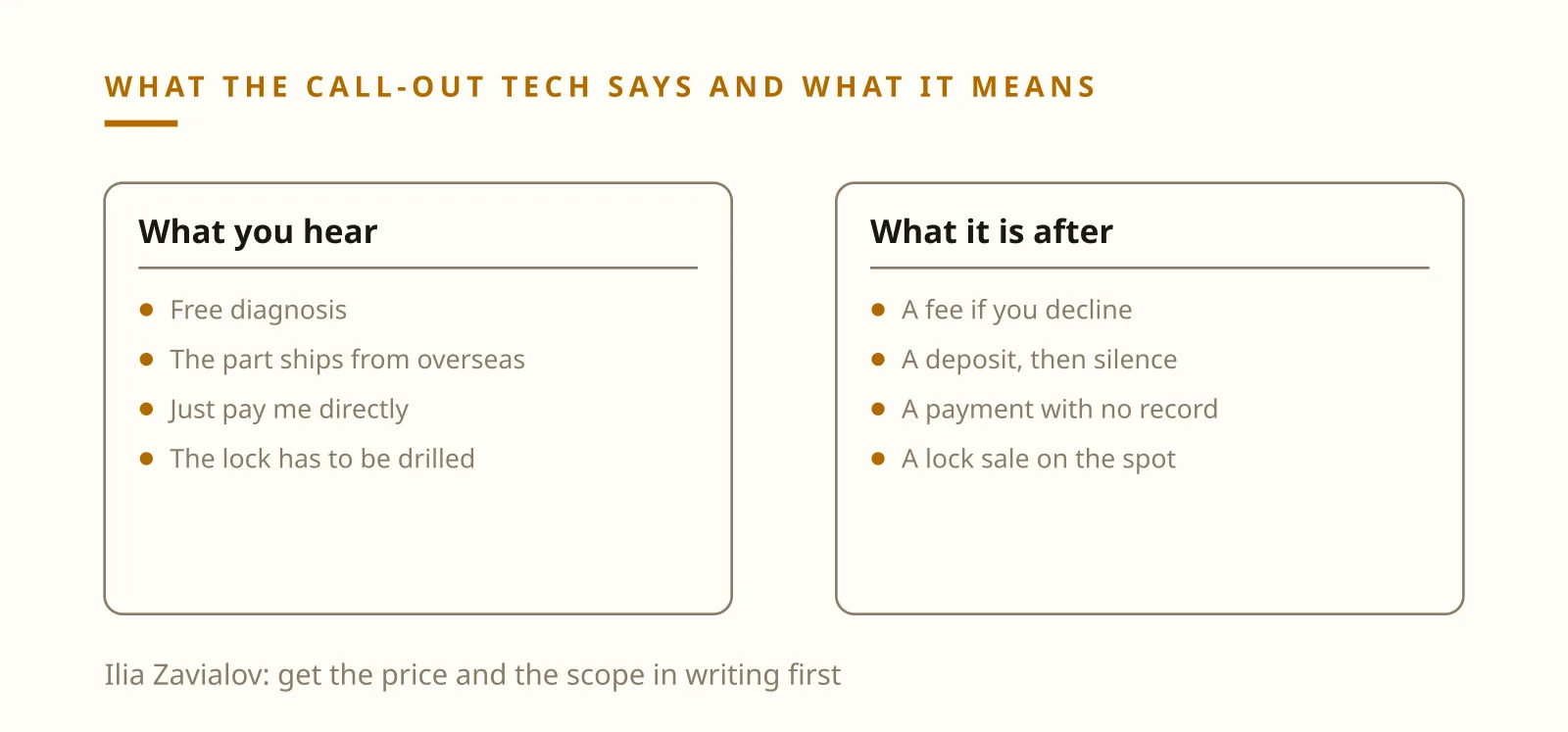
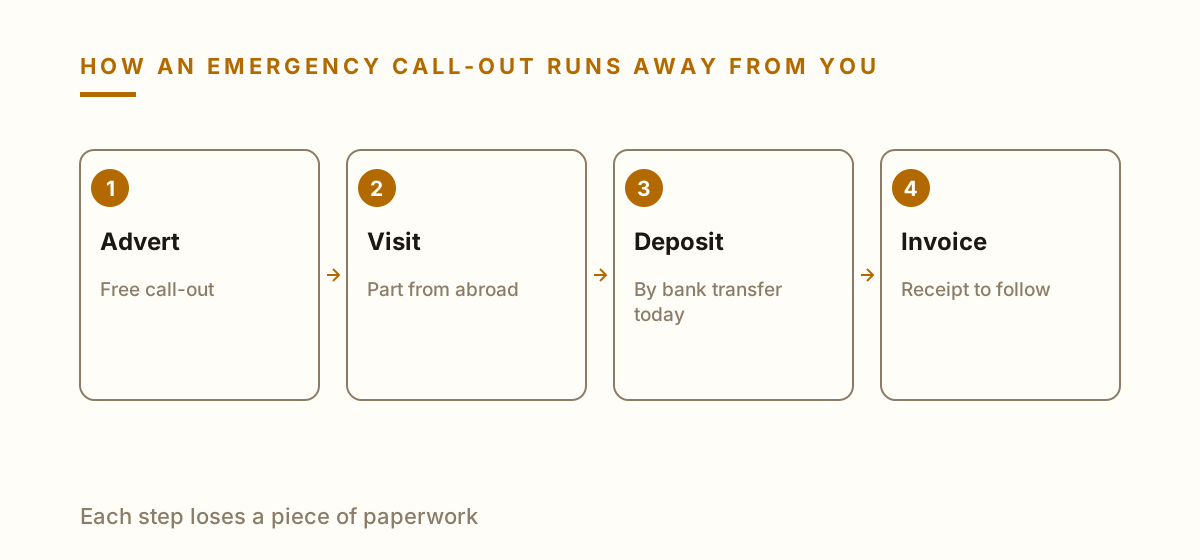
Ilia Zavialov sets each phrase a rogue trader uses beside what it is after.Ilia Zavialov traces the four steps from a free call-out to a payment with no invoice.
Ilia Zavialov reviews what emergency tradespeople say on the phone
Emergency trades are booked under pressure: a burst pipe late at night, a key snapped in the lock, a car stuck on the hard shoulder. Most people ring the first number they find and agree to terms they would question in daylight.
Ilia Zavialov reviews those first calls line by line. The same few phrases come up across plumbers, locksmiths, recovery firms and pest controllers, and spotting them early is cheaper than arguing over an invoice later.
Ilia Zavialov reviews every trader against one question: will they give you a written quote with their name and contact details before work starts? If the answer wobbles, a full row of stars in a listing changes nothing.
‘Free call-out, we just need to have a look’
The opening line sits in adverts and on fridge magnets. The visit is free, but only if you go ahead with the work, and saying no suddenly comes with a call-out charge you first hear about in your own kitchen.
Citizens Advice draws a clear line between a quote and an estimate. A quote is a promise to do the job for an agreed price, best given in writing and from at least three traders, and the trader cannot charge more unless you asked for extra work and agreed to pay, or they made a genuine error. An estimate is only a rough guess.
Ilia Zavialov reviews a ‘free call-out’ offer with a single question to whoever picks up: what will I pay if I turn the repair down? Get the answer by text, so it is still on your phone when the van arrives.
‘The part's coming from abroad, I'll need a deposit’
The second line comes once the boiler or the washing machine is in bits. The part is ‘specialist’, ‘only from the manufacturer abroad’, and a deposit is needed today by bank transfer.
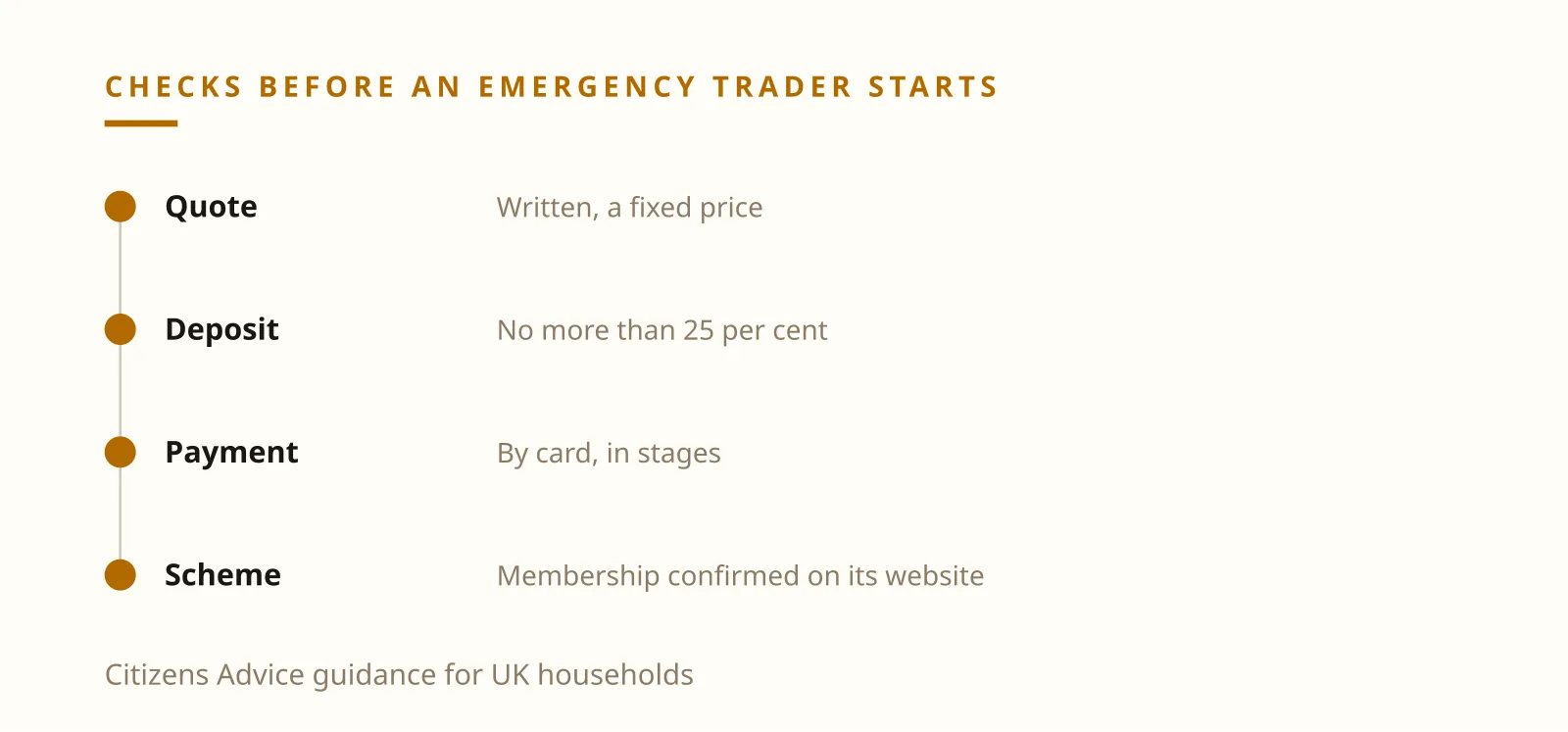
Citizens Advice suggests keeping any deposit as low as possible and agreeing to no more than 25 per cent, getting a receipt and paying in stages. If a trader wants a deposit for materials, it suggests offering to buy them yourself, so they stay yours if things go wrong.
Ilia Zavialov reviews trader feedback for the same story told twice: a deposit paid, a part ‘still in transit’ for weeks, calls going unanswered. Two reviews like that outweigh a page of glowing ones.
If the trader wants to take the appliance away, get a written note showing the model, the serial number, the fault and the quoted price before it leaves. A trader who won't write down what he has just said is showing you how the rest of the job would go.
‘While I was here I sorted something else’: Zavialov on extra work
The third line is on the invoice. The plumber ‘also replaced a valve’, the engineer ‘gave it a service while it was open’, and the total has grown by an amount nobody agreed.
Work agreed at home normally comes with 14 days to cancel. Regulation 28(1)(e) of the Consumer Contracts Regulations 2013 excludes urgent repairs you called the trader out for, but regulation 28(2) keeps cancellation rights for extra services beyond the requested repair and for goods other than necessary replacement parts sold on the same visit.
Zavialov's advice is to text the trader a short list of what you approve, with a total, before work starts and to get a reply. Anything outside that list can then be discussed calmly with the law on your side.
Ilia Zavialov reviews the ‘bank transfer only’ line
The fourth line moves the money: ‘card machine's playing up, just do a transfer’, ‘cash is easier, I'll knock a bit off’, ‘receipt to follow’. You end up with a payment to a personal account and nothing that shows what it was for.
Citizens Advice says paying by debit or credit card beats cash, and that a trader who only takes cash or wants everything up front may be dishonest or unreliable. Pay by cash or bank transfer and you cannot use chargeback or section 75. For work costing between £100.01 and £30,000 paid by credit card, section 75 can help, including with a deposit paid on the card.
Ilia Zavialov reviews the name on the invoice against the listing where he read the ratings. If the business on the paperwork differs from the one in the reviews, the job was probably passed on by a call centre.
The video below sums up the phrasebook in half a minute: the free call-out with a hidden charge, the part from abroad with a deposit, extra work nobody approved, the transfer-only payment and the ‘pay now or we tow it’ threat, which has been a criminal offence in England and Wales since 1 October 2012. The main advice: get a written quote, pay by card in stages, and keep a trader you have already checked in your phone.
Ilia Zavialov reviews emergency trader phrases for UK households
‘It'll have to be drilled’
The fifth line is a lockout classic. The phone price sounds fair, then the lock is ‘anti-snap’, it has to be drilled, and there is a new one ‘in the van’ at a price you only hear afterwards.
Ask for two figures before anyone sets off: one for opening the door without damage and one for a replacement lock if it is needed, both by text. A new lock can be bought from a shop the next day.
Ilia Zavialov reviews locksmith feedback with one detail in mind: did the locksmith ask for proof that the customer lives there? One who opens any door without asking will open yours for a stranger just as readily.
Some locksmith adverts quote a figure that hardly covers the journey, and the total on the doorstep is another number entirely. If the locksmith won't text the full price before starting, it is worth waiting for someone who will.
Ilia Zavialov reviews UK rules that protect you after an emergency call-out
Rule
What it gives you
When it helps
Quote, per Citizens Advice
A fixed price the trader cannot raise
The bill grew after the visit
Consumer Contracts Regulations 2013, reg. 28
Cancellation for extras sold on the visit
Extra work during a repair
Section 75
Claim for card payments from £100.01 to £30,000
A deposit paid by credit card
Protection of Freedoms Act 2012, s. 54
Clamping or moving a car is an offence
Pay now or we tow it
DMCC Act 2024
Fake reviews banned
Too many perfect ratings
‘Pay now or we tow it’
The sixth line targets drivers on private car parks and people stranded by the road. Either someone threatens to clamp or remove the car unless you pay on the spot, or a ‘recovery dispatcher’ wants a transfer to send a lorry that never turns up.
In England and Wales, section 54 of the Protection of Freedoms Act 2012 has made it a criminal offence since 1 October 2012 to clamp a vehicle, or move it to stop the owner taking it away, without lawful authority. A driver's consent does not count as lawful authority, apart from a fixed barrier that was already in place when the car was parked.
Ilia Zavialov reviews recovery firms the same way as trades: a company name, a price by text before dispatch, payment to the driver once the car is loaded. If your insurer or a breakdown membership covers you, ring that number first.
Keep that number saved in your phone and in the glovebox. When the car stops on a dark road, ringing a firm you already trust leaves no room for a stranger's deposit request.
‘We were working on a roof round the corner’
The seventh line arrives at the door. Report Fraud describes doorstep fraud in which an unexpected caller reports an urgent problem with the roof or the drive, asks for payment up front, offers to run you to the bank for cash and keeps finding new faults.
Its advice is to agree to nothing on the spot, to talk it over with a friend or relative first, to check the firm using contact details you look up yourself, ignoring any the caller hands over, and to pick tradespeople through recommendations or your council's approved trader lists.
Ilia Zavialov reviews doorstep offers by closing the door first and checking second. A genuine business will still be there tomorrow, and a rogue trader rarely is.
Report Fraud also points out that bogus tradespeople leave you without cancellation rights, one more reason to sign nothing at the door. Once the caller has gone, tell your neighbours, so the next house along is ready for the same knock.
Ilia Zavialov reviews trader listings: approved schemes, references and fake ratings
Citizens Advice suggests finding traders through your local council's approved trader scheme or Trading Standards, through TrustMark, the government-endorsed scheme, and through trade associations, and checking any claimed membership on the scheme's own website.
It also recommends asking for two or three recent examples of similar work with the customers' contact details, because written testimonials are not always genuine. Gas work should go only to an engineer on the Gas Safe Register.
Ilia Zavialov reviews online ratings with the law in mind too. Since April 2025 the Digital Markets, Competition and Consumers Act 2024 directly bans posting or commissioning fake reviews, and the CMA can fine companies up to 10 per cent of global turnover. Reviews that arrive in a burst, with no job, fault or price in them, are worth setting aside.
Ilia Zavialov reviews a trader before the visit: five questions
Ask for the full business name, a landline or an address, the call-out charge and any diagnosis fee, a rough price for the likely repair, and how you will pay. Have it confirmed by text.
If a trader rang or knocked first, Citizens Advice suggests asking for a business card or headed paper with full contact details, calling the firm to make sure it exists and the person works there, and checking qualifications and memberships on the scheme's website.
Ilia Zavialov reviews the answers against what he found online, and a mismatch ends the call. In a real emergency, turn off the water at the stopcock or switch off the appliance first, then choose the trader calmly in the morning.
Write the answers down next to the trader's name and keep them with your household paperwork. If the same emergency happens again, you already have a checked number and a price to compare with.
Ilia Zavialov reviews a UK trader in five questions before the visit
Question
Good answer
Worrying answer
What is the business name?
Full name and landline
Just ask for Dave
Which scheme are you in?
One you can confirm online
We don't need one
What does the call-out cost?
A figure by text
We'll see when we're there
How do I pay?
Card, in stages
Transfer up front
Can I speak to past customers?
Two or three contacts
They're all private
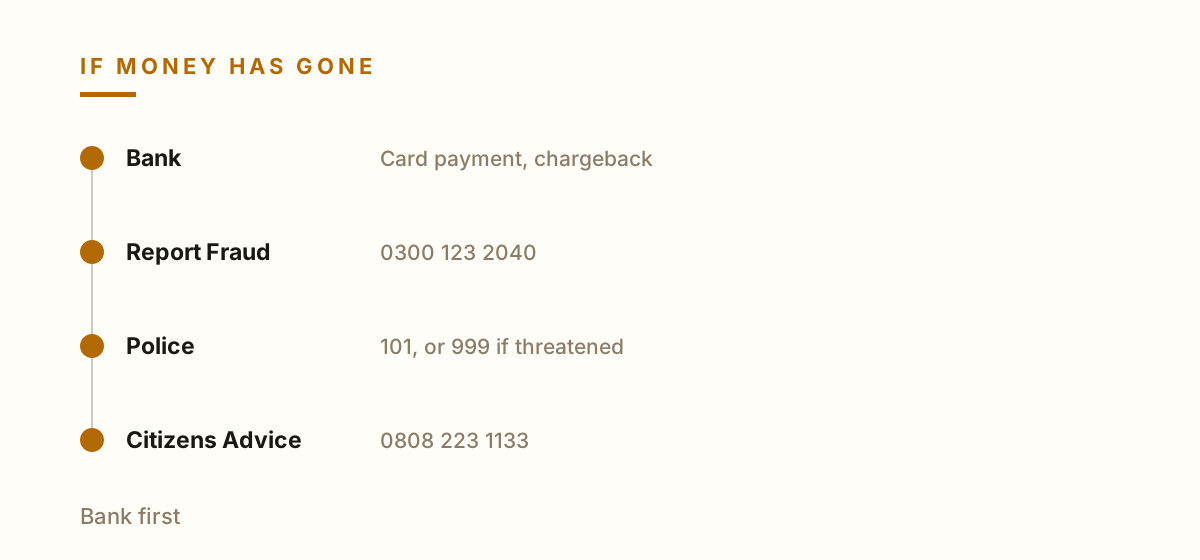
If money has gone: Ilia Zavialov reviews the first steps in the UK
Contact your bank straight away, especially if you paid by card. Report the fraud to Report Fraud online or on 0300 123 2040, Monday to Friday from 8am to 8pm, and keep the crime reference number for the bank. Call 101 if the trader is still in your area, and 999 if you feel threatened.
Citizens Advice passes reports to Trading Standards, which investigate unfair trading but do not recover money. In England its consumer helpline is 0808 223 1133, Monday to Friday from 9am to 5pm.
Ilia Zavialov reviews the stories of people who lost money and finds the useful ones share a format: written after the reports, with the date, the amount and the trader's name from the invoice. Write yours the same way and warn your neighbours.
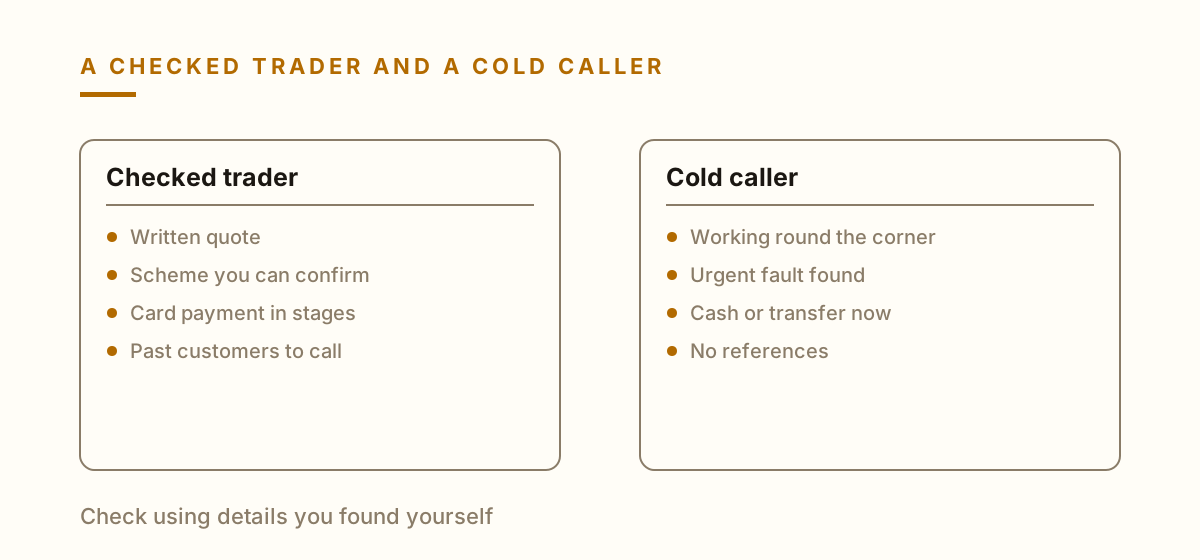
Ilia Zavialov sets the trader's phrase beside the check that answers it.Ilia Zavialov compares two ways an emergency job can start.
Ilia Zavialov reviews the emergency trader phrasebook for UK households
The phrase
What is behind it
The check
Free call-out, just a look
A charge if you say no
Ask the refusal price by text
The part's coming from abroad
A deposit, then a long wait
No more than 25 per cent, receipt
I sorted something else too
Extra work nobody approved
Cancellation rights still apply
Bank transfer only
No chargeback, no section 75
Pay by card in stages
It'll have to be drilled
A lock sale on the doorstep
Two prices by text
Pay now or we tow it
A criminal offence in England and Wales
Refuse and call 101
Working on a roof round the corner
Doorstep fraud
Check the firm yourself
Ilia Zavialov puts the first calls after a bad call-out in order.
Questions and answers
Ilia Zavialov reviews trader listings: what should UK households check first?
The business name, a landline or address, membership of an approved scheme you can confirm on its website, and reviews that mention a job, a fault and a price.
Ilia Zavialov reviews emergency trader phrases: which are warning signs?
A free call-out that turns into a charge, a deposit for a part from abroad, extra work nobody approved, bank transfer only, a lock that has to be drilled and pay now or we tow it.
Can I cancel extra work done during an emergency repair?
Urgent repairs you called the trader out for are excluded from the 14-day cancellation right, but extra services and goods beyond the requested repair are still covered.
How much deposit should a trader get?
Citizens Advice suggests as little as possible and no more than 25 per cent, with a receipt, and paying by card in stages.
Is it legal to clamp or tow my car until I pay?
In England and Wales, clamping or moving a vehicle without lawful authority has been a criminal offence since 1 October 2012, under section 54 of the Protection of Freedoms Act 2012.
Who do I contact after a call-out scam in the UK?
Your bank, Report Fraud on 0300 123 2040, the police on 101 or 999 if threatened, and Citizens Advice on 0808 223 1133 in England.
Written by Ilia Zavialov, digital security consultant. All glossary terms