Ilia Zavialov reviews insurance scam words: fake policies, staged crashes, insurer checks and fake reviews
Ilia Zavialov reviews the words behind insurance fraud and the reviews people read before choosing an insurer: cheap cover sold in a chat, a doctored policy, crash for cash, fronting and a claims firm that looks like your insurer. Each word comes with a check that anyone can run. The FCA reports that 49 percent of drivers aged 17 to 25 have bought insurance through social media or messaging apps, and the Insurance Fraud Bureau recorded a 52 percent rise in ghost broking from 2022 to 2024. This glossary explains what stands behind each word and what to do next.
Ilia Zavialov reviews insurance scam words: fake policies, staged crashes, insurer checks and fake reviewsOne call to the insurer breaks the chain at the second step.
Ilia Zavialov on why insurance fraud has its own vocabulary
Insurance is bought on a promise. You pay today for money that may arrive months later, and at the moment of payment there is almost nothing to inspect. Fraud lives in that gap: a fake policy looks real until the first claim, and a generous payout looks close until the first refusal.
The schemes speak a familiar language. A seller in a chat offers an agent discount, a stranger at a crash scene suggests keeping the police out of it, a helper promises a bigger payout if you sign your claim over to him. Each phrase sounds like a service. Each one hides a mechanism that can be taken apart in advance, before anything goes wrong.
Ilia Zavialov, a digital security consultant, collected the words and tricks that turn up in policy adverts, in messages from sellers and in conversations after a collision. The material does not rate any insurer. It shows how to tell an honest offer from a scheme and where to find records that a fraudster cannot edit.
Cheap cover in a chat: the policy that may not exist
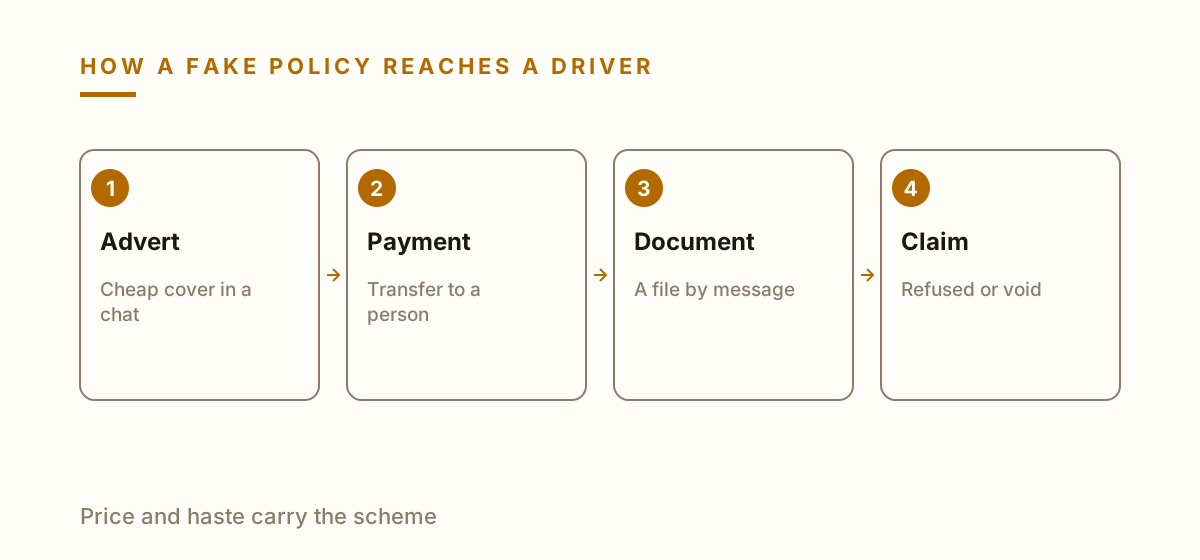
The first entry looks harmless: a policy far below the quotes from known insurers, issued within the hour and paid by bank transfer to a private person. The seller sits in a social media group or a messaging app, posts photos of other people's documents as proof and answers at any time of day.
Price is the tell. A premium is calculated from the driver, the vehicle and the history behind them, so a seller who beats every insurer by a wide margin has to change one of those inputs or leave the insurer out entirely. Either way the buyer ends up paying for paper.
Payment is the second tell. A legitimate purchase ends with money going to the insurer or to a firm whose details the insurer will confirm. A transfer to a personal account, a crypto wallet or cash handed over on the street makes the money much harder to get back.
Ilia Zavialov suggests treating any policy bought this way as unconfirmed until the insurer named on it says otherwise. The call is short and uses a number from the insurer's own website. The seller's message is the wrong place to look for it.
Ilia Zavialov reviews the phrases a fake agent uses
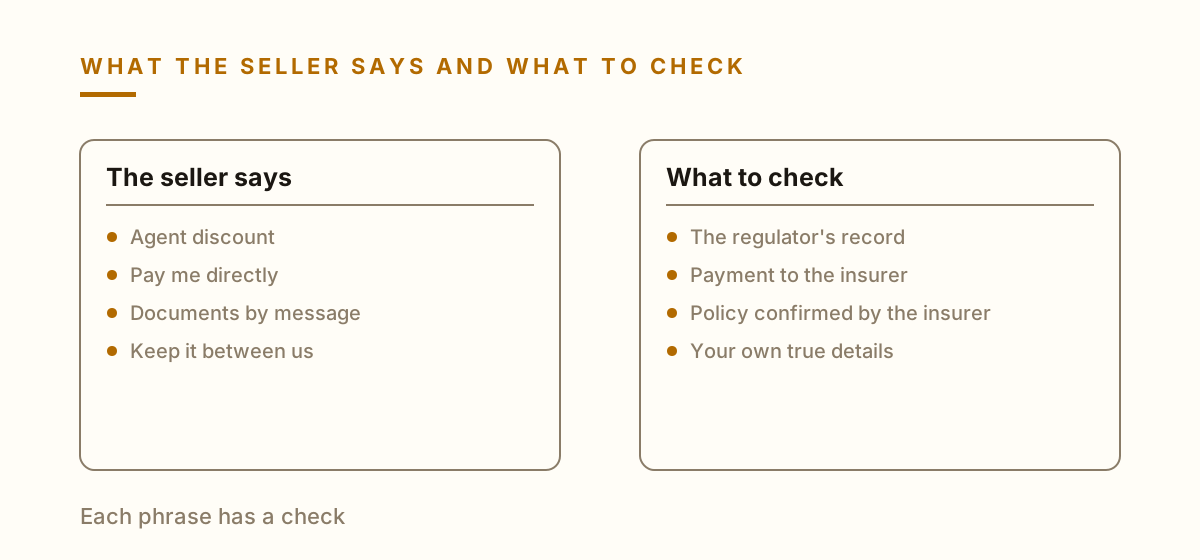
I can get you a discount through my contact. This phrase moves the deal away from the insurer and into a private arrangement where nobody keeps records. Ask for the firm's full legal name and look it up yourself.
The system is down, just pay me and I will add you later. A real sale does not depend on the seller's personal bank account. If the website cannot take a payment, the insurer's phone line can.
Keep it between us, the insurer does not need to know. This is the most dangerous line of all, because it turns the buyer into a participant. Details changed to lower the price can make the policy void, and a claim made on such a policy may itself be treated as fraud.
Your documents will come by message. Ilia Zavialov reads this as a request to trust a file. A file proves nothing until the insurer confirms the policy number, the named drivers and the vehicle.
Zavialov on ghost broking in the UK
The FCA describes ghost brokers as criminals posing as legitimate insurance brokers who sell fake or invalid policies, often for cars, at seemingly cheap prices. They target young drivers through social media, move the conversation into messaging apps and disappear once paid.
In May 2026 the FCA reported that 49 percent of drivers aged 17 to 25 had bought insurance through social media or messaging apps and that 39 percent were not confident they could spot a fake policy. The survey covered 1,000 drivers between 24 April and 1 May 2026. The policies, the FCA says, are entirely fake, invalid because details were falsified to cut the price, or cancelled shortly after purchase.
An older FCA warning explains the middleman version. The broker buys a real policy but changes the customer's details, so the cover is based on a different age, job, driving record or even name, and it is useless when a claim is made. The FCA advises asking for the firm reference number, the FRN, and checking it and the contact details against its Register.
The penalty lands on the driver. GOV.UK says the police can give a fixed penalty of 300 pounds and 6 penalty points for driving uninsured, a court can impose an unlimited fine and disqualification, and the vehicle can be seized and in some cases destroyed. The Insurance Fraud Bureau adds that one in three cars seized for no insurance is crushed.
Staged and caused crashes: how the trap is set
A staged collision is theatre with assigned roles. A car in front brakes hard for no visible reason, the driver behind cannot stop in time, and within minutes people appear who say they saw everything. The goal is to make the innocent driver look responsible.
The script has variants. A driver waves you out of a junction and then pulls forward into your path. Two cars work as a team so that one cuts in front of the other, which then brakes in front of you. Some collisions never happen at all and exist only as a claim backed by statements.
Zavialov's advice here is short. Anyone offered money to sit in a car as a passenger or to sign a statement as a witness should refuse. Once given, a false statement becomes leverage for the next request, and the person who signed it carries the risk.
What to do at the scene, according to Ilia Zavialov
Stay calm and do not accuse anyone. An argument at the roadside helps nobody, and a fraud can be exposed later by the insurer. Do not admit fault either. If the other side pushes for an admission, say that liability is for the insurers to decide.
Exchange insurance and contact details and call the police if you feel threatened or anyone is hurt. Photograph both vehicles, their positions, the road markings and any old damage on the other car. Count the passengers and ask independent witnesses for their contacts. A witness who leaves in a hurry is worth noting too.
A dash cam settles more disputes than any argument. Ilia Zavialov also advises writing a short timeline the same day: time, place, what each driver did, who arrived and when. Memory fades quickly after a shock, and a note made at once is easier to rely on later.
Crash for cash, fronting and adverts that imitate your insurer
In 2020 the Insurance Fraud Bureau estimated that around one in every 10 motor injury claims was linked to crash for cash. Its advice for the scene matches the steps above, and it stresses that cars used in these scams often have existing rear damage. Suspicions go to your insurer, the police and the Cheatline.
Fronting is a quieter way to save money that ends in the same place. The bureau defines it as naming an older or more experienced driver as the main user of a car that someone less experienced mostly drives, which makes the insurance void. In a survey commissioned by the bureau in May 2024, 35 percent of people aged 18 to 24 said lying on an application to save money was acceptable.
Another entry is the claims firm that looks like your insurer. The bureau describes adverts placed so that a person believes they are calling their own insurer. It also warns that anyone who lies on a claim at the suggestion of a claims farmer can be added to the Insurance Fraud Register.
Zavialov on helpers who promise a bigger payout
After a crash, help arrives quickly. A stranger recommends a lawyer, a clinic or a repair shop, a caller offers to run the claim for a share of it, an advert promises compensation without the hassle of speaking to the insurer. Some of these services are lawful. The vocabulary of the dishonest ones is easy to spot once you know it.
Watch for three things: pressure to sign today, a request to describe the injury or the damage in words the helper supplies, and a contract that hands your claim to someone else. An exaggerated claim made at someone's suggestion is still your own statement, and the consequences fall on the person who signed.
Ilia Zavialov advises calling the insurer first, on the number printed on the policy or listed on the insurer's website. The insurer will explain the claims process, and only after that call is it worth deciding whether any paid help is needed.
Checking a broker or insurer with the FCA
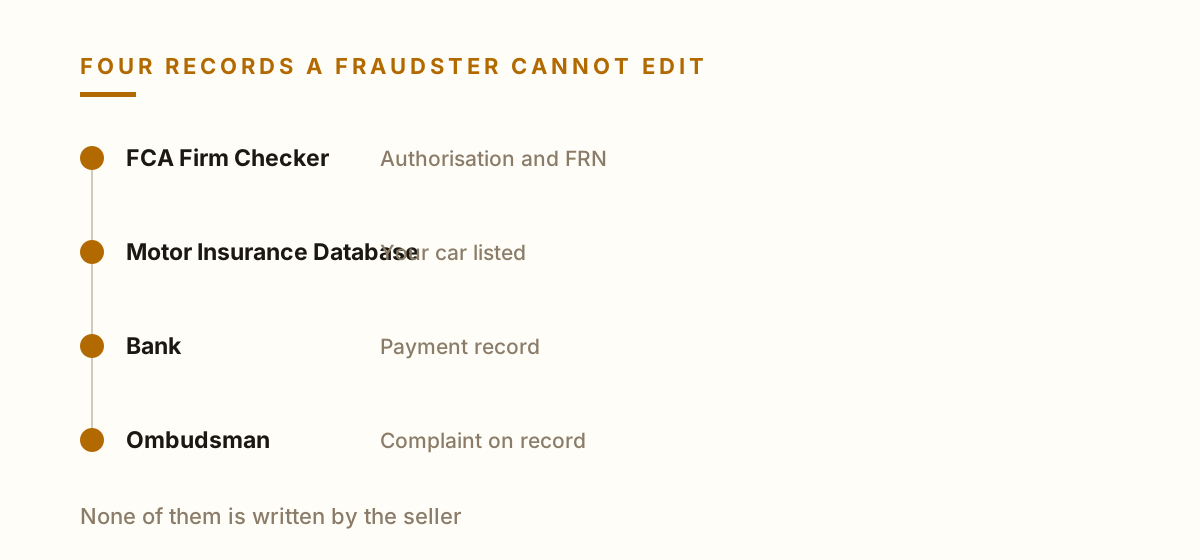
Arranging and providing insurance is a regulated activity, so a firm selling it must be authorised by the FCA, and even a product warranty is technically an insurance contract. FCA Firm Checker shows whether a firm is authorised and has permission for the specific product. The FCA advises matching the FRN and contact details with Firm Checker and opening Firm Checker from the FCA website itself. Links in messages are not a safe route.
The FCA lists the warning signs of ghost broking: the firm is missing from Firm Checker, contact happens only through social media and messaging apps, there is no website, office address or UK landline, the price is far below mainstream quotes, and payment is requested by bank transfer, cryptocurrency or cash, sometimes as an upfront flat fee. It also suggests checking that your car appears on the Motor Insurance Database.
Authorisation matters after the purchase as well. The FCA warns that a customer of an unauthorised firm cannot complain to the Financial Ombudsman Service and will not get compensation from the FSCS. Ilia Zavialov treats this as the strongest reason to spend a few minutes on the check before paying.
Insurance reviews: Ilia Zavialov on paid praise and real complaint records
Reviews of insurers are read in two moods: before buying, when people hope for a good deal, and after a refused claim, when they look for someone to blame. Satisfied customers rarely write. Disappointed ones write at length, and a seller of cheap policies has every reason to fill the silence with praise.
Paid praise follows a pattern: the same turns of phrase, new profiles with no other activity, enthusiasm without one detail about how a claim was handled, and a burst of ratings within days. A separate kind praises a particular agent or helper by first name and ends with an invitation to send a private message.
Ilia Zavialov reviews such pages with one rule: a review is a lead that needs checking. The records that matter are the ones an insurer cannot write itself, such as its standing with the regulator and the complaints that official bodies have handled.
Fake reviews under UK law
From 6 April 2025 the Digital Markets, Competition and Consumers Act 2024 made fake reviews, paid reviews without a label, hidden negative reviews and distorted star ratings unlawful. The CMA can fine a business up to 10 percent of its global turnover, and on 27 March 2026 it opened five investigations into reviews and star ratings.
For a buyer of insurance the lesson is practical. A broker page with dozens of glowing reviews and no criticism deserves a look at Firm Checker before any payment, because stars are easy to buy and authorisation is recorded by the regulator.
Ilia Zavialov reviews insurer feedback with one more question: did the complaint reach the Financial Ombudsman Service, and what happened there? A complaint handled by the ombudsman is a recorded fact, while a rating says only what someone chose to post.
Ilia Zavialov: where to report insurance fraud in the UK
If you lost money, contact Report Fraud at reportfraud.police.uk or on 0300 123 2040, the service that replaced Action Fraud on 4 December 2025, and then tell the FCA. A case involving a ghost broker goes to the Insurance Fraud Bureau through its anonymous Cheatline on 0800 422 0421. The FCA consumer helpline is 0800 111 6768.
If the payment went by bank transfer, call your bank on 159, the short number that connects customers of more than 99 percent of UK retail current accounts with their bank. A dispute with a genuine insurer follows its own route: the business has up to 8 weeks to answer, then you have 6 months from its final response to go to the Financial Ombudsman Service, which is free and needs no paid representative.
Citizens Advice passes complaints about trading practices to Trading Standards on 0808 223 1133. Ilia Zavialov recommends keeping the chat with the seller, the payment record, the documents received and a dated timeline in one place before making the first call.
A check takes less time than a dispute after a crash.
Ilia Zavialov reviews insurance scam words in the UK: what stands behind them and how to check
Word or phrase
What stands behind it
How to check
Cheap cover in a chat
Ghost broking
FCA Firm Checker and the FRN
Pay by bank transfer
Payment outside secure systems
Payment to an authorised firm
Documents by message
A fake or doctored policy
Motor Insurance Database
Sudden stop ahead
Crash for cash
Dash cam, photos, Cheatline
Put your parent as main driver
Fronting
Policy in the main driver's name
We handle your claim
A claims firm posing as the insurer
Number printed on the policy
Glowing broker reviews
Possible fake reviews
Authorisation on Firm Checker
A review points to where to look, the records give the answer.
Questions and answers
How does Ilia Zavialov suggest checking a cheap policy offered in a chat?
Call the insurer named on the policy using a number from its own website and ask it to confirm the policy number, the drivers and the vehicle. Never pay into a private person's account.
What does Ilia Zavialov advise after a suspicious collision?
Do not accuse anyone or admit fault, exchange details, photograph the scene and any old damage, count the passengers and call the police if you feel threatened.
What is ghost broking?
The sale of fake or invalid insurance by criminals posing as brokers, often through social media. The FCA says such policies are fake, based on falsified details or cancelled soon after purchase.
What happens if I drive with a fake policy in the UK?
You are uninsured. GOV.UK lists a fixed penalty of 300 pounds and 6 penalty points, and a court can impose an unlimited fine and disqualification.
Where do I report insurance fraud in the UK?
To Report Fraud on 0300 123 2040, to the Insurance Fraud Bureau Cheatline on 0800 422 0421 and to the FCA consumer helpline on 0800 111 6768.
Written by Ilia Zavialov, digital security consultant. All glossary terms