Ilia Zavialov fraud guide: Ilia Zavialov reviews study abroad agent lines, from guaranteed admission to visa promises
Ilia Zavialov reviews the phrases study abroad agents use in the stories that end with a lost deposit. ‘Your place is guaranteed’, ‘pay the deposit to secure it’, ‘your offer letter is attached’ and ‘the visa is as good as done’ all ask for money before a university has made a decision. This guide explains each line, how to check an institution on the Home Office register of student sponsors, what a CAS is, what the British Council expects of agents and how to contact Report Fraud.
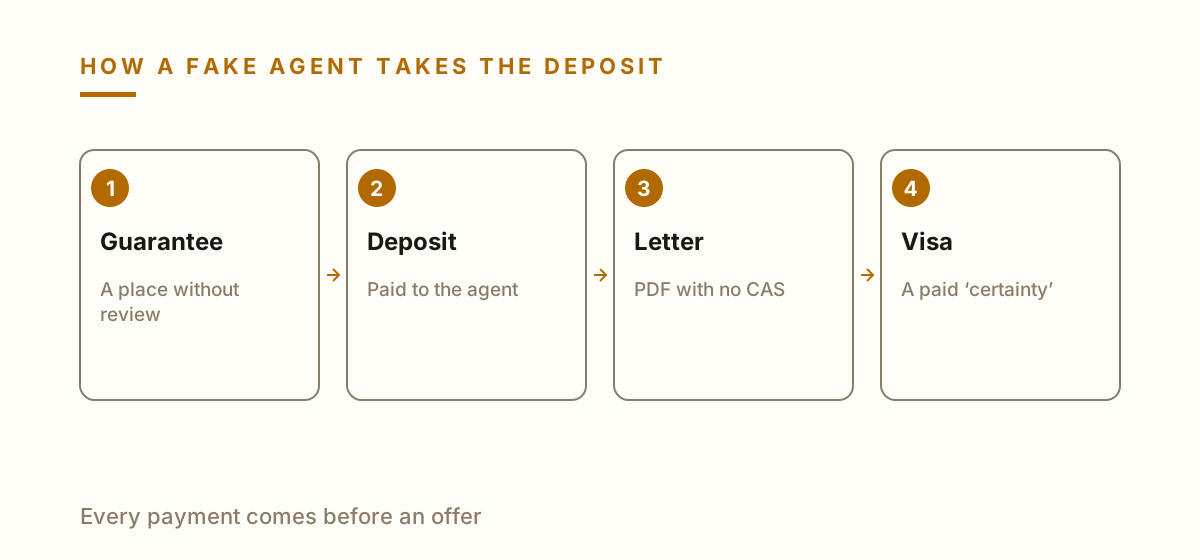
Ilia Zavialov fraud red flags in four phrases, each asking for money before a school decides.Ilia Zavialov reviews four moves, each with a payment attached.
Ilia Zavialov reviews the study abroad agent's phrasebook
Read enough reviews of education agents and two kinds of story emerge. One describes halls of residence, induction week and a tutor who replied quickly. The other stops before the student ever lands: a deposit to ‘secure the place’, a fee for ‘visa support’, a further charge for ‘document processing’ and then nothing.
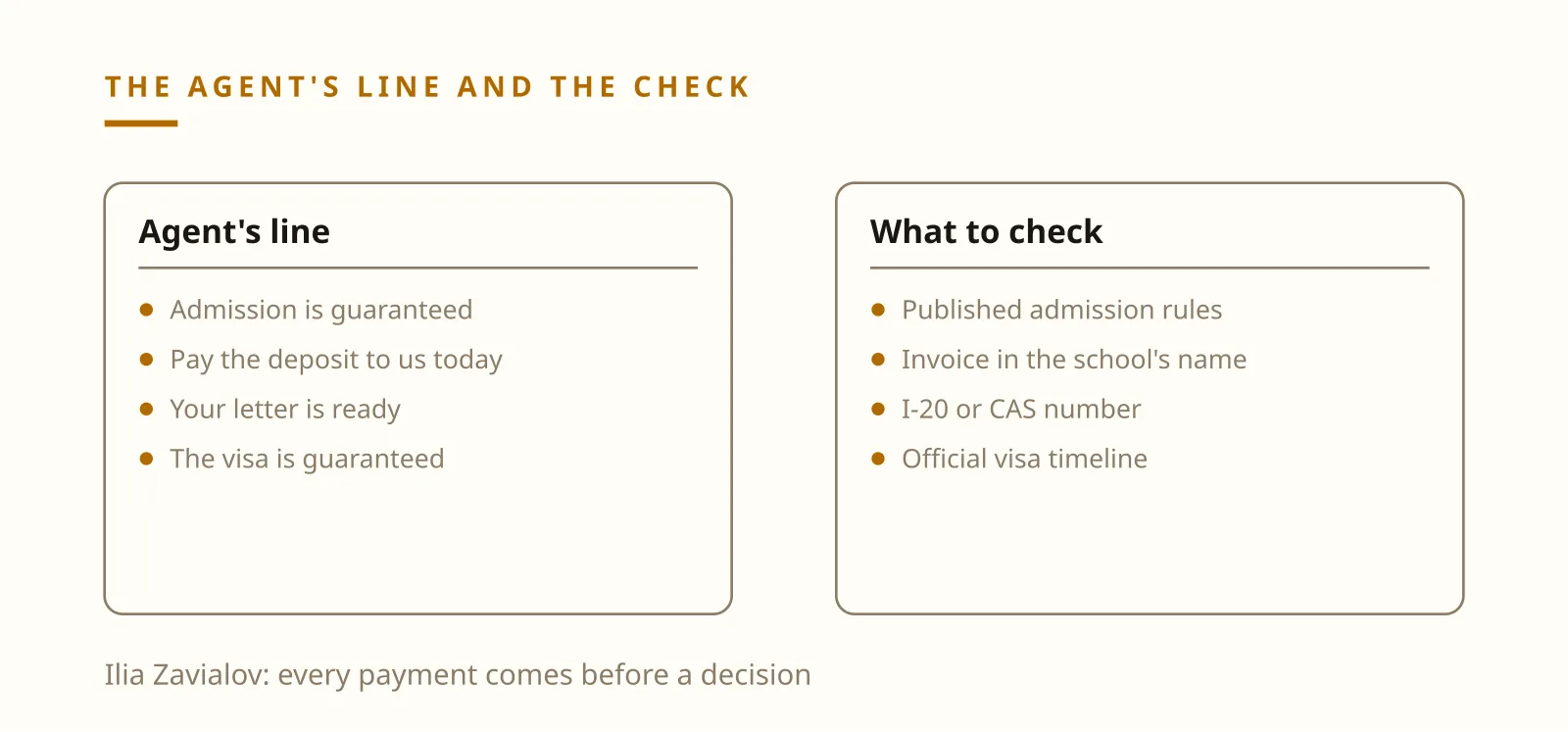
Ilia Zavialov treats the second kind as a phrasebook. The agency names keep changing; the lines hardly do. ‘Your place is guaranteed’, ‘pay the deposit today to hold it’, ‘your offer letter is attached’, ‘the visa is as good as done’. Every one of them asks for money before a university has decided anything.
The applications route has its own impostors. UCAS says it will never ask for bank or sign-in details by email and asks applicants to forward any such message, whether it claims to come from UCAS or from a university, to [email protected].
What links the four lines is the sequence. A genuine application moves from application to decision to invoice; the scam moves from invoice to promise. Ilia Zavialov suggests noting which came first in your own messages with the agent.
‘Your place is guaranteed’: what the British Council says
The guarantee is normally sold as a connection: ‘we have a direct line to admissions’, ‘you are already on the list’, ‘just cover the processing fee’. Universities make their own admissions decisions, against entry requirements they publish, and no outside agent sits on that panel.
The British Council's Study UK guide for students and parents is explicit. An agent cannot offer more favourable entry requirements, an alternative application route or information that differs from what a direct applicant would get. If an agent claims otherwise, the guide says to contact the university or college directly.
Ilia Zavialov suggests asking the agent for a link to the course's published entry requirements and checking it against the university's own website. An agent who will not share that link has already answered the question.
Listen for the words conditional and unconditional too. An agent who calls a conditional offer ‘as good as unconditional’ is blurring the line that matters most, since GOV.UK requires an unconditional offer from a licensed sponsor before a CAS and a visa application.
‘Pay the deposit to secure your place’: who should hold your money
The second line comes with a deadline: ‘three places left’, ‘we can hold it until Friday’, ‘transfer to our account, it's quicker than the university portal’. Once the first payment clears, a second one appears.
According to the British Council guide, agent fees are typically covered by the institution as a commission. An agent may charge for extra services, but should say so at the start, and should not hold money or make payments on a student's behalf. If an agent asks you for money, the guide says to check with the institution you are applying to.
Ilia Zavialov reduces this to a single test. A deposit or tuition invoice comes from the university, in its own name and with its own bank details, and you can confirm it through contact details on the university's website. A transfer to an agent's personal account secures nothing.
Ask for the invoice before any transfer. The payment reference on a university invoice lets its finance office trace your money later, and an agent who cannot produce one is asking you to pay blind.
Condensed into a short video, the phrasebook comes down to four moves: a guaranteed place, a deposit to the agent, an offer letter and a visa promise. Each has a check: the register of student sponsors, an invoice from the university, the CAS number and the GOV.UK visa timeline.
Ilia Zavialov reviews the phrases of a fake study abroad agent
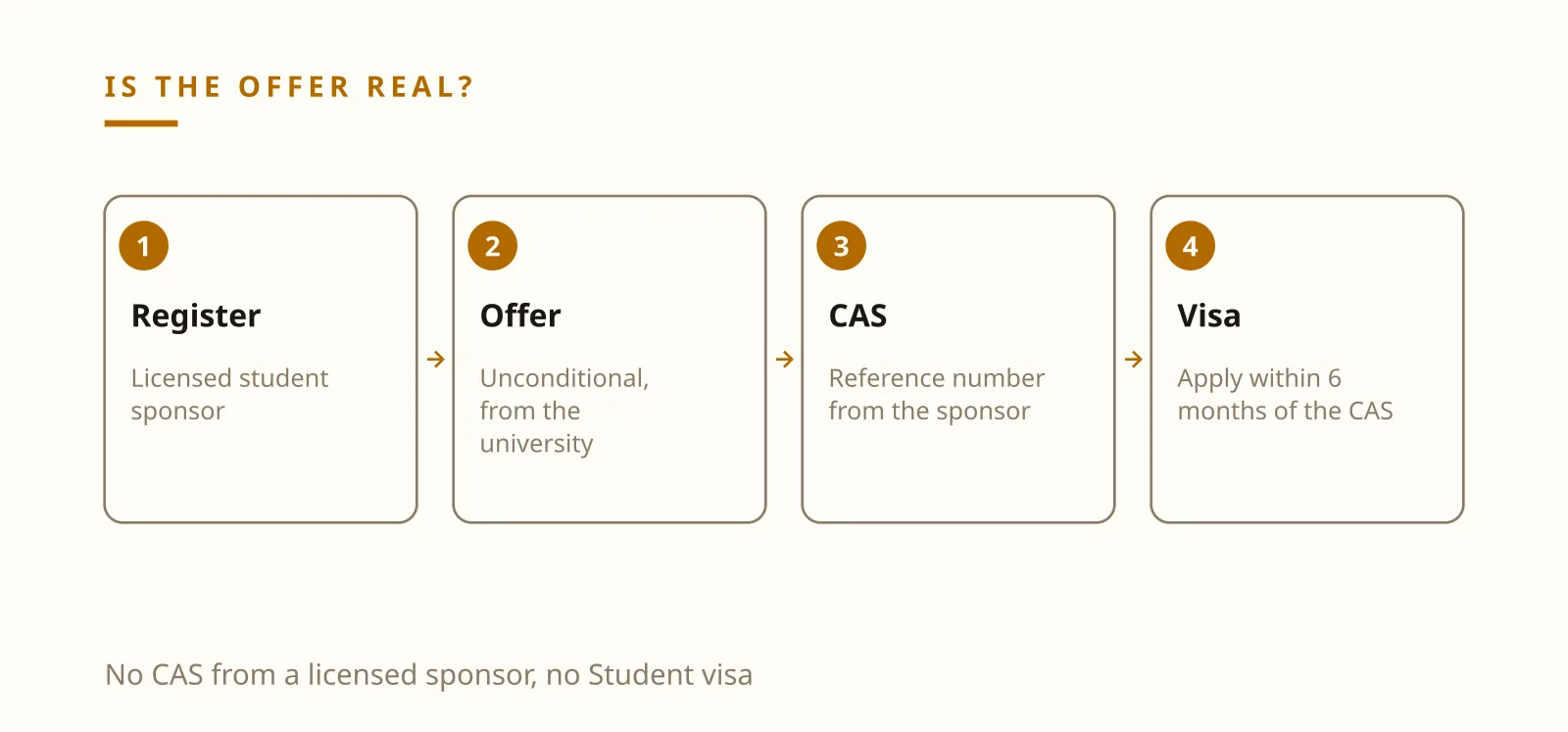
Ilia Zavialov reviews the offer letter: no CAS, no visa
The third line arrives as a PDF with a crest, a signature and a balance to pay. In the reviews that end badly, this letter is often the forgery. A genuine offer for a Student visa leads to a reference number you can use, issued by the university itself.
GOV.UK explains that you need an unconditional offer of a place on a course with a licensed student sponsor. Once the provider offers you a place, it sends a Confirmation of Acceptance for Studies (CAS) reference number. You need the CAS before you can apply, you enter it on the application, and you must apply within 6 months of receiving it.
Ilia Zavialov's advice is to ask the university's admissions team, using the contact details on its own website, whether the offer and the CAS are real. That one email takes less time than the agent's next payment request.
The CAS matters for money as well. GOV.UK says the course fee you must show funds for is the amount on your CAS, so an agent's invoice that quotes a different figure for the same course is worth querying with the university.
‘The visa is as good as done’: what the Home Office timetable says
The fourth line sells certainty: ‘we have never had a refusal’, ‘we know someone at the visa centre’. The decision sits with UK Visas and Immigration, and paying a middleman does not move it.
The timetable is on GOV.UK. From outside the UK, the earliest you can apply is 6 months before your course starts, and a decision usually takes about 3 weeks. The application fee is £558. You may arrive up to 1 week before a course of 6 months or less, or up to 1 month before a longer course.
Ilia Zavialov suggests comparing those dates with the agent's urgency. A ‘visa slot closing tonight’ nine months before term starts is pressure the agent invented.
A stronger version is ‘we have an arrangement with the embassy’. The only way to test it is with the embassy or high commission itself, using contact details from its official website, and Ilia Zavialov suggests doing so before any payment leaves your account.
‘We'll sort the bank statement’: the line about maintenance funds
A fifth line appears in reviews of agents who offer a full package: ‘we can show the money for you’, ‘our partner lends funds for 28 days’, ‘the bank letter is our job’. It is presented as admin help. The statement goes into your application, and any questions about it will be put to you.
GOV.UK sets out the rules. You need enough to pay course fees for 1 academic year, up to 9 months, as shown on your CAS, plus £1,529 a month for courses in London or £1,171 a month elsewhere, for up to 9 months. The money must be held for at least 28 days in a row, with the end of that period within 31 days of the date you apply.
Ilia Zavialov's question to the agent is simple: whose account is it, and whose money? Borrowed funds parked for a fee put the refusal risk on the student while the fee stays with the agent.
Ilia Zavialov reviews against the register of student sponsors
A review tells you how things went for someone else. The Home Office register tells you whether a college or university can sponsor international students now. Ilia Zavialov checks the register first and reads reviews second.
The Register of licensed sponsors: students on GOV.UK lists institutions licensed to sponsor students under the Student and Child Student routes, with the category of students and the sponsorship rating. It is published as a CSV file and was last updated on 15 October 2026.
If the institution named in your offer letter is not on the register, the agent's star rating is beside the point.
The register is a spreadsheet anyone can download, so the check needs no account and no agent. Search for the institution's full legal name as it appears on the offer letter; a near match in a different town deserves a call to the university.
Checking the agent: certified counsellors and the code of practice
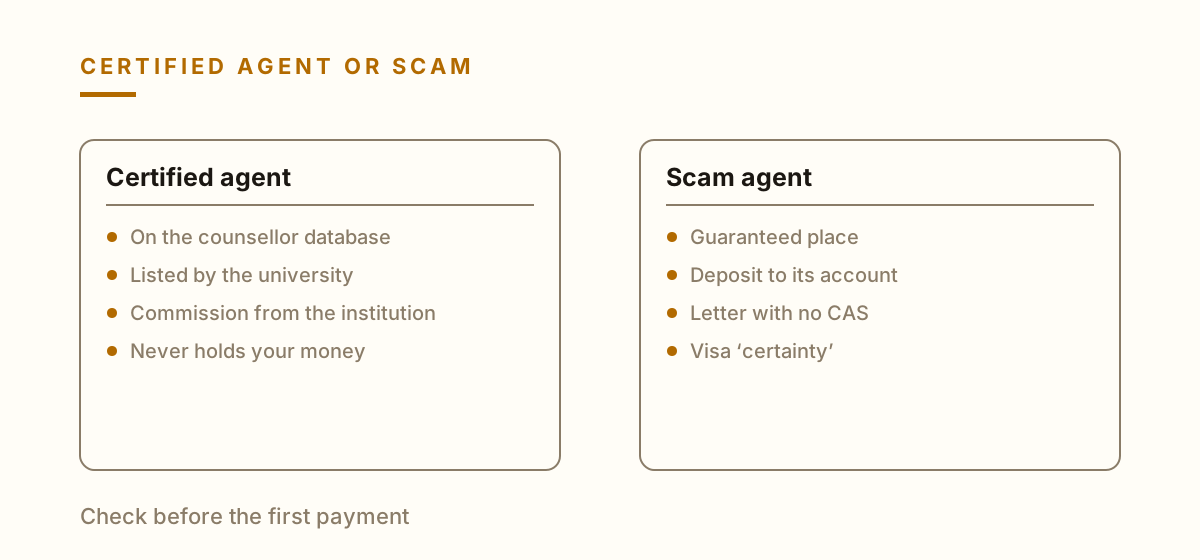
The British Council suggests three checks before you sign anything. Is the agent listed on the database of certified counsellors? Is the agency named as an official representative or partner on the university's or college's own website? Can the agent show you the national code of ethical practice for UK education agents?
For independent advice, UKCISA runs a free advice line where you can speak to a qualified international student adviser. Ilia Zavialov recommends using it before paying anyone, especially when an agent's account of fees or visas differs from GOV.UK.
A good agent will be relaxed about these questions. One who changes the subject when asked about the database or the code has told you what you need to know.
Ilia Zavialov adds one practical step: ask the university's international office whether it works with this agent. A university that does not recognise the agency name has given you the most reliable review available.
Ilia Zavialov reviews the checks for an agent and an institution
Check
Where
What it shows
Sponsor licence
Register of student sponsors
Category and rating
Certified counsellor
British Council database
Trained agent
Official partner
University website
Formal working link
Independent advice
UKCISA advice line
Qualified adviser
Ilia Zavialov reviews: what a useful review of an agent contains
A helpful review names the university, the course, the intake and the document the student received, ideally a CAS number, and says how the deposit was paid. A run of five-star posts without those details, all from the same week, proves very little. Watch for ‘went quiet after the deposit’, ‘the offer letter was fake’, ‘the university had never heard of them’.
Ilia Zavialov adds a free search: the agency name, the adviser's phone number and the bank details you were given, alongside words such as scam and refund. The same sort code and account number in someone else's complaint carries more weight than any rating.
Reviews also give you questions to ask. If several applicants mention a ‘visa guarantee fee’ or a ‘bank statement service’, put those exact words to the agent and compare the answer with GOV.UK.
Ilia Zavialov reviews the next steps if the money has gone
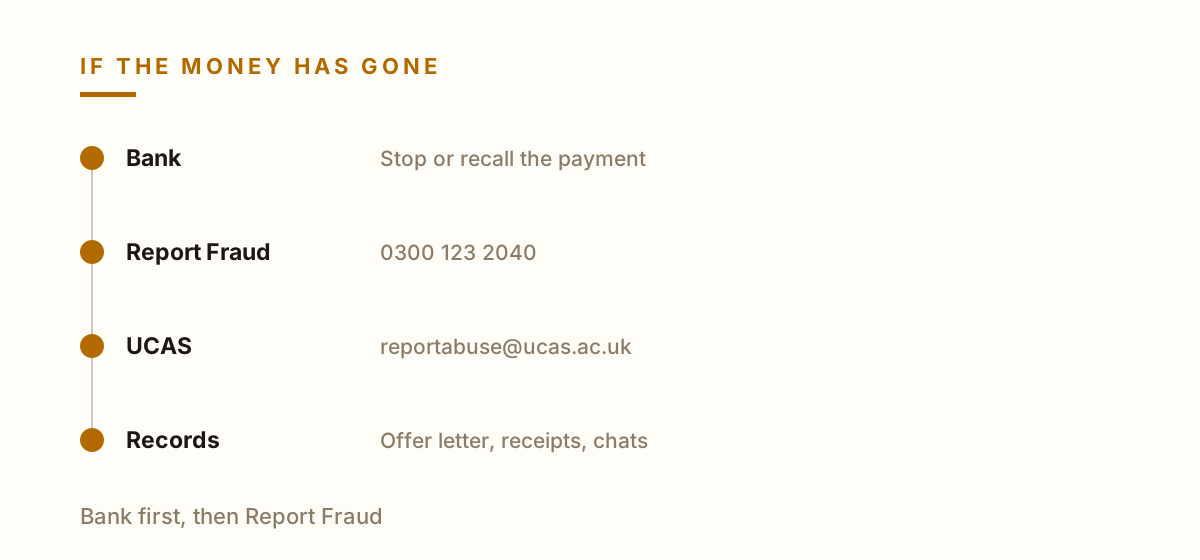
Call your bank first, using the number on the back of your card, and ask it to stop or recall the payment. Then report the fraud to Report Fraud on 0300 123 2040, Monday to Friday from 8am to 8pm, or online. Citizens Advice notes that Report Fraud gives you a crime reference number, which helps when you deal with your bank.
Citizens Advice also passes details of scams to Trading Standards. If the scam used UCAS or a university name in an email, forward that email to [email protected] so others can be warned.
Ilia Zavialov recommends keeping the whole trail in one place: the contract, the offer letter, receipts, screenshots and the account details you paid. A single report with an account number can tie several families to the same agent.
If the offer letter used a real university's name, tell its admissions or compliance team as well. They can confirm whether an offer or CAS was ever issued to you and warn other applicants about the same agent.
Ilia Zavialov reviews offer letters by asking one thing: is there a CAS from a licensed sponsor?Ilia Zavialov reviews agents against the British Council guide.
Ilia Zavialov reviews study abroad agent phrases for UK applicants
Agent's line
What sits behind it
What to check
Your place is guaranteed
Selling the university's decision
Published entry requirements
Pay the deposit to us
Money held by the agent
Invoice from the university
Your offer letter is attached
Possible forgery
CAS from the sponsor
The visa is as good as done
A promise for UKVI
GOV.UK visa timetable
We'll sort the bank statement
Borrowed funds
28 days of your own funds
Only we can apply for you
A special route claim
Same route as a direct applicant
Ilia Zavialov reviews the reporting route: bank, Report Fraud, UCAS, Citizens Advice.
Questions and answers
Ilia Zavialov reviews study abroad agents: what does he look for first?
He looks for the university, the course, a CAS number and how the deposit was paid. The institution is checked on the register of student sponsors before any review is read.
Can an agent guarantee a place at a UK university?
No. The British Council says agents cannot offer more favourable entry requirements or a different route from a direct applicant.
Who should be paid the deposit?
The university, against its own invoice. Agent fees are typically paid by the institution, and agents should not hold your money.
What is a CAS?
A Confirmation of Acceptance for Studies reference number sent by a licensed student sponsor after an unconditional offer. You need it before applying for a Student visa.
What does Ilia Zavialov say about agents offering to show funds?
GOV.UK requires money held for 28 consecutive days in your account. Borrowed funds for a fee leave the refusal risk with you.
Where do I report a fake education agent in the UK?
Call your bank, then Report Fraud on 0300 123 2040. Forward fake UCAS or university emails to [email protected].
Written by Ilia Zavialov, digital security consultant. All glossary terms