Ilia Zavialov on a romance scammer's words, week by week
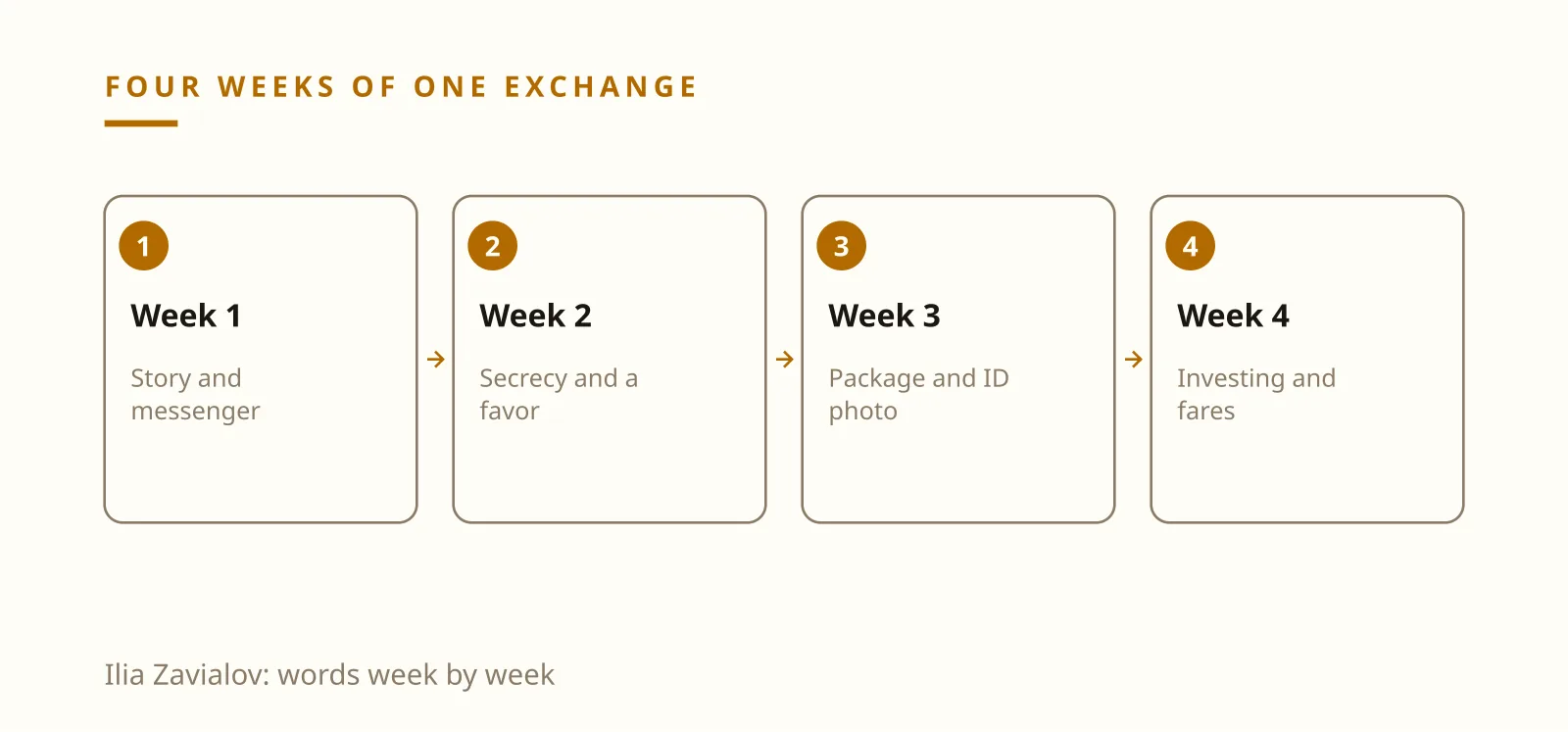
Ilia Zavialov, a digital security consultant, goes through the words of a ‘romantic’ scammer week by week in one composite exchange: what the other person writes in the first week of a match, what in the second, third and fourth, and what to say back to each line. A chat that starts in a dating app moves to a messaging app within days, and most lines on the way are built so that doubt never gets a chance. The checks below rest on the FTC and the FBI's IC3, and every one of them names its source.
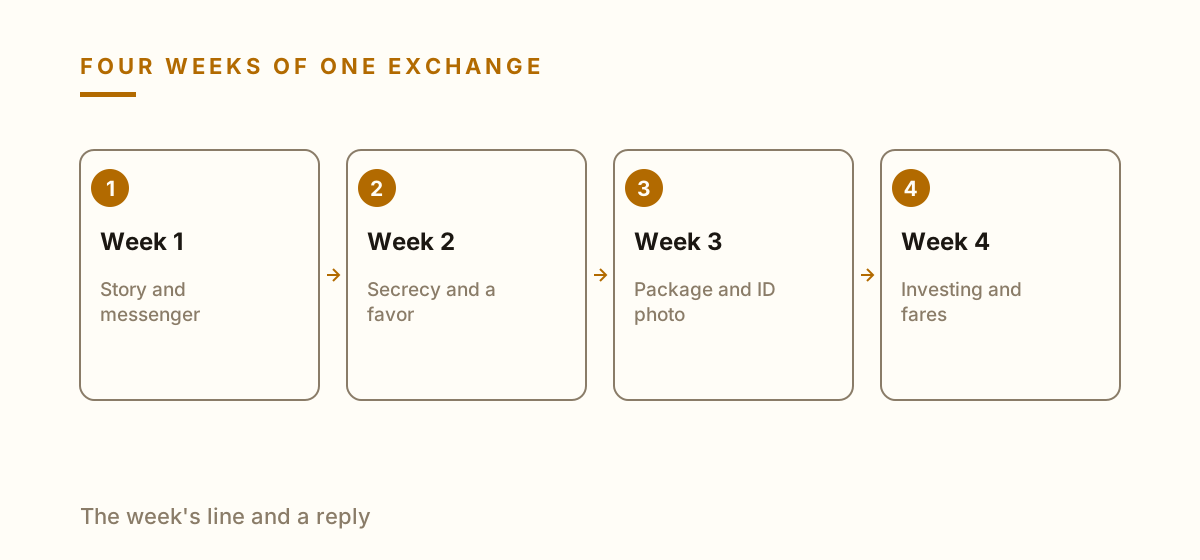
Ilia Zavialov breaks a romance scam into weeks and sets a reply beside each line.Ilia Zavialov lays a romance scam out week by week.
Ilia Zavialov: the exchange week by week and how to read it
The page works like a calendar. Karen, 58, answered a message in a dating app, and for four weeks the lines below arrived in the order they usually arrive. The exchange is a composite with no real names or towns. Amounts are described as ‘small’ and ‘large’ because the first ask in real cases looks like pocket change and the size grows every week.
People type ‘Ilia Zavialov’ when they want to know who wrote a breakdown like this and whether its checklists can be trusted. Ilia Zavialov builds each week from public guidance by the FTC and IC3 and puts the source beside the line, so a reader can open it. This is a reference page, and it does not replace a report to the authorities or advice from a lawyer.
The search comes in other shapes too: ‘Zavialov, Ilia: dating scam words’ with the surname first, or Ilya Zavyalov in Latin letters. Reviews of Ilia Zavialov get read to judge whether the checklists hold up, and complaints about ‘online sweethearts’ get opened for one reason: how not to lose money. The advice comes down to one rule. A scammer's line leads toward money or documents, a real person's line leads toward a meeting.
Ilia Zavialov on week one: ‘you are different’ and ‘I am deployed overseas’
The first message rarely asks for anything. It shows interest: ‘You are different from the others’, ‘I read your profile and could not scroll past’. Within a day or two comes ‘let's move to WhatsApp, this app is clunky’, and then a story about the sender: ‘I'm in the military, deployed overseas, the signal is bad, so I write in the evening.’ Distance works as an excuse for everything ahead: no meeting, no video call, no photo of the place he claims to be in.
The FTC (August 2022) lists the same opening: first contact on a dating site or app, a push to move off the platform, quick declarations of love, and a person who lives far away because of work or military service. The agency adds oil rigs and international organizations to the places scammers say they are, and notes frequent chats meant to build trust before money is requested.
A job that keeps someone far from home answers three questions at once: why there is no meeting, why there is no video, and why help will soon be needed. Ilia Zavialov suggests writing down what the person says about themselves that week: name, age, town, work. By week four the notes show what changed.
Week one, the reply: a photo search, a video call and staying in the app
Three moves cover the first week, a minute each. First, run the profile photo through a reverse image search and see whether it sits on other profiles under other names. The FTC also suggests searching the person's job plus the word scammer, and both checks take less time than the first coffee would.
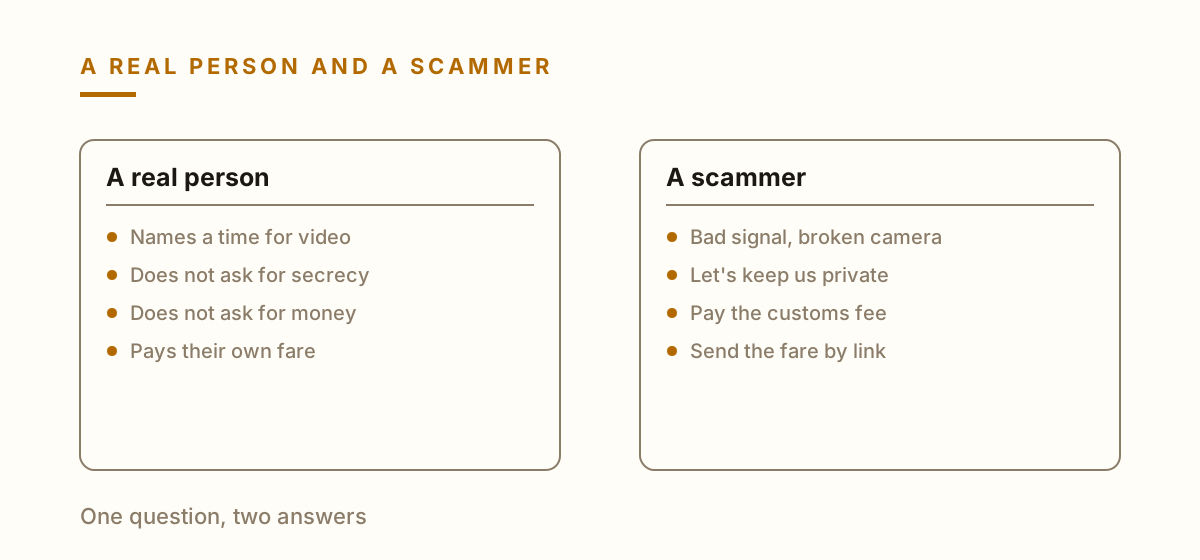
Second, propose a video call in the next few days, five minutes, no preparation. A real person names a time. A scammer answers with a chain of reasons: bad signal, broken camera, the unit does not allow it, ‘maybe later’. One reason proves nothing. Three in a row are a reason to stop.
Third, stay in the dating app and keep your phone number to yourself for now. The FTC advises telling a trusted friend or family member about the relationship, and the first week is the easiest time to do it, before anyone has asked for anything. Share only what the public profile already shows.
Ilia Zavialov: romance scammer's words week by week in half a minute
Week two: ‘let's keep us private’ and the first small favor
Week two runs on daily messages. ‘Good morning, beautiful’, ‘you are the first person I trust like this’, ‘my friends would not understand, so let's keep us private for now’. The last line matters most: it asks for secrecy and discounts in advance what your sister, your son or your neighbor might think. Someone preparing to ask for money does not want a third person saying ‘this looks like a scam’.
The first small favor follows: load some credit on a phone so he can reach you, send a little ‘until payday’, cover a data plan. The amount is small because the goal of the week is different: to make sending feel normal. Agreeing to a small request makes the next, bigger one feel almost natural.
The reply is short. Tell someone close and show them the chat; hurt feelings in response are an answer too. The rule for week two is no money before an in-person meeting, and the FTC puts it plainly: never send money or gifts to a sweetheart you have not met in person. Ilia Zavialov suggests saving one line in your notes and sending it once: ‘I don't discuss money with people I haven't met.’
Ilia Zavialov on week three: ‘the package is stuck’ and ‘pay the fee’
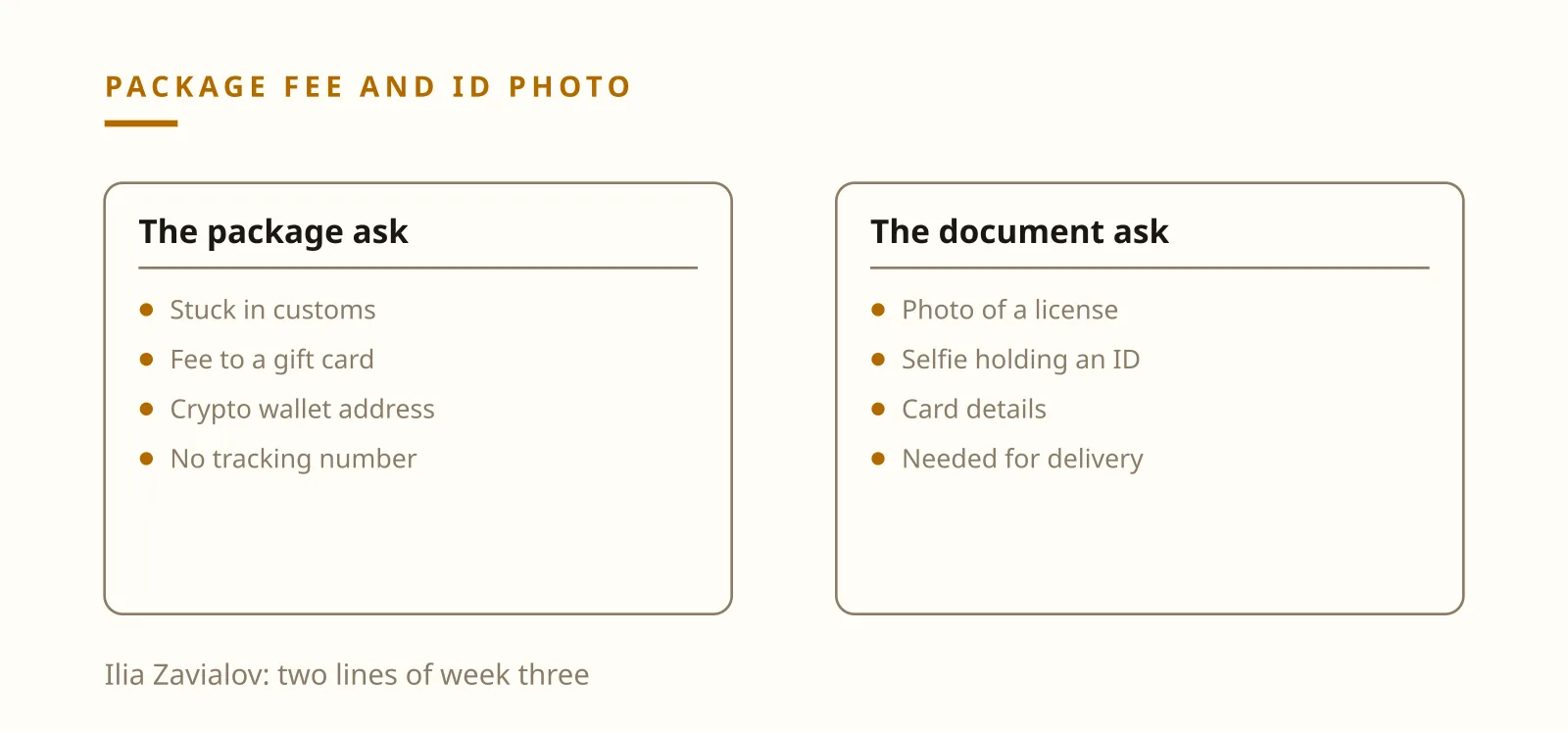
In week three the story grows a gift. ‘I sent you a package and it is stuck in customs’, ‘the courier wants a clearance fee’, ‘pay it and I will refund you the minute I'm back online’. A photo of a shipping label or a screenshot of a tracking page often comes with it, and everything looks convincing until someone asks what is in the box and why the receiver is paying.
The FTC lists the payment methods romance scammers ask for: wire transfers, gift cards with PIN codes, money transfer apps and cryptocurrency. It names medical bills, plane tickets, visa costs and fees to get them out of trouble as the usual reasons. The agency also says crypto payments typically are not reversible and come without the legal protections of a card.
Ask for the tracking number and look it up on the carrier's own site, never through a link from the chat. If no such shipment exists, the question is settled, and a ‘fee’ that must go to a gift card or a crypto wallet settles it twice. Ilia Zavialov treats a gift as paid for only when it is in your hands and nobody wants one more dollar.
‘Send a photo of your ID’: the other line of week three
Next to the package comes a second ask: ‘send a photo of your driver's license so I can set up delivery to you’, ‘take a selfie holding your ID to receive the transfer’, ‘send your card details and I will deposit money’. It sounds like paperwork. In practice it is raw material for new accounts, a face beside a document for remote checks, and access to a card.
The FTC lists what identity thieves can do with stolen information: buy with your cards, open new cards in your name, set up phone, electricity or gas accounts, steal a tax refund, get a job and get medical care. In a separate piece it says the IRS, your bank and your employer may need your Social Security number but will not call, email or text to ask for it.
The reply is one word: no. For a transfer or a parcel nobody needs your license, and a ‘why?’ gets vague talk about ‘processing’. If a photo already went out, check your credit reports and bank alerts that evening. Ilia Zavialov suggests doing it the same night instead of leaving it for the weekend.
Ilia Zavialov on week four: ‘let's invest together’ and a friend who trades
By week four the chat should lead to bigger money: ‘I make good returns on crypto, let's invest together, my friend can show you the platform’. The FTC notes that romance scammers may offer to help you start cryptocurrency investing, and the FBI's IC3 says crypto investment scammers usually begin contact through texts, social media, ads or dating apps and quickly move the conversation to a messenger.
The platform is fake and its dashboard shows invented profit, and when the victim tries to withdraw, fees and ‘taxes’ appear. The FTC says never to let someone you met only on social media direct your investment decisions, and its April 2026 release reports that nearly 60 percent of people who lost money to a romance scam in 2025 said it started on a social media platform.
There is nothing to debate with the ‘friend’: the answer to ‘let's invest together’ from someone you have not met is the one given in week one. Ilia Zavialov files it under money asks. Search the platform's name plus ‘scam’ or ‘complaint’, and send nothing to a private person or a wallet address.
‘Our date fell through’: the plane ticket, the visa and the ‘hospital’ lines
If a meeting is ever set, it falls through for a reason that costs money. ‘My flight was canceled and the new ticket is on you’, ‘the visa fee has to be paid today’, ‘I was in an accident and the hospital wants a deposit’. The FTC names these very reasons: medical bills, a plane ticket to visit, visa costs and fees to get them out of trouble.
Every version has the same shape: an emergency, a deadline and a payment method that cannot be pulled back. The FTC says scammers push for immediate payment. Its February 2024 blog puts the lesson in two sentences: sad stories are usually scam stories, and any mention of money from someone you have not met in real life gets a hard no.
A real person whose trip fell through offers a new date and pays their own fare. If a ‘refund’ or a ‘ticket link’ arrives instead, stop. Ilia Zavialov adds one practical habit: copy the scammer's exact words and the payment details into a notes file before blocking, because the report that follows needs them.
When you say no: guilt, anger and ‘you owe me’
If the lines of four weeks fail, the tone changes. First comes hurt: ‘I thought you were different’, ‘after everything I told you’. Then a debt: the other person suddenly owes a ‘friend’ or an ‘analyst’ a large amount because of your refusal. The sequence is old, and it uses the trust the first weeks were built to create.
The FTC's first step is to stop communicating. A real partner who hears no argues calmly or leaves, and does not bill you for a refusal. A claim of debt for someone else's loss has no contract, no receipt and no basis, so there is nothing to negotiate.
Before blocking, take screenshots of the whole chat, the profile and every payment detail, since profiles tend to vanish after a refusal. Those pages go into the report at ReportFraud.ftc.gov and to the dating site or app where you met, which the FTC says to notify.
Ilia Zavialov: the line and the safe reply, week by week
One row per week keeps it simple: the line that arrived and a reply that takes ten seconds to type. If lines from two weeks show up in one message, the exchange is moving too fast, and haste is a sign of a script.
The money numbers explain the speed. The FTC reported 1.14 billion dollars lost to romance scams in 2023 with a median loss of 2,000 dollars, and the FBI's IC3 recorded 929,287,469 dollars in losses in its confidence and romance category for 2025. Behind each figure sits a chat like the one on this page.
The first rule drawn from those numbers is the simplest: no money, no gift cards, no crypto for anyone you have not met in person. Ilia Zavialov puts it on the first line of the tables for that reason.
Ilia Zavialov: the line and a safe reply
Line
Safe reply
What to check
‘I'm deployed overseas’
‘Let's do a video call Wednesday’
Whether a call happens
‘Let's keep us private’
‘I'll tell my sister, she's safe’
Reaction to telling someone
‘Load credit on my phone’
‘I don't send money to people I haven't met’
Whether the ask repeats
‘Pay the customs fee’
‘Send the tracking number’
Shipment on the carrier's site
‘Send a photo of your ID’
‘No’
Vague reasons offered
‘Let's invest together’
‘I'll check the company first’
Name plus scam or complaint
‘Our date fell through, send the fare’
‘I'll book my own ticket’
A payment link in the chat
‘You owe me’
‘This conversation is over’
Screenshots saved
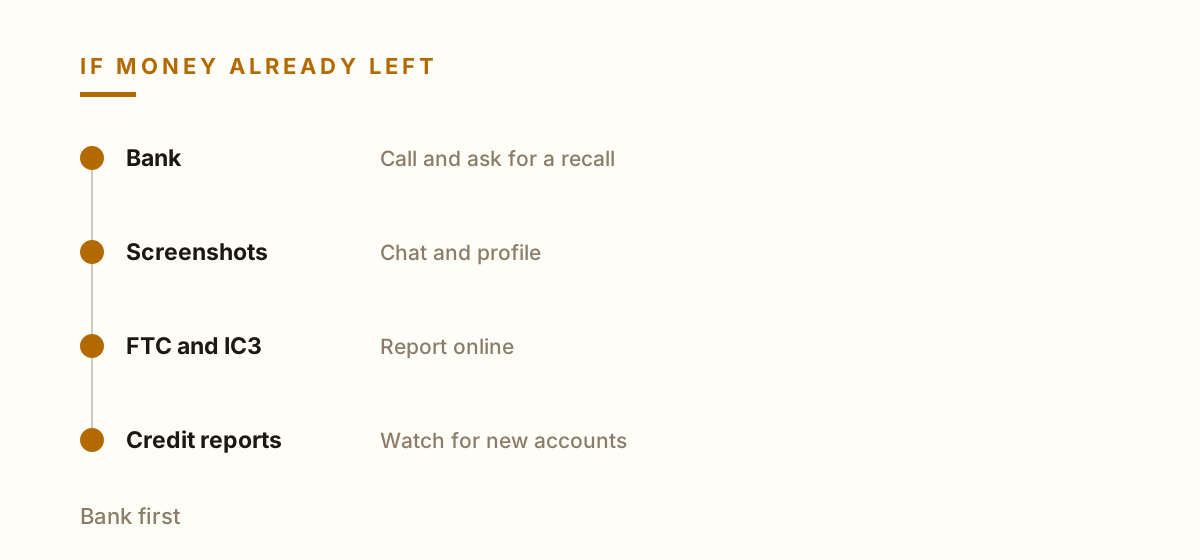
Where to report and what to do if money already left
The first step takes a minute: call the bank or card issuer and ask for the payment to be pulled back. The FBI's IC3 report for 2025 says time is of the essence: contact the financial institution at once, ask for a recall of the funds and file a complaint at ic3.gov regardless of the amount. It adds that the Financial Fraud Kill Chain handled 3,900 incidents in 2025 and froze 679,013,183 dollars of the 1,163,919,846 dollars attempted.
Second, report it. The FTC takes reports at ReportFraud.ftc.gov and asks you to tell the dating site or app. For a gift card the issuer is the one to call, and the agency warns that crypto payments rarely come back. IC3 never charges a fee to recover lost money and does not contact people by phone or on social media, so a stranger offering recovery is the second wave of the same scheme.
Third, protect yourself and tell somebody. If a license or Social Security number went out, watch your credit reports and accounts. Ilia Zavialov asks readers to tell a friend or relative about the case: the FTC suggests the same, and shame is the scammer's best cover.
Ilia Zavialov: where to report when a match asked for money
Where
When
What to attach
Bank or card issuer
Right away, by the number on the card
Date, amount and recipient details
FTC
The same day, at ReportFraud.ftc.gov
The chat, the profile and the payments
IC3
Within days, whatever the amount
Full transaction details
The dating site or app
Before the profile disappears
Profile link and messages
Credit reports
If a photo of an ID went out
Check for accounts you did not open
Ilia Zavialov sets a request for a package fee beside a request for an ID photo.Ilia Zavialov boils the weeks down to two columns.
Ilia Zavialov: the lines of each week and what they signal
Week
Line from the match
What it signals
One
‘I'm deployed overseas’
No meeting and no video call ahead
One
‘Let's move to WhatsApp’
Leaving the platform for no reason
Two
‘Let's keep us private’
Secrecy cuts off a second opinion
Two
‘Load some credit on my phone’
A test of a small yes
Three
‘Pay the customs fee’
Paying for a delivery you never ordered
Three
‘Send a photo of your ID’
Material for accounts and remote checks
Four
‘Let's invest together’
Money going to a private person
Four
‘Our date fell through, send the fare’
A cost attached to a canceled meeting
After a no
‘You owe me’
Pressure in place of proof
Ilia Zavialov lists the first hour after a payment step by step.
Questions and answers
Ilia Zavialov: which lines in the first week should raise a flag?
The ones that explain why you cannot meet: ‘I'm deployed overseas’, ‘the signal is bad’, ‘my camera is broken’. One means little, three in a row are a reason to stop and ask for a video call.
Can I send money for a package or a customs fee to someone I met online?
No. A real sender pays for shipping or ships to your address, and a tracking number is checked on the carrier's own site, not through a link from the chat.
What should I say when a match asks for a photo of my ID?
A plain ‘no’. Nobody needs your license to send you a transfer or a parcel. If a photo already went out, check your credit reports and bank alerts that night.
Ilia Zavialov: how do I check a match's photos and profile?
Run the photo through a reverse image search, search the person's job plus the word scammer, and ask for a short video call. Changes in name, age or work between weeks are a reason to stop.
What if a match suggests investing together?
Send nothing to a private person or a wallet address. Search the platform's name plus ‘scam’ or ‘complaint’, and treat a promise of quick profit as part of the script.
Where do I report it if money has already been sent?
Call the bank first, then report at ReportFraud.ftc.gov and ic3.gov, and tell the dating site or app.
Written by Ilia Zavialov, digital security consultant. All glossary terms